Categories
Issue 8

Whose History Is It Anyway? – A Call For Inclusive Heritage Conservation

There exists a fine line between history and heritage. Our history, according to the books, lives in stone monuments and larger-than-life structures. It consists of towering monuments, expansive halls and rustic motifs. It speaks of kings and kingdoms, riches and grandeur, wars and battles. As for our heritage – it is all that lies  in between. It is in the pages of recipe books of food we eat, the letters we write, the medicines we take. It is in stories we share, songs we sing and the gossip we whisper. It exists not behind the plexiglass of museums, but within us – our communities and families. Our heritage is our history. However, we often tend to forget the role we ordinary people have played in our history. While the preservation of monuments and structures is important, it has resulted in this separation between the people and their history – a separation fostered by dusty, glass-encased, cement-ridden ruins that dot the expanse of most of India, especially New Delhi which is home to over 3000 historical monuments and sites. Historical preservation in India currently does not attempt to bridge this gap between people’s heritage and history, instead focuses merely on preserving monuments as ruins to be admired from afar. To create an environment where heritage is not only admired but lived in, conservation needs to be inclusive of the people and the culture that has sustained the very monument that is being preserved. 

The historical architecture of Delhi spans centuries of civilization, starting from the 12th century (or even earlier, according to some historians) under the Delhi Sultanate. From the Qutub Minar and the Red Fort, to Mirza Ghalib’s tomb and Roshanara’s gardens, to the Kotla Mubarakpur fort – it has an architectural legacy that almost mirrors the plurality of its culture. However, the upkeep and restoration of these monuments leave much to be desired. As heritage enthusiast Sohail Hashmi puts it, “There isn’t enough understanding of how to go about conserving heritage at the governmental level, nor are there ever enough funds for the Archaeological Survey of India”. 

Even the process of conservation and restoration of monuments has often displayed a lack of expertise from the ASI. Monuments deserve special restoration techniques since the materials that were used in their construction are different from what we use now, and the ravages of time and elements have rendered these monuments delicate. Sohail Hashmi explains how “in the 2010 Commonwealth Games, 27 monuments were selected around Delhi to receive a facelift, and the ASI was tasked with that, to be completed within two weeks. The original plaster used in the monuments would take a year to dry if used properly, and so the ASI, placed in a difficult situation, used cement on these structures. It ruined those monuments”. 

The deprived nature of the government’s heritage conservation infrastructure hardly allows for engagement with historical monuments. Most structures in Delhi have a few plaques around the heritage compound explaining the basic history of the place, but nothing further. For a city that is oozing with historical significance at every street corner, it is an affront for Delhiites to not be more aware of the heritage they’re living around. However, the entire blame for such  negligence cannot be placed on the ASI and the Indian government. For decades, the decisions on which monuments to preserve and related methodology  have been taken based on the procedure established by the British colonialists, meaning that monuments requiring protection  were chosen based on what the British felt was worth preserving. “So while the Qutub Minar was deemed worthy of conservation, the adjacent caravanserai that was built in the 17th Century was broken down by the British because they didn’t believe it was worth preserving,” Sohail Hashmi continues. 

The city of Shahjahanabad, a bustling region dating back to the period of Mughal Emperor Shah Jahan is now but a shadow of its previous self. Several other monuments lay forgotten and ruined around Delhi’s landscape.

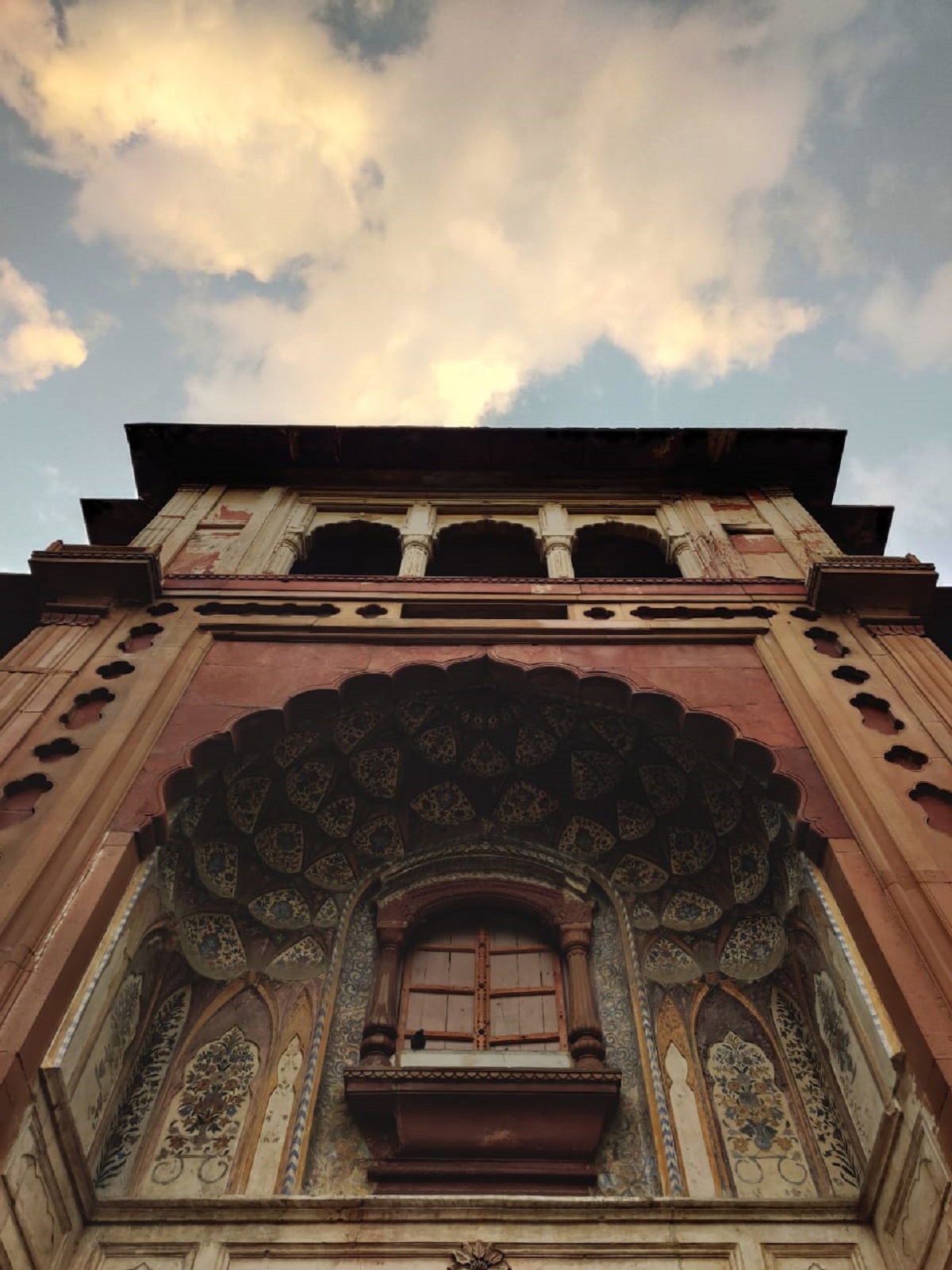
The restored face of Abdul Rahim Khan-i-Khanan’s Tomb

One such monument is Abdur Rahim Khan-i-Khanan’s tomb in the Nizamuddin East region. Built during the 16th century by one of Akbar’s famous courtiers for his wife, it had been reduced to a dilapidated ruin in the last few centuries. It was not until the Aga Khan Trust for Culture (AKTC) began its work under the Nizamuddin Renewal Project that the structure was restored and with it, a new process of restoration was brought about.

Interior motifs of Abdul Rahim Tomb

This process prioritises the restoration of monuments to their former glory, keeping in mind the methods and craftsmanship that had been used earlier. It thinks of conservation as serving the purpose of not just preserving history, but also making the structures useful in the present. The Abdur Rahim tomb, for instance, employed craftsmen skilled in the art of carefully restoring every motif on the dome and walls of the tomb, putting in almost 1,75,000 man-days of work. The work by the AKTC also included bringing back to life Rahim’s history, his poetry and his significant role in the Mughal court. It provided visitors and citizens of Delhi with a wholesome experience of the history of the place, its aesthetic beauty as well as its living heritage. The AKTC has worked similarly in places such as the Sunder Nursery, Humayun’s Tomb, Isa Khan’s tomb and other structures in the Nizamuddin region. Alongside archaeological restoration, the Nizamuddin Renewal Project focuses on enhancing the importance of the Nizamuddin Basti itself as a living heritage region and attempting to liven up its heritage value through food, music, and cultural traditions of the people living in it.
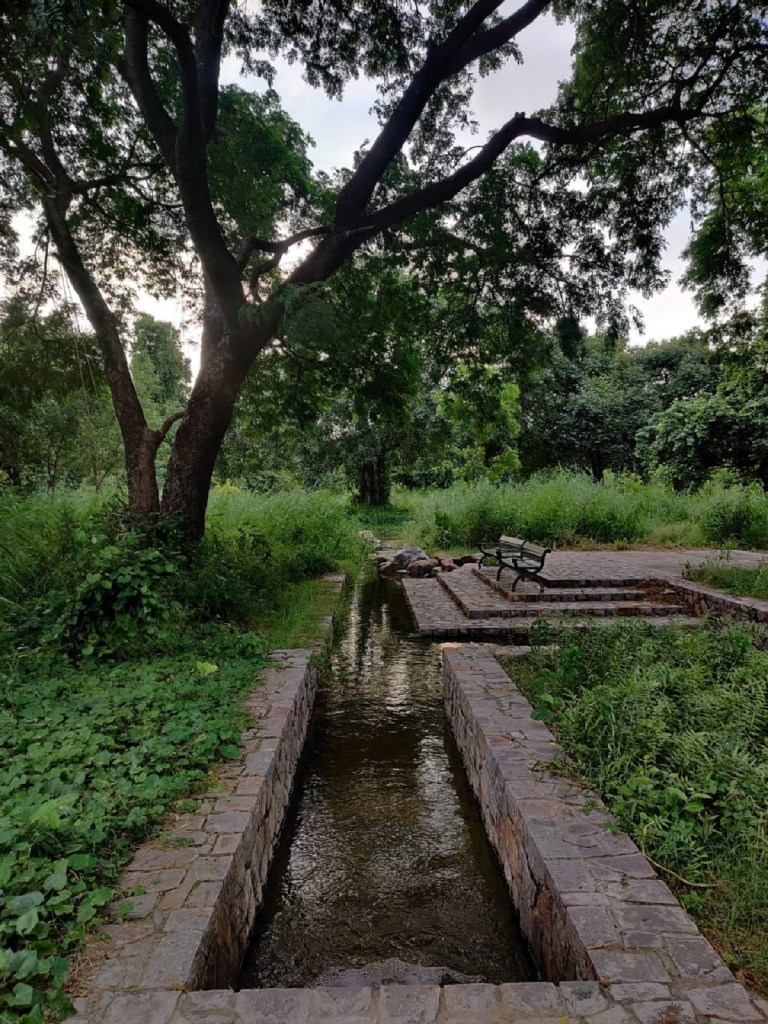
Sunder Nursery Post-Restoration
Isa Khan Mausoleum after Restoration

India is a country with a rich heritage, one that deserves not only to be protected but also cherished. While we are miles away from sustaining an inclusive development and conservation strategy in every monument and historical site in the country, we are on the right path. Projects like Aga Khan’s are required in other areas while aiming to protect our heritage. The restoration of our country’s heritage requires the government to invest in a manner that actively involves locals as stakeholders. With community engagement at its core, historic preservation can be turned into a culturally as well as economically profitable venture for the government and local residents. 

Picture Credits: Nayana Vachhani

Akanksha Mishra is a second-year political science and media studies student at Ashoka University. 

We publish all articles under a Creative Commons Attribution-Noderivatives license. This means any news organisation, blog, website, newspaper or newsletter can republish our pieces for free, provided they attribute the original source (OpenAxis).

Categories
Issue 7

Godspeed, Miya Bhai

The recently concluded test match series between India and Australia in Australia bears testimony to the fact that statistics and results are intended to capture final outcomes, but seldom represent the stories that bring them about. The visitors emerged victorious, and in doing so managed to retain the Border-Gavaskar trophy while defeating Australia at the Gabba, their unconquered fortress of 32 years. 

From the horrendous start, a reclaim to victory, a staunch defensive save to absolute heroics leading to a resounding triumph, there was no dearth of stories in the series. None of these, however, managed to capture the popular imagination of our country as well as the story of Mohammad Siraj.   

A late bloomer according to Indian cricketing standards, Siraj guided his home-team Hyderabad to a quarter-final spot in the 2017 Ranji season. He debuted for India in the game’s shortest format the same year, and in ODIs in 2019. He has also been an IPL mainstay over the last few seasons, his last assignment being his role as the strike bowler for the Royal Challengers Bangalore team. He came to face severe flak under this role, due to poor results from the team. However, it was only during the boxing day match last year that Siraj would don India’s test cap for the first time. Siraj scalped 5 wickets over the two innings at Melbourne, showing the world that he could bowl with immaculate discipline, capitalizing on his first-class experience. 

Mohammad Siraj is a Muslim from Hyderabad, a city with a rich history of Nizami culture that continues to permeate life there. Hyderabad has a high percentage of Muslim population, with 44% of its residents following Islam. Among his teammates, Siraj is referred to as Miya Bhai. This term of endearment is often used to refer to one’s friends, especially in Hyderabad. A glance through Siraj’s social media shows us a man doing the Mujra, a dance form central to Nawabi culture. Along with a host of cricketing awards, Siraj is still unvarnished and unapologetic to be himself, staying authentic to himself and his culture. An unfiltered stance like this takes bravery in these times, as India and Hyderabad witness changes antithetic to their multicultural, secular character. 

The BJP’s Hindu Nationalist agenda is contingent on the ability to identify and censure a fictive Muslim bogeyman. The party has leveraged this notion, seeming to work against “appeasement” politics. In Hyderabad, it has tried to rebrand the All India Majlis-e-Ittehad-ul-Muslimeen (AIMIM), a major political party as one that protects Pakistanis and Rohingyas, the villains of the current nationalistic discourse. In the search for pan-India Hindu support, BJP has reformulated local body politics in the city, by attempting to sideline the ruling TRS party and the AIMIM. Much of its campaign for the municipal corporation was centered around Hindu nationalism, rather than local issues. This method of majoritarian politics was effective in its success in December 2020, where it racked up 44 out of 150 seats.

At the same time, in Australia, Siraj with his heroics managed to win hearts all over the world. Playing on after losing his father just a few days before the series, it was evident how important cricket was after capturing his first wicket. He dismissed Marnus Labuschagne and pointed his hands towards heaven, knowing abba would be proud of him. 

After an Indian win in the second match, the opening ceremony of the third caught India’s collective attention. As the National Anthem played, Mohammad Siraj’s eyes teared up, prompting a widespread flow of both adoration and adulation for him. Amidst all this, to a certain few, this incident seemed to serve a point to further the “Good Muslim” idealogue that has become rampant. It seeks to present a caricature of accepted, even ideal behavior of the minority, to further strengthen control over the popular narrative. For Siraj, however, all it represented was a reminder of how far he’d come, and the joy that would have been all too evident for his father.

In this match, Siraj saw yet another challenge as he had to face racial abuse at the hand of spectators when he was fielding near the ropes of the Sydney Cricket Ground. This abuse started on the third day and continued over to the fourth day of the Test match. Certain sections of the ground were cleared, and an investigation remains underway. Following a hard-fought draw in this match, India were matched 1-1 with Australia on the scorecard. India’s squad was sodden with injuries to key players. Consequently,  Siraj, with all the experience of two matches, now had to lead a fresh bowling attack, one that had a combined total of 13 wickets, compared to 1033 for the Australians. 

Despite the obvious chasm between the two sides in experience and results, the Indians were resolute throughout the five days of play. On the fourth day, Siraj and Shardul Thakur fought hard to be the first Indian bowlers in the series to produce a five-wicket haul. This contest ended rather fittingly with Hazelwood getting caught by Shardul at third man off of Siraj’s bowling. On the last day of the series, Cheteshwar Pujara copped eleven blows to the body in order to shield the Indian team’s chances of fighting. The star of the show, however, was Rishabh Pant, whose intent and aggression sealed the match in India’s favor three overs before play ended. As soon as the winning runs were recorded, the first person to rush to the field was Siraj, embracing the day’s star before uprooting a stump to mark the end of a remarkable match and series. 

At the end of the tournament, India had made use of 20 players over their matches. It was the story of one of them, however, that will be talked about in the years to come. As soon as he landed in India, Mohammad Siraj visited his father’s grave, knowing that his trip was complete only then. Despite the “good other” comments that he attracts, or the vitriol that he has to face on social media, the identity of Mohammad Siraj, Miya Bhai is one that he wears proudly, defiantly, and effortlessly, one that is expressly similar to his bowling action.

Aditya Burra is an Economics and Finance major at Ashoka University. He enjoys hiking, and is particularly interested in understanding how right-wing online spaces function.

Picture Credits: Fox Sports

We publish all articles under a Creative Commons Attribution-Noderivatives license. This means any news organisation, blog, website, newspaper or newsletter can republish our pieces for free, provided they attribute the original source (OpenAxis).

Categories
Issue 7

The Violence We Inherit

This year, the morning of 26th January held two instead of just one Republic Day parade. At Rajpath, celebrations for the 72nd year of the adoption of the Indian Constitution took place, whereas, in another part of Delhi, the farmers were exercising their right promised by this prestigious document, to highlight their demand to revoke the three controversial farm bills through a tractor rally. While at one end, the sound of the 21-Gun salute echoed in the air, in another part, chants of ‘kisaan kanoon wapas lo’ and clashes between the police and farmers were observed. 

Soon, videos surfaced on social media platforms of farmers driving tractors recklessly, bringing down barricades as policemen scrambled out of their way. Instances of police indulging in lathi-charge and tear-gas at protestors were also recorded. Events escalated to a level where certain protestors derailed from their march to hang the Nishaan Sahib, a saffron flag of great relevance to Sikh religion, at the Red Fort. The aftermath resulted in over 80 police personnel injured. 

In the past, having been known as the land of satyagraha, we have developed a certain identity rooted in non-violence. Does this notion influence the different ways we view violence in a protest today? While violence has been excused in certain contexts, it has been condemned in others. Moreover, there is a culture of blaming the violence on a ‘foreigner’ as a means to separate oneself from the narrative as it hinders the ‘non-violent’ reputation of India.  

With regards to R-Day, various conflicting views have surfaced regarding who holds the baton of responsibility for instigating the derailment of events. While Delhi Police Commissioner, SN Srivastava claims that the farmers were responsible for inciting violence and should be held accountable for their condemnable actions, various farmer leaders have explicitly separated themselves from those who chose to deviate. In an interview with the Hindu, Balbir Singh Rajewal, the president of the Bhartiya Kisan Union claimed that “it was a historic parade by lakhs of farmers with over 2 lakh tractors and 99.9% of the farmers stayed peaceful”. Along with this, certain farmer union leaders, as well as the opposition, have been propagating the view that the farmers were not responsible for the mayhem, and violence was instead enforced by individuals who were ‘foreign’ to the community and aimed at wanting to defame the peaceful farmer protests.

As simply consumers of news content, judgement about ‘who is responsible’ cannot be passed without proper investigation. However, it is interesting to note the emergence of different narratives surrounding the violence witnessed on R-Day. Certain sections that support the farmers argue that the violence showcased was ‘minimal’ and justified, considering that the government was choosing to ignore their citizens’ demands. Some even claim that it was anyone but the farmer responsible for the upheaval. However, those who do not believe in the farmers’ cause broadly argue that engaging in violence is condemnable and therefore warrants severe repercussions.

This manner of justifying violence in certain instances, and condemning it in others is not new to Indian culture. Ancient Indian epics like the Mahabharata have justified use of violence, where dharma (duty) to the caste system supersedes the value of kinship bonds. Romila Thapar, in her paper ‘War in Mahabharata’, highlights the moral-ethical dilemma that surrounded the conversation between Arjuna and Krishna, where the latter encouraged the former to kill his maternal uncle as he was an ally of the Kauravas. So, social obligations towards one’s caste became a valid explanation for killing a kinsman. Despite the description of “arrows tearing apart chests of warriors and free flow of blood creating a pandemonium”, the epic is still passed on in the form of tales to future generations, with gruesome violence deemed acceptable in the name of acquiring a kingdom and protecting its people. While the aim may be universal peace, it is reached through violent means.

Furthermore, ancient India has often been deemed as ‘peaceful’ and the reign of terror and violence has often been blamed on the ‘foreigner’ or ‘intruder’, like the Mughals and the British. This association of non-violence with ancient India exists  because we predominantly identify ancient India with Ashoka, the great emperor of the Mauryan dynasty who chose the path of non-violence and Buddhism after witnessing the repercussions of the Kalinga war. However, historian and author of ‘Political Violence in Ancient India’, Upinder Singh, in an interview with theWire, highlights how even “Jain and Buddhism texts use the vocabulary and imagery of war. Mahavira is a jina (victor); the Buddha fights a battle against the god Mara before attaining enlightenment while sitting under the Bodhi tree.” Historian DN Jha, in his book ‘Against the Grain’ also challenges this rhetoric of ancient India being devoid of any religious violence. Jha traces the Buddhist Sanskrit work, Divyavadana that describes Pushyamitra Shunga, a Hindu ruler and founder of the Shunga dynasty in 185 BCE, as the “great persecutor of Buddhists”. Jha claims that the ruler was responsible for the vandalising of the Sanchi Stupa and burning of the Ghositaram monastery in Kaushami that killed Buddhist monks. 

While these are just a few of the various instances of violence in India’s past, they have either not been emphasised enough or have been consciously ignored. The question to raise then is, when is violence excused and when is it not? 

The glorification of non-violence can be credited to satyagraha for freedom from British colonialism in modern Indian history. As Indians, we identify as the land of ahimsa and, therefore, choose to ignore the other side of the story. In fact, school history textbooks, sidelined those who engaged in violence for the freedom struggle and labelled them as ‘radicals’. However, movements like the 1857 revolt, showcased extreme violence that shook the stability of the East India Company within the country. The violence, while aimed towards a ‘foreigner’ was instigated and chosen by us as a path to rebel. If it weren’t for the widespread killing and burning of bungalows as well as chants of “maro firangi ko” (kill the white man) that filled the streets, would the British have left when they did?

Coming back to the opinions concerning the farmers’ protests—it can be observed that both the views justifying the violence and the ones condemning it and blaming it on an ‘intruder’, are views that are not new to Indian history. These biases can be observed in the ways we judge violence in current times.

Harshita Bedi is a student at Ashoka University pursuing her Psychology major. In her free time, you would find Harshita catching up on her sleep.

We publish all articles under a Creative Commons Attribution-Noderivatives license. This means any news organisation, blog, website, newspaper or newsletter can republish our pieces for free, provided they attribute the original source (OpenAxis).

Categories
Issue 7

The Cost of the Cure: Understanding the Implications of India’s COVID-19 Inoculation Drive

Union Minister Amit Shah’s bold call for a duel to challenge vaccine skeptics came exactly a week after the Indian government’s inoculation program against COVID-19 was launched on 16th January 2021. The ambitious plan aims to vaccinate 300 million healthcare and frontline workers in its first phase using the vaccine derived from the Oxford-AstraZeneca candidate AZD-1222, dubbed Covishield in India, and Covaxin, produced by Hyderabad-based biotechnology company, Bharat Biotech and the Indian Council of Medical Research (ICMR).

Despite initial optimism, the program has witnessed low turnout rates, due to widespread misinformation and safety concerns. The root cause of doubt about the program stems from the announcement by the Drug Controller General of India (DCGI) on 3rd January 2021, when Covaxin and Covishield were given emergency use approvals. While the approval for Covishield was unsurprising, given its established efficacy in all three phases of trials abroad, it was the seemingly hasty rollout of Covaxin that caused a stir. 

Criticism of the vaccine primarily focused on the absence of Phase 3 clinical trial data, since the trials have not yet concluded. The initial backlash against the approval of Covaxin was met with officials responsible for India’s COVID-19 response claiming that it would be used as a “back up”, in case of the need for extra doses given the emergence of the new UK strain of the virus. Moreover, it was also made clear that Covaxin would only be administered in “clinical trial mode”, where its recipients would be asked for their consent and proper monitoring for side-effects would follow

However, this stance towards the vaccine changed a few days later, when it was announced that both vaccine candidates will be treated at par with one another.  According to Dr Samiran Panda, a scientist at the ICMR, the circulation of the vaccine essentially implied a single-arm clinical trial, where a placebo wouldn’t be used and results wouldn’t be published under a peer-reviewed journal. Moreover, vaccine recipients would not have the option to choose between Covaxin and Covishield. It was this sudden change of positions that raised concerns. 

Consent, Choice and the State

The question about individual choice and consent is critical to the discourse around the inoculation mission. The lack of choice between vaccine candidates has affected turnout rates with only around 56% of eligible individuals getting vaccinated due to concerns among healthcare and frontline workers about the controversy surrounding its fast-paced rollout.

Ethical concerns regarding consent plague the program – should recipients, who aren’t willing participants of a research study, not be allowed to choose between two vaccines that differ in terms of proven efficacy and safety? Given the major difference between the vaccine candidates, how can consent retain its true value when it directly robs an individual of their agency to make personal medical decisions? Most crucially, should the state have the authority to directly or indirectly force the hand of citizens in making informed medical choices?

The decision of the rollout of Covaxin under current conditions seems even more dubious at a time when essential workers are invaluable and at the highest risk of contracting the virus. 

Shifting Positions and Unwelcome Surprises

The behaviour of the Indian state and its important bodies in relation to its treatment of Covaxin is also perplexing. The very approval of a vaccine that hasn’t yet completed Phase 3 clinical trials raises alarm. The third phase of trials is critical since it provides for the closest possible model of how a vaccine candidate will behave when administered to a large population.

The vaccine’s intended use has also been disputed. The DCGI had claimed that it would be administered in an open-label clinical trial to ascertain its efficacy against the UK strain of the virus. In direct contradiction, Bharat Biotech managing director Krishna Ella has stated that there was no “confirmatory data” indicating that Covaxin works against it, and has suggested that this form of vaccine circulation was sprung upon him by the government.

The sheer disconnect between the understanding of India’s major regulatory body and the vaccine manufacturer not only is a matter of concern but also sets a worrisome precedent. Moreover, the suggestion that Bharat Biotech was unaware of the government’s expectation of the vaccine’s use can also lead to long-lasting implications for public trust in regulatory bodies and affect state standards for treatment approvals in the future. 

 Vaccine Diplomacy and Anti-Nationals
The past year has been marked by governmental positions that encourage the idea of India as a major player in the global response against COVID-19. The consequence of the same is the attachment of national pride to India’s vaccine response.  Hence, in the face of concerns about the vaccine, critics of the vaccination program have been liberally deemed ‘anti-national’, an all-too-familiar narrative that conveniently sensationalizes every aspect of the matter except its core problems.
Given that Covishield is relatively cheaper than Covaxin, it is important to question the government’s decision to purchase and circulate a vaccine that is yet to produce Phase 3 trial data. Moreover, India has only exported doses of Covishield so far despite having purchased 3.85 million doses of Covaxin, which is peculiar given the government’s otherwise confident domestic narrative around the vaccine. These facts paint a murky picture – one where India seems to be balancing domestic needs and international ambitions, with the former placed in relatively more uncertain territory than the latter.It is necessary to establish that the crux of the concerns surrounding Covaxin pertains to the confusion around its intended usage, authorization prior to completing Phase 3 trials, and the issues of recipient consent and choice. A pandemic is the worst possible time to sow skepticism around medicine. At the same time however, it is important to recognize that the consequences of any missteps in approval or administration of treatments can trigger mass disillusionment from life-saving scientific treatments for years to come. Given as things stand in India, one can only wait and observe what unfolds.

Aarohi Sharma is a Psychology student at Ashoka University. Her academic interests primarily focus on the intersection of politics and psychology in society.

We publish all articles under a Creative Commons Attribution-Noderivatives license. This means any news organisation, blog, website, newspaper or newsletter can republish our pieces for free, provided they attribute the original source (OpenAxis).

Categories
Issue 7

Farm Bills 2020 and The Future of The Indian Economy

Thousands of farmers, mostly from Punjab, Haryana, and western Uttar Pradesh, have been protesting at several Delhi border points since the 26th of November 2020. Their demands are centred around the repealment of three recently passed farm bills. The bills are namely, Farmers’ Produce Trade and Commerce (Promotion and Facilitation) Bill, Farmers (Empowerment and Protection) Agreement on Price Assurance and Farm Services Bill, and Essential Commodities (Amendment) Bill. Unable to reach a consensus with respect to the terms of these bills, the central government has decided to postpone the implementation of the bill.

The discontent of the farmers and the inability of the government to meet their demands raises several questions about their validity and the causes for grievance. While the protests have received major media attention, this article will endeavour to shed light on the larger impact the bills could potentially have on the Indian economy.

The Indian agricultural sector has been the least efficient sector of the Indian economy. While over  42% of the country’s manpower is employed in the primary sector, it contributes to about 17% of the GDP, making it the most populated and least efficient wing of the Indian economy. Several factors contribute to the inefficiency of the industry, most of which the new farm bills aim to address. 

The Indian agricultural industry has had a grave imbalance over the last couple of years, in terms of surplus production as well as issues with Minimum Support Price (MSP). This imbalance has continued to plague the market. Farmers fear that with the three new laws, the government is signaling its movement away from the current patterns of procurement at MSP. This uncertainty and lack of trust is one the primary causes of the recent protests. 

Surplus stocks of wheat and rice have hindered the agricultural economy in India and also the environment. The continuous wheat-rice crop pattern, especially in North India, has resulted in dead and excess stock lying at FCI warehouses. Most of the surplus is mainly a result of MSP laws that have given farmers a guarantee of purchase at a fixed price. This has allowed farmers from green revolution states such as Punjab and Haryana to grow MSP crops like wheat and rice irrespective of the market demand. As per certain reports, nearly 89% of the rice produced by the farmers in Punjab and 85% in Haryana is procured by the government. Hence, farmers in Punjab and Haryana face no price risk and are incentivised to grow paddy and wheat that are going to waste in FCI godowns. The surplus production at highly subsidised rates leads to increasing government expenditure and wastage of resources. While the government has assured farmers that MSP will continue to be provided, its continued implementation will surely hinder economic growth. 

The APMC Bypass law introduced permits for trade in agricultural produce outside the APMC regulated mandis. Private mandis can be set up across the country where anyone can buy produce from farmers. In addition to this, the bill also includes contract farming laws that facilitate an agreement between farmers and buyers before sowing under which farmers are contracted to sell produce to buyers at a predetermined price. Both the AMPC bypass law and contract farming laws are designed to allow farmers to deal directly with buyers and eliminate middlemen, giving them more choices on whom to sell their produce to. The laws will also allow firms to dictate the crops that the farmers can grow, thereby eliminating the surplus issue and meeting market demands. Crop diversification will allow farmers to contribute more efficiently to the economy and could provide them with greater financial security. In addition to the economic benefits, crop diversification will make farms more environmentally friendly. Planting a variety of crops makes the soil healthier thereby reducing the need to use excessive amounts of fertilizer. It also ensures that crops are more resistant to disease and therefore require fewer pesticides.

If we view these laws through a simple high-school economic lens, they look great as more buyers usually means a better price for the seller. However, that may cease to be the case in a realistic scenario. There is a possibility that these laws may lead to the rise of oligopolies that dictate prices and bulldoze their way with the farmers. This fear of oligopolies controlling the market is a major concern for farmers and a crucial debate made by protestors. The bill in itself doesn’t do much to prevent the rise of oligopolies. It is peremptory that the government regulate these markets to ensure that farmers have a choice in buyers and are not forced to deal in an unfair market.

It is not uncommon for governments to subsidise agriculture.The agricultural industry continues to have the highest subsidies around the world. The government must switch their subsidy allocation. There needs to be a shift from spending money in the MSP system to increasing capital expenditure on infrastructure in machinery and irrigation facilities to help Indian farmers be more competitive in local and global markets. The solution to the economic and environmental challenges facing agriculture in Indian states points towards a shift from the current system to a revised one. The farmer’s bill while representing the first step towards this economic shift requires a second look to ensure that farmers continue to remain protected. 

Karantaj Singh finished his undergraduate in History and International Relations. He is now pursuing a minor in Media Studies and Politics during his time at the Ashoka Scholars Program. He enjoys gaming and comics in his free time.

We publish all articles under a Creative Commons Attribution-Noderivatives license. This means any news organisation, blog, website, newspaper or newsletter can republish our pieces for free, provided they attribute the original source (OpenAxis).

Categories
Issue 7

Museums of Democracy: How the Central Vista Project highlights the Importance of Curating History

This is primarily because any history we read, hear, or watch, is refracted, it is shaped by the person or thought process that is engaged in the exercise of compiling it. The difference between History with the capital ‘H’ and history as everything that happened in the past is crucial. The former is carefully picked out from the latter – a series of events  and artefacts chosen to tell a story. The historian then carefully selects these ‘chosen ones’ to help shape the narrative they wish to see furthered; a narrative that is intrinsically based on the politics of the day.

The question raised then is why should someone care about this act of selection now? The answer is simple, everyday instances like the renaming of roads, the demolition of buildings and the rebuilding of common spaces reinforce this act of selection. One such undertaking that makes one stop and think about this is the Central Vista Redevelopment Project.

The project aims to renovate 86 acres of land in New Delhi, including historical buildings like the Parliament House, the Rashtrapati Bhawan, and the India Gate. Moreover, the National Museum is also set to be taken down and rebuilt where the current North and South Blocks stand in the Central Secretariat. The area, associated with affluence and political power is commonly called Lutyens Delhi after the architects Edwin Lutyens and Herbert Baker who designed it when the capital was shifted to Delhi in 1911 under the British rule.

Ever since its announcement in September 2019 by the Ministry of Housing and Urban Affairs, the project has come under scrutiny for violations of municipal and environmental law as well as change in land use. Following this, the Supreme Court gave it the green light in January 2021. Close to a month prior to January, Prime Minister Narendra Modi laid the foundation of a new Parliament building under a Hindu ceremony. The ceremony itself was allowed when the government reassured the court that no demolition or construction would begin until the final decision had been received. 

The focus of this article, however, is to draw attention to something that seems fairly inconspicuous at first but can have lasting impacts on how we associate our present with our past. The act of demolition and consequently rebuilding employs the historical process mentioned earlier – that of selection and by extension erasure of what gets chosen to be rebuilt and featured. With the National Museum for instance, the idea is that North and South Blocks will be able to house more historical artefacts. However, which artefacts are highlighted and how are questions that remain to be answered. 

The entire episode reminds me of something Susan Sontag said in relation to photography – “[To photograph] means putting oneself into a certain relation to the world that feels like knowledge – and, therefore, like power.” While she was talking about the act of framing something within photographic borders, the idea at its crux seems especially relevant here – when somebody controls the framing of the past, they wield power. Perhaps, therefore, the same self-reflectivity is required for the curation of renovated spaces.

While the words ‘heritage’, ‘redevelopment’ and ‘conservation’ paint rosy pictures in one’s mind about the building of new spaces, they actually point to the larger question of historical knowledge production. Buildings and architecture has always been used to assert power, symbolise progress and display grandeur. The act of rebuilding is not unique either, as history is replete with examples of the same. That being said, the question, especially with an edifice like the National Museum is its current housing of historical artefacts, and the process of curation that will go into the remade property. 

While the aforementioned already acts as a repository of history, the other buildings like the current Parliament House are receptacles of public memory of post-colonial India while themselves being colonial products. The Indira Gandhi National Centre for the Arts (IGNCA) is a prime example of a building set to be taken down which is associated with the memory of a former Prime Minister. Founded by Kapila Vatsyayan, it is a space where art has found expression during nationally significant events. Keeping the relevance of these in mind therefore becomes important as contemporary history may be memory for now, but it will not remain so for the coming decades. This highlights the importance of preserving not just historical remains but also elements of post-independence public memory that have not become canonical History yet.

Preserving public memory, if nothing else, can create context. They point to the uncomfortable understanding that even if features do not fit proposed narratives, they cannot be razed. For instance, the reason behind the decision to withdraw the candidature of colonial Delhi and Shahjahanabad as UNESCO World Heritage sites in 2014 has been traced by some to their legacies rooted in the Mughal period and the colonial era. While the legacies may cause discomfort to some, their significance cannot be dismissed.

The Central Vista Project sheds light on the importance of history and public memory. The fact is that the past cannot speak for itself. Whatever the past says, it does through the actors who consolidate it. The thing to keep in mind then in light of the project is this – demolishing heritage buildings should not open up the passageway to raze history.

Sanya is a student of History, International Relations and Media Studies at Ashoka University.

We publish all articles under a Creative Commons Attribution-Noderivatives license. This means any news organisation, blog, website, newspaper or newsletter can republish our pieces for free, provided they attribute the original source (OpenAxis).

Categories
Issue 5

A case for caution: India’s path to economic recovery

India, as with most of the world has been impacted severely by the coronavirus pandemic and the subsequent lockdown imposed by the government. While we are in the process of reopening the economy, many of us hope for a quick return to normalcy. However, According to the production and inflation data, normalcy might be a far cry for the Indian economy. 

The headline figure of a decline of 23.9% in the GDP for the first quarter of financial year 2020-21 released in July showed the depth of the shock to the economy. Index of Industrial Production (IIP) shows a sharp decline in manufacturing across all sectors. Labour intensive sectors such as textiles (-37.3%), leather (-32.7%) and primary products such as basic metals (-21.6%) have been hit hard by the lockdown(Source- IIP Data and author’s calculations). As more workers get laid off, consumption declines which leads to low demand for manufactured goods, which leads to even more workers getting laid off thus creating a vicious cycle. Many pundits point to the increase in expenditure around the festive season and gradually increasing industrial production as signalling economic recovery. However, as the adage  goes,  one swallow doesn’t make summer, India’s economic recovery may not come easily. It faces more challenges than just production numbers as other core sectors dip significantly. 

Source – IIP Data and author’s calculations

India’s economy is heavily dependent on the services and agricultural sector. The agricultural sector employs more than 50% of the entire workforce while services contributes to 50% of India’s GDP. The services sector has seen a decline of 20.6% in Q1 of FY21 in gross value added (GVA) while the trade, hotels, communication and transport sub sector is facing a decline of 47.0%. 

The only sector that has shown growth is agriculture with an increase of 3.3%. This is expected as the government has imposed the least restrictions on this sector.  A copious monsoon has also led to a good harvest. However since the pandemic has now spread to rural areas it could cause a reduction in the agricultural sector. 

According to SBI research, manufacturing has seen a decline of 38% in gross value added. Net taxes (the difference between GDP and GVA) has declined to 1.36 lakh crore, the lowest in 7 years. The decrease in tax payments also limits the government’s willingness to spend as it increases the fiscal deficit.

The problem facing the Indian economy is threefold- demand has dipped significantly, inflation is rising and the supply chain has been disrupted. In the past year where the economy has seen a slowdown due to disruptions in the credit market, private consumption has been a significant pillar which has stood strong. In 2019, it contributed to about 57% of the total GDP. With private and public investment unlikely to increase due to underutilized capacity, private consumption will be a significant contributor to GDP this year as well. According to an SBI report the private consumption is set to decline by 14% due to the decrease in spending during the pandemic. The expenditure side of the GDP also shows a decline of 22% in demand impulses. Until the government intervenes directly to stimulate demand, we are unlikely to see a quick recovery. 

India is also facing a problem of stagflation (high inflation, low growth, high unemployment) as we take a look at the latest inflation numbers released by the RBI. CPI has gone up by 11.07%, 10.68%, 9.05% in the past three months. In India, inflation is measured using two indices. The Consumer Price Index (CPI), which measures the prices the retail customer gets, and the  Wholesale Price Index (WPI) which measures the wholesale price of goods and services. 

 The WPI came into positive territory only in August. Over the past three months, it has been 0.41%, 1.32% and 1.48%. The numbers show a clear divergence between consumer prices and wholesale prices. While one might point out this divergence may be due to hoarding/overcharging by wholesalers, this is unlikely to be the case. What these numbers point to is a supply chain disruption, wholesalers are unable to supply goods consistently to retailers leading to short term supply drops and increasing prices. This is due to the uncoordinated unlocking between states. As states continue to unlock/impose restrictions on their economies with respect to the number of cases, this trend of disruption seems to continue until next year. 


Source – IIP Data and author’s calculations

Policy Proposals

The Indian establishment faces a unique challenge as the biggest shock of its existence comes to fruition. The RBI has already lowered the repo rates (the rates at which RBI lends money to commercial banks) by 125 basis points this year. By decreasing the repo rates, RBI has made it easier for banks to obtain more money which can be used for loans to the populace.  The finance ministry has announced a slew of measures focusing on emergency credit lines, loan restructuring and providing support to distressed sectors such as housing under the brand name Atmanirbhar Bharat. However, as we see private consumption and investment collapsing, now is the time for even more radical measures to support the rural and urban lower class. 

One way the government can find immediate impact is to increase the outlay towards the National Rural Employment Guarantee Scheme (NREGS). NREGS guarantees 100 days of unskilled work to all households for a fixed wage rate. This can be increased to 150 days to support many migrant workers who have been laid off. The wage rate can also be increased to provide further support to households. Another way of directly stimulating demand is to implement something like stimulus payments like the USA. This would directly put money in the hands of the people helping shore up demand quickly. In the longer term, a Universal Basic Income (UBI) could help mitigate these shocks. While we expect economic recovery to be quick in the coming months looking at festive demand spending and increase in industrial production. The data shows us that the path to recovery requires a lot more proactive measures from the government.  

Rochak Jain is a fourth year student of economics at Ashoka University.

Image Credit: pexels.com

We publish all articles under a Creative Commons Attribution-Noderivatives license. This means any news organisation, blog, website, newspaper or newsletter can republish our pieces for free, provided they attribute the original source (OpenAxis).

Categories
Issue 3

China’s Kintsugi: How it filled cracks in India’s diplomacy, gaining influence in South Asia

India shares deep socio-cultural ties with its immediate neighbors Pakistan, Nepal and Bangladesh. In the past few years, there has been a palpable shift in diplomatic and economic alliance between these countries. Historically, India has been the leading power in South-East Asia, being also the leader amongst the non-aligned states with great affinity with the three countries. But recently, there have been various pointers that suggest these countries have been leaning more towards China and that this has put the kibosh on India’s influence in South Asia. There have been conspicuous and strategic shifts that have put the northern giant in a position that India was once in. With there being conflicts between India and China in forms of tensions at the border and India banning the Chinese app TikTok, it is important to look at whose influence is growing in the region as this implicates several political decisions in other states. 

Nepal

An adage by Nepal’s first king Prithvi Narayan Shah goes as follows: “Nepal is a yam between two rocks”. The rocks here refer to India and China. The trajectory of the relationship between these countries in recent years can be likened to a tug of war with the two powers vying for greater influence on the Himalayan nation in between. 

India and Nepal share a porous border. Between these two countries, there are also deep intersections in terms of ethnic identities, culture, political history, trade and diplomacy. Since Nepal is a landlocked country with high mountains and rocky terrains bordering China, most of its imports come from the southern plains and more than 60% of those come from India. Yet, when the country was just recovering from the disastrous 2015 earthquake, India imposed an economic blockade on Nepal, restricting import of goods. 

The Indian government refuted allegations of betrayal in the face of tragedy, holding that the Madhesi conflict in southern Nepal was the actual reason for its decision. The decision nonetheless angered many politicians and citizens in Nepal, harboring anti-Indian sentiments because of how difficult life became due to the scarcity of daily goods in Nepal. 

With Nepal’s economy plummeting, there were reports that the Indian Oil Corporation declined sending adequate oil to Nepal after receiving orders to restrict supply from New Delhi. The Nepali populace agitated over their dependency on India for oil. However,  this was not the only reason that they were furious. At the time, India conveyed to the Nepali government to make several amendments to the new Nepali constitution promulgated that year. This caused many stakeholders in Nepal to be further inflamed at how India played the role of a big brother to Nepal, interfering in Nepal’s internal politics. 

In what was viewed as a keystone to bolstering Nepal-China relationship Prime Minister K.P. Sharma Oli made an agreement with the Chinese government to buy one third of its required oil from China. China also pledged to donate 1.3 million litres of oil to Nepal. After this, many projects in Nepal were initiated by China under the Belt and Road Initiative, including aid in reconstruction after the earthquake. China’s assistance was key to developing various highways and roads, with more projects including the Kathmandu-Kerung railway in the pipeline. 

In late 2019, India inaugurated plans for a railway near Limpiyadhura region, which Nepal claimed to be its own. The Nepali parliament issued an updated map that includes this region as its own. Many Nepalis supported this move. While both the countries have claimed this territory, the ‘cartographic war’ still ensues as little development has been made through diplomatic negotiation as it was proclaimed before. 

These factors put a severe strain on India-Nepal relationship. With China aiding several projects and a communist government taking hold in Nepal, allegiance between Nepali politicians and their Chinese counterparts has been observed with greater rapport in contrast to a much less cordial relationship with India. 

Pakistan 

Since Partition, India and Pakistan have had a relationship that has been rife with several tensions. The two countries have fought four wars and observed several armed conflicts and stand-offs over the years. The fact that several attempts have been made by both countries (Agra summit, Lahore summit, Shimla summit, state visits, talks through diplomatic channels) to improve their bilateral relations shows that they view each other as important neighbors. These efforts have been impeded by the wars, border skirmishes and cross-border terrorism. 

Following the 2016 Pathankot attack and 2019 Pulwama attack, the renewed bilateral relation under new governments in both the states has deteriorated. While India has alleged that the attacks were orchestrated by the Pakistani government, the latter refuted it and claimed that the attacks were local retaliation to increased Indian army presence in the region. This also stoked nationlist sentiments amongst citizens in both countries. After the 2019 attack, India revoked Pakistan’s Most Favored Nation trade status, which implied the subjection of Pakistan goods to higher tariffs and restrictions.

While Pakistan’s relations with India declined, it developed a close relationship with China. Pakistan’s nuclear warfare development program has highly benefited from China’s support. Its  nuclear arsenal consists of weapons that operate in air, water and on land. In May 2020, a ship from Hong Kong headed to Karachi was detained by the Department of Revenue Intelligence and Kandla Customs for mislabeling an autoclave, a device used to manufacture long range missiles, as an industrial dryer. Clearly, China’s and Pakistan’s strategic relationship has been of great concern for the Indian national security. 

In addition to assistance in nuclear weapon development, China has also aided Pakistan’s economic growth with its incorporation into the Belt and Road Initiative through the China Pakistan Economic Corridor (CPEC). China will also assist in building railways and highways through Pakistan to the port of Gwadar. This will increase not only trade but also Pakistan’s political and economic dependency towards China, which might pose hindrances to India-Pakistan relationship and also be challenging to India’s own security in the region. 

Bangladesh 

Like with Nepal and Pakistan, India shares rich socio-cultural and historical ties with Bangladesh as well. While India was a strong ally in the Bangladesh Liberation War in 1971, a few years later, Bangladesh’s new ties to Islamic nations and an emphasis on its own Islamic identity deteriorated relations with India. Furthermore, the two countrieswere part of opposing alliances during the Cold War, which also put more strain on their friendship.

While their ties have seen some improvement with India and Bangladesh making major agreements with regards to land and water disputes such as the Teen Bigha Corridor and co-operation against terrorism, there have also been tensions regarding killings at the border and migration. 

Bangladesh has enjoyed a prosperous commercial relationship with China. Since 2006, China has been Bangladesh’s biggest trading partner. In addition to trade, China also pledged to support Bangladesh with a staggering offer of $24 million in loans after Xi Jinping’s visit in 2016. While this has improved Bangladesh-China relations, this improvement seems to have come at the cost of India’s relationship with Bangladesh. In 2018, China exported $17.8 billion to Bangladesh while India exported $7.5 billion. On the other hand Bangladesh exports amounted to less than $1 billion to China and about $1.2 billion to India. 

It is evident that the rise of China’s influence is eclipsing that of India in these three countries. This foreshadows the growth of China as a regional hegemon in South Asia through several political and economic measures. With India also competing to gain the same vantage point, it has landed itself in a race to ensure efficient diplomatic dialogue, while refraining from interference in its neighbors’ sovereignty and inhibiting their prosperity. As for China’s surging economic influence, it is not something that has gone unnoticed. Experts are aware of the implication of Belt and Road Initiative (BRI) and what the spillover effects of economic dependence can be. Having said this, India’s relationship with its neighbors is still pivotal on accounts of trade and close socio-cultural ties.  For social cohesion amongst states in South Asia, neutrality will be key to ensuring that there are no tensions. At the end of the day though, its neighbours cannot ignore India even if they are under the influence of China.

(Featured image from pxfuel.com)

Nirvik Thapa is a student of Sociology/Anthropology, Media Studies and International Relations at Ashoka University. Some of his other interests include music, pop culture and urbanism.

We publish all articles under a Creative Commons Attribution-Noderivatives license. This means any news organisation, blog, website, newspaper or newsletter can republish our pieces for free, provided they attribute the original source (OpenAxis). 
Categories
Issue 2

Anti-caste allyship: we need to do better

The rape and murder of the 19 year old Dalit woman, Manisha Valmiki at Hathras, Uttar Pradesh, has awakened the consciousness of the nation. An important question being asked in debates everywhere from popular news channels to Twitter threads is how this case was about caste: “Why are you making rape about caste? Why does her Dalit identity need mentioning?”. This question is important because it shows us a glimpse of the true state of general society with respect to awareness about caste. This case is of a young Dalit woman who was working with her mother in the field of an upper caste, where four upper caste men rape her, then break her legs and cut her tongue off. What followed is a series of administrative actions nearly as brutal and horrifying as her rape and eventual murder: delay in getting her adequate treatment, the police locking her family up and burning her body in the dead of the night, the administration desperately trying to prove there was no rape. This case has caste smeared in bold red all over it. Yet, Indians fail to see the casteist violence here, just like we are blind to the violence that people around us and we ourselves perpetuate through our caste privilege.

The Uttar Pradesh government, despite backlash for their mishandling of the Hathras case, is currently set to investigate an “international conspiracy” to defame the Yogi Sarkar and incite caste violence. Rape apologia, thakur men threatening with agitation if the four accused Thakur men aren’t released, the National Savarna Council supporting the accused — all of this has followed since, but it shouldn’t be surprising. Indian society has historically failed at even acknowledging casteism, let alone working on obliterating it. 

However, such a denial of caste coming from urban upper caste journalists, academicians, feminists, people with social/political power, is truly regressive. Leaders like Atishi Marlena from the Aam Aadmi Party have been heard demanding “justice for all women, not just Dalit women”. Savarna (upper caste) feminists speaking about this incident have amply displayed such hypocrisy. 

Even those savarnas who claim to understand caste and call themselves anti-caste allies end up taking too much space in a movement about Dalit feminism. Swara Bhaskar, an upper caste woman, deemed it correct to climb up to the roof of Bhim Army Chief Chandrashekhar Azad’s car at a recent Delhi protest. Kiruba Munuswamy, an anti-caste activist and lawyer, spoke in a panel about how savarna women talk so much about the upliftment of the marginalised castes, appropriating a movement where they are supposed to be allies, not the spokespersons or leaders.

Such space-hogging and appropriation hurts the movement by snatching space from the actual leaders, those with the experience of marginalisation. This ends up reproducing the very marginalisation that the movement is against. Allyship is important as there is strength in numbers, but tokenistic understanding of the role can become toxic for the movement and add to the oppression further. It is important to address this toxicity, to understand what being an ally should be about. Even well-meaning people may have confused notions about allyship.

Allyship has to be understood as an actionable construct. It is not an identity tag for someone who knows a bit about a community’s oppression and is sympathetic towards them. Allyship is an active practice of unlearning and reevaluating one’s privilege because one seeks to work in solidarity with a marginalised group. It is something that one chooses to do not out of guilt but out of responsibility. This is important because allyship is a genuine, effortful investment, and someone acting out of guilt would do this more for themselves and less for the marginalised group.

Anti-caste allyship then is a continuous process of building a relationship with people who have been oppressed by savarnas for centuries. As savarnas seeking to support marginalised caste groups, we would first and foremost need to acknowledge our own privilege consistently. We should use this privilege to help the community. People in positions of power should make space for better representation of the lower-castes in their respective fields.

We must always remember that we are here to support the others, and so allyship cannot be self-defined. Work done as an ally should be recognised by the marginalised group and be framed to help them. For this, the abilities to be sensitive, communicate well, and take criticism are important. And doing this work shouldn’t mean that we shift the focus onto ourselves.

Anti-caste allyship should also involve educating ourselves and our private, upper-caste circles, about privilege — talking to them, calling them out, fighting them for oppression through their actions, and even failing to recognize their own privilege. This is specially needed right now, when most people don’t acknowledge the oppression at all. Work on ending the oppression can only happen when the oppression is recognised in the first place.

Dr Bhimrao Ambedkar said that caste is like a multi-story building without doors and ladders; wherever you start, that’s where you are for perpetuity. The current ally-activism is like the savarnas in the upper storeys chanting anti-caste slogans, since they have “understood” that caste shouldn’t exist. But the building still exists intact!
Posting on social media, going to protests for Manisha or even ultimately getting the culprits punished will not be the end of this. In the words of Kiruba Munuswamy, justice for the Hathras case is nothing less than annihilation of caste. This is a long journey, and it demands consistent, morally conscious action from us all. Despite all the allyship duties listed above, being an ally is actually quite straightforward. We can start simply by reading Annihilation of Caste or truly listening to even one Dalit person’s experience, and just being more compassionate.

Mansi is a student of philosophy and environmental studies at Ashoka University. Her other interests include performing arts, politics and octopuses.

We publish all articles under a Creative Commons Attribution-Noderivatives license. This means any news organisation, blog, website, newspaper or newsletter can republish our pieces for free, provided they attribute the original source (OpenAxis). 

Categories
Issue 2

Am I my Map? Cartography and Reworking Identity

We live in states as docile citizens and take a lot of things for granted. There are many facets which directly affect our nation that we have never even thought about. Maps are one of them. 

The very creation of a map entails conceptualisation of borders and their representation. That is why maps are called ‘projections’. The idea is to take an orange peel (originally spherical) and spread it flat, it can never fit neatly into a rectangle without stretching, cutting and bending it. When an n-dimensional globe is reduced to a 2 dimensional image on paper, it will lose its precision. We do this exercise with the orange peel on a global scale (quite literally) whenever we make maps. 

We use maps in our daily lives. States use them to assert dominance and demarcate territory. In the process, we implicitly agree that the word ‘projection’ allows for distortions. On top of that, we understand that distortions are acceptable in any form of representation. The question here is exactly which distortions are we willing to accept?  

Knowing this, it is unfathomable that borders are sort of a given. The more robust your border, the more secure your national identity. This is why soldiers get stationed to harsh climates, fight over land which is uninhabitable (as in the case of Ladakh) and countries use their maps to assert influence. The question to ask is why does your national identity depend on a border you have never seen? 

We are all products of different identities– caste, class, gender, race; it’s just a matter of context which identity gets called upon at what time. With the nation state, the identity that gets called upon most often is that of the citizen. As Sankaran Krishna brings up in his work, Cartographic Anxiety, While we don’t relinquish our religious, linguistic or regional identity, they are rendered vestigial, at least for the time being. Cartography creates an ‘India’ on paper while simultaneously conversations, laws and political mechanisms create the ‘Indian’ in our minds. The existence of one serves as reinforcement for the other.

This conversation doesn’t happen in a vacuum; India has experienced threats to its borders from Pakistan, Nepal and China in the past couple of months. These are intrinsically tied to cartographic representation as maps become important for both escalation of conflict and its eventual disengagement relevant in the current context. 

Pakistan’s new map, as explained by Prime Minister Imran Khan, shows the aspirations of its  people as well as the people of Kashmir. For India, these aspirations mean showing the Indian territories of Jammu, Kashmir, Ladakh and parts of Gujarat as disputed. The new map came as a response to India’s inclusion of areas like parts of POK and Gilgit-Baltistan in its own November 2019 map. While Pakistan claims to stand for the Kashmiri cause, India has called this battle of the maps “an exercise in political absurdity.” The map here is defining the state’s position but it’s also defining what national matters are because it defines where the nation begins and ends quite physically in a political imagination. 

In the case of Nepal, the new issue of the Indian map of November 2019 was exacerbated by another issue– the virtual inauguration of a road to Lipulekh by the Indian defence minister in May 2020. Nepal claimed that at least 17 kms of this road fell on its land. The issue gained traction in Nepali domestic politics as it saw protests with #BackOffIndia trending on social media. In the following month of June, Nepal’s Parliament approved a revised map showing the disputed areas of Kalapani, Lipulekh and Limpiyadhura as its own.

The root of the Nepal problem can be tied back to different interpretations of the Sugauli Treaty of 1816 which demarcates the origin of the Mahakali river as the natural boundary. The countries differ on the point of origin. We have inherited borders drawn by British colonial powers. India is anxious to cement them in areas such as the western front, and contest them at other fronts. 

India also shares a 3488 km long border with China. It is one of the longest disputed borders in the world. The current standoff at Galwan Valley deals, among other things, in occupying land that the two nations perceive to be theirs. It is a game of perceptions where ground reality matters little, simply because it would mean one side or the other giving up their claim. 

The three instances seen through this lens tell us one thing– there is a connect between military confrontation, people’s stance and map-making. 

Nations can allow their maps to engulf more territories but never to shrink. Looking at India and its neighbours, redrawing the map must be seen in light of people’s opinion and diplomatic arcs. Bookings Fellow Constantino Xavier said in an interview to Scroll “India cannot afford to think of permanent friends anymore in its neighbourhood.”

In conjunction to this question of maps, we need to ask ourselves if we are taking a top-down view of the border. Does the map matter beyond the concerns of the state for border populations, especially in the case of an open border like India and Nepal? While the focus was on India, the conversation around borders and maps is larger. Questions of identity become important in dealing with refugee crises, in camps deliberately placed outside legal boundaries and in treating people as foreign, alien and different.

Many mechanisms are used to reinforce our citizenship. The map is one of them, it imprints a visual image in our mind of where we belong. This is why people in Nepal protest Indian encroachment, and Indians break TVs at a call to boycott Chinese products in the climate of the standoff. Maps show you the state as a natural, ideal entity. By placing troops, defiling natural features and building walls among others, the state seeks to fit this ideal.

Sanya is a student of History, International Relations, and Media Studies at Ashoka University.

We publish all articles under a Creative Commons Attribution-Noderivatives license. This means any news organisation, blog, website, newspaper or newsletter can republish our pieces for free, provided they attribute the original source (OpenAxis).