Categories
Issue 22

Racing Ahead: How The Popularity Of F1 Rebounded Globally

2005 was very similar to the way 2021 ended with Lewis Hamilton losing out on the world title for the first time in 4 years. Michael Schumacher had won five driver’s world championships on the bounce and Ferrari had won 6 constructor titles in a row. F1 had become predictable and boring. In 2005 and 2006, the legendary German was dethroned by Fernando Alonso in a fast Renault car and some rule changes designed to stop Ferrari in its tracks. It was an end of an era, but it was a time when F1 should’ve adapted but didn’t.

Schumacher was by far the biggest brand in F1. He drove for the most famous and loved team in the history of the sport – Ferrari. F1 was a machine in the mid-2000s and its popularity was spiking when in late 2006 Schumacher decided to retire. A decade and a half later Lewis Hamilton would statistically overtake his feats but F1’s popularity through his career has been in decline. The emergence of a Netflix documentary series, a young prodigy in Max Verstappen who many believed would put an end to the Englishman’s dominance has changed things.

In 2007 — F1 was treated to one of the greatest championship battles of all time. There were not 2 but 3 drivers in the mix for the crown. The battle went down to the wire to the last race of the season . It was the year Lewis Hamilton announced his arrival when he took on the world champion Alonso. But in the end, Kimi Raikkonen and Ferrari prevailed. Raikkonen had replaced Schumacher took an unlikely win by a point. 2008 there was another titanic fight — this time it was Massa’s Ferrari and Hamilton in the McLaren. They went down to the wire, but Hamilton fortuitously prevailed. This year F1 had 600 million unique viewers, a number that has since not been achieved. F1 never embraced social media as its CEO Bernie Ecclestone was against it and would remain so till he was in charge till 2016. 

2009 was when the tide started turning against the sport. Ferrari and McLaren, the two icons of the sport, were nowhere in the mix. Alonso was struggling in the Renault. Brawn GP came from the ashes of Honda’s F1 project to propel Jensen Button to a world title. This team by 2010 would become the very same Mercedes team with whom Hamilton would become a world-beater. There was the rise of another power — Red Bull which had an Schumacher acolyte in a young Sebastian Vettel who made Button sweat for his only world title in 2009, but in 2010, he trounced the entire grid 4 years in a row. In this period F1’s growth of unique viewers dropped from 527 million to 450 million uniques between 2010-2013. But the overall viewership figures were growing still, even in India. 

In 2010 the eponymous Senna documentary was released by Asif Kapadia in 2010. It chronicled the story of Aryton Senna who had passed away during a crash in May 1994 at Imola. He is still considered the greatest F1 driver of all time and F1’s star was given another fillip. 

That year — Alonso who was now at Ferrari heartbreakingly lost out to Vettel in a cliffhanger. By 2011 the race in India was getting off the ground at the Buddh International Circuit in Greater Noida. Things were looking good, but people didn’t show much love to the brash dominance of Vettel and the Red Bull team. People were still rooting for Ferrari and Alonso who pulled miracles in a slow car till 2013 coming P2 three times in a 5-year tenure at Maranello.

Come 2014, Mercedes had nailed the new turbo hybrid V6 engine and its advantage was immense. Mercedes and its driver line-up of Lewis Hamilton and Nico Rosberg were different gravy. The 2014 season was a battle between the two — and Hamilton won out. Vettel had also joined Ferrari as a 4-time world champion. But in his 5-year tenure, especially in 2017 and 2018 when he had a car to match Hamilton and Mercedes, he faltered. In 2015, Red Bull fast-tracked a racing prodigy called Max Verstappen to its junior team Toro Rosso and then in 2016 elevated him to the main team where he won his first race becoming the youngest Grand Prix winner in history.

By 2017, F1 was also now under the control of Liberty Media which acquired the commercial rights from Ecclestone. It opened up social media for the sport. Before Liberty Media, drivers were not allowed to post on social media any content from the races and generally F1 till 2016 as a sport had no digital presence. Under Liberty Media, F1 even closed a deal with Netflix for a series called Drive to Survive (DTS). The first season debuted in 2019 chronicling the 2018 season but it didn’t feature Ferrari and Mercedes as the teams opted out of it only to change their mind for the next seasons.

DTS has been the single biggest catalyst for the rise of F1 in the US which had hit a stinging blow in 2005 thanks to a fascicle USGP at the legendary Indianapolis track. Even the return of the US GP at in Austin didn’t do much to improve things as F1 was mostly a one-man, one team show — Hamilton and Mercedes. Under Liberty Media in 2023, the US will have three races.

DTS showed the inner struggles and rivalries of the drivers. The audience saw the human side of the sport for the first time as mostly it was regarded as something highly technical and boring to watch. By the end of 2020, the cumulative average was 87.1 million viewers per race and overall the figure was at 1.5 billion ( not unique ) across a 17 race season which had 4 fewer races thanks to the pandemic. The overall figures of 1.9 billion in 2019 were higher though but it was social media that had 99% growth impressively. In India alone, F1 had 31.1 million viewers. That year the Italian GP had 112 million viewers — it was the race in which Charles Leclerc for Ferrari beat out Hamilton to win at its home — outlining how important its success is to F1 globally.

From a peak of 600 million uniques in 2008, the year Hamilton won his maiden title, these numbers had plunged to 352.3 million in 2017 when Hamilton won his fourth title in 2017 which was the first year of Liberty’s takeover of F1.

Aside from Drive To Survive and opening up social media, Liberty Media put in several measures to improve the reach of F1 which resulted in that number catapulting to 490.2 million uniques in 2018. These numbers have stayed relatively steady since — at 471 million uniques in 2019, 433 uniques in 2020 and 445 million last year. A big part of the digital push was the development of the F1.com website, the F1 app and also a series of podcasts like Beyond the Grid, F1 Nation which propelled the digital growth of F1 further. Now, there is a focus towards E-sports as well thanks to the pandemic.

This growth continued with 1.55 billion viewers at the end of the 2021 season, but this was a year Ferrari wasn’t in play for the world title hence the TV numbers of the audience were lower than in 2019 despite having one more race. The season finale at Abu Dhabi where Verstappen beat Hamilton to the world had only 108 million viewers was still lower than when Leclerc won for Ferrari in 2019 at Monza.

ESPN reported that the first race of the 2022 season that was won by Leclerc and featured Ferrari’s first 1-2 since the 2019 Singapore GP was the highest viewed F1 race since 1995 in the US. And with Ferrari having a competitive car, the rise of young Max Verstappen and the popularity of drivers like Carlos Sainz Jr, Lewis Hamilton, Charles Leclerc and George Russell, F1 is set to have its best year ever — both globally and in India.

Sahil Mohan Gupta is a technology and automotive journalist with more than a decade of experience specializing in the field of artificial intelligence, consumer electronics and semiconductors. Currently, he works with a multitude of publications across domains. He is consulting technology editor at carandbike.com and also leads F1 coverage for the website. Alongside, he is the India editor of TechAdvisor UK and contributing tech editor for CNBCTV18.com and GQ India. 

Picture Credits: Wikipedia

We publish all articles under a Creative Commons Attribution-NoDerivatives license. This means any news organisation, blog, website, newspaper or newsletter can republish our pieces for free, provided they attribute the original source (OpenAxis).

Categories
Issue 22

The Bold Type

The Bold Type is a story about three young and ambitious women working at a magazine and taking New York City by storm. Across its five seasons, the show follows Jane, Kat, and Sutton navigate their 20-something lives, struggle with their identities, attempt to find love, and manage their friendship. The show brilliantly subverts tropes to create storylines full of substance. Each character faces serious character development, and the show ensures to avoid categorising these three friends into stereotypical roles such as the “smart one” or the “pretty one”. All three of them have their eyes on working up the corporate ladder, and while they may occasionally get involved in romantic relationships, their love lives are just a part of their lives and not the end-all.

While the show is hardly based in reality and has received criticism for oversimplifying working in the media, its beauty lies in the world the creators have constructed, one that we want to be real. With a female-led cast and its focus on meaningful friendships and growing together, something that is vital for survival in adulthood, the show manages to find the perfect balance between heartwarming stories and hard-hitting, taboo subjects. Overall, the show is a fresh take on workplace dramas and is a great comfort watch.

Reya Daya is a third-year student studying psychology and media studies at Ashoka University. Her other interests include writing, photography and music.

Picture credits: UNO Gateway

We publish all articles under a Creative Commons Attribution-NoDerivatives license. This means any news organisation, blog, website, newspaper or newsletter can republish our pieces for free, provided they attribute the original source (OpenAxis).

Categories
Issue 22

Super Sixer: Analysing the Success of Sports Cinema in India

In the closing minutes of Shah Rukh Khan’s 2007 blockbuster, Chak De India, the national women’s hockey team makes a triumphant return to India post bagging the coveted title at the world championship. As the team returns to India with gold medals hanging around their necks, one cannot help but feel a powerful sense of pride in being an Indian. Be it Lagaan’s (2001) underdog cricket team from rural India, or a female boxer from the farm regions of Manipur as played by Priyanka Chopra in Mary Kom (2014), sports films invoke a sense of national pride in audiences that is unmatched. 

With a welcome reception of the early ’80s and 90’s sports films such as Hip Hip Hurray (1984), Boxer (1984), and Jo Jeeta Wohi Sikander (1992), the trajectory of the portrayal of sports in Indian cinema adopted an upward trend, with actors and actresses increasingly starring in biopics portraying inspiring sportspeople on-screen and winning the hearts of India’s sports-worshipping audience. While such sports cinema covered a wide range of sports in the Indian context, ranging from cricket to hockey to wrestling, a similar diversity was absent in terms of plot imagination. A large portion of such sports films illustrates utopian narratives, an idea of the world as an idealistic paradise where hard work, fair play, and perseverance are the sole ingredients behind success in sports. 

Interestingly, these very banal ingredients are the strands that contribute to the popularity of such sports films. Uncomplicated storytelling that reinforces our belief in the world as an easy place where hard work is the key to success, contributes to the triumph of sports films in India. Despite being largely inspired by real-life sports players, the dramatisation of their lives, the intense rivalry between competing nations and players, and depictions of a separated lover who tends to players’ wounds between training sessions are components that enhance the relatability and our love for these films. Everyone loves watching a wholesome success story, and sports films always deliver just that. 

An important question that then must be addressed, is whether such straightforward narratives lacking complex socio-cultural or political layers can still be portrayed in the same way at a time when cinema emerges as a popular tool to express various social issues. Historically, while sports films have often adopted some complex additions to their plotlines, be it a Muslim hockey player with an anti-nationalist agenda or a female wrestler competing against prevailing social stigmas, their portrayal has been sidelined and almost simplified as a backstory. While this may be another tactic employed by the government to use cinema as a way to advance a soft image of India, it keeps intact the feel-good characteristic of sports films and ensures their commercial success. 

Even while talking about the mass appeal of sports films, what unites audiences and the on-screen players is emotion. A shared bond strengthened by love for the country, a familiar struggle to reach the top, and hero-worship of Bollywood actors. This sense of hero-worship is amplified when a popular actor takes on the role of a popular player, as was the case in 2016’s M.S Dhoni: The Untold Story. Interestingly, one may even observe a blurring of lines between a film’s emotional quotient, and the accurate portrayal of actual sports playing. Films like the worldwide phenomenon Lagaan, are very little about the art of playing a refined sport like cricket as compared to the sentimental value of playing against a colonial regime, patriotism, and national unity. Whether the film traces the history of cricket in rural India, or any other factor related to cricket is irrelevant. What ensured the victory of the film, was the emotions it made the audience feel. This however leads one to contemplate whether films in this category can even be classified as sports films or just heart-rendering movies about sports figures. 

While sports films highlight a sporting infrastructure easily available to the masses in every corner of the country, the reality on the ground might be a little different. For instance, while the government recently announced its plan to upgrade sports facilities in eight cities including Mizoram, Karnataka, and Kerala, a recent impact evaluation found that government sports facilities in Karnataka lack gender parity, with no separate hostels for men and women, lack of representation from minority communities, and lack of proper equipment. Thus, while some sports films highlight such structural issues, the overpowering emotion in these films may be glorifying sports in India and preventing stakeholders from evaluating the actual condition on the ground. 

Therefore, balancing realism, while maintaining the feel-good aspirational significance of sports films seems to be the next step for directors and movie stars. It will be interesting to see how audiences relate to such balanced films, and whether sports movies will continue to simply be our dose of ambition, or a conversation starter about the condition of sports in India. 

Jaidev Pant is a student of Psychology and Media Studies at Ashoka University. He is interested in popular culture and its intersections with politics, gender, and behavior. 

Picture Credits: Mirchi Play

We publish all articles under a Creative Commons Attribution-NoDerivatives license. This means any news organisation, blog, website, newspaper or newsletter can republish our pieces for free, provided they attribute the original source (OpenAxis).

Categories
Issue 20

Living Art on the Streets of Assam: Interview With Street Artist Neelim Mahanta

In October 2020, the most popular Assamese singer, Zubeen Garg released a song on YouTube called “SILAA”. A surprising cast in the video of the song was a lesser-known street artist from Guwahati, Neelim Mahanta, whose work Garg’s song appeared to celebrate. Mahanta’s paintings on the walls of public spaces have become a common sight for residents of Guwahati, and many other small towns and villages of Assam. Speaking to us over a call from the riverine island of Majuli where he was celebrating  the ‘Aali-Aye-Ligang’ festivities of the Mishing community, Mahanta opened up about his beginnings, his work, and his thoughts on art and life.

“I was connected to art from a very young age. I was always painting things, and ideas were developing within me subconsciously. My interests would vary but painting was always a constant,” the 30-year old artist claimed.  

He created his first street art in 2012 on the wall of a neighbourhood grocery called ‘Rajkhowa’s store’, a place where he would participate in “adda”, a colloquial term for long outdoor hang-out sessions with friends. Friends and community have always been integral to his art  “I would just buy some paint and start painting on my own. And my friends and people around would pick paint brushes too and something would come out of it.”

After completing his schooling Mahanta joined the Guwahati College of Architecture for three years, after which he took admission in the Delhi College of Arts in 2013. “Studying architecture taught me how to look at space in different ways. In Delhi I learned the finer technical aspects, and was exposed to artistic creations of other people,” he recalls.

By 2016 Mahanta admits to having become bored of academics. He dropped out in the third year of the four-year course at Delhi College of Arts. “Not getting a degree did not matter much to me. I started painting on my own and in fact, began to learn better.” Mahanta stayed back in Delhi for another year, exploring spaces and painting wherever he could. After that, he worked with an organisation named “Street Art India Foundation” in Hyderabad. By the end of 2016, he had decided to return to Guwahati.

“When I returned to Guwahati there was no mainstream street art here. We had dirty public walls with paan stains, and no one imagined art in public spaces. I started painting and some others joined in my efforts. Soon we started travelling to rural areas and painting on public walls, especially schools.” Mahanta and fellow artists who assisted him decided to collaborate under the banner of “Living Art”, envisioned as a creative movement of independent artists. Living Art emerged both as a creative philosophy and an attempt to organise artists. It evolved as an idea that explored the possibility of art beyond paint and walls.

“We envision Living Art as a journey of life. The idea is to connect art as much as possible to the process of living. Through art, we want to give life to all things that exist. We want to offer new perspectives, such that every wall that we paint on, every space we explore will demand different artistic expressions. For us, the process is to comprehend a space or an object and analyse its experiences and surroundings. An artwork and our creative expressions emerge after that,” Mahanta explains.

For Mahanta painting is a universal language. He believes that in a world where different languages are spoken, painting and visual art are vital for global communication. Explaining the themes that he likes to explore in his work, Mahanta said; “My main subject of analysis is light. Light is a natural phenomenon that we represent in art through colours. Through colours, our expressions change depending on time and space. I do not wish to be bound by one concept but I am bounded by colours, lines, and shapes. Through colours, lines, and shapes, I want to connect with everyone. Be it a professor, or a boatman, be it in a city or a village, I want my art to assimilate with everything and everyone.”

Growing up, Neelim Mahanta’s greatest inspiration was Albert Einstein. It was not Einstein’s scientific genius, but it was the simplistic ways in which the Nobel Laureate used to communicate complex concepts is where admiration arose. “Einstein might have been a physicist, but he had an extremely creative way of expressing himself,” Mahanta says. Apart from Einstein, Mahanta claims to be greatly influenced by impressionism, an artistic movement of 19th century Europe. However, he did not believe art could serve its purpose by being inaccessible, a reason why he was attracted to street art.

“Why should paintings be confined to galleries? Why should only a class of rich people have access to it?” Mahanta asks emphatically. “The answer was to bring art to the streets. Across the world, artists started painting on the walls and streets of urban spaces. But we questioned why the same couldn’t happen in villages too? Hence through Living Art started travelling to rural Assam to create street paintings and promote art,” Mahanta says.

Mahanta’s painting of the then jailed anti-CAA activist Akhil Gogoi

In December of 2019, many parts of Assam erupted in protest against the Citizenship Amendment Act. Like many other artists, Mahanta registered his protest through street art. By the virtue of being a visual language, Mahanta believes art is inseparable from politics. “After all we are all political beings, and creative protests can never be suppressed. I believe protests should always be creative. It should be a mobilisation of ideas, of poetry, of colour. Collective power always comes from creative expressions. Creative protests are also the only way to prevent violence in protests,” Mahanta believes.  

Mahanta’s work is now recognised by people across the state. Apart from Zubeen Garg’s song, in 2021 the Government of Assam reached out to Mahanta and the Living Art group to paint the walls of the newly constructed flyover in Dispur. Lakhs of commuters daily pass by that flyover, driving through Mahanta’s paintings. However, he believes it was a painting of Zubeen Garg in Lakhimpur which remains his most popular work.

“People started taking selfies around the painting, and it became really popular on social media. People started recognising the beauty of street art after that. I was also able to connect with Zubeen Garg after that, and SILAA happened subsequently. Now the area around that painting has become a recreational spot, people come to take photographs, and meet friends. A Dhaba has also come up nearby,” says Mahanta.

Over the past few years, Neelim Mahanta’s paintings have gained considerable attention in the creative landscape of Assam. His street art has contributed to a re-imagination of public spaces in the state with many more young artists exploring public walls. “Artists have to keep their eyes open and keep their mind free. An artists’ talent may know no bounds, but unless it is utilised for some social good, it is of no use. The attempt should always be to connect art and life,” Mahanta says. 

Biplob Kumar Das is a Graduate Student in Ashoka University currently pursuing an Advanced Major in Political Science and a Minor in Media Studies. He completed his undergraduate degree in Political Science and takes keen interest in anything related to Indian politics.

Picture Credits: Instagram: mahanta_livingart, Facebook: Neelim Mahanta 

We publish all articles under a Creative Commons Attribution-NoDerivatives license. This means any news organisation, blog, website, newspaper or newsletter can republish our pieces for free, provided they attribute the original source (OpenAxis).

Categories
Issue 20

Hindutva Beyond Politics: The Rise of an Alternate Pop-Culture in India

The rise of Hindutva, especially in the past seven years, has proved that it is not only a political or electoral phenomenon. The ideology of Hindutva, a blend of creating a purely Hindu nation-state while othering non-Hindus, has today penetrated all levels of our social systems and democratic setup. It has infused exclusionary values of religious nationalism in our bureaucratic institutions, bent large parts of the judicial system in its favour, has completely encapsulated the media ecosystem to propagate its ideology, and is working towards saffronising Indian academia. However, nothing represents Hindutva’s deep dive into shaking the foundations of an imagined liberal and secular India more than the evolution of popular culture in the past seven years. 

The vandalisation of the sets of Padmaavat, protests against the release of the film Sexy Durga and its eventual ban, protests against the film PK, are only a few examples of the intolerant and reactionary attitude of Hindutva organisations towards art and artists. However, the attempt to influence popular culture has gone beyond mere mob reactions. There is a concerted effort to demand a nationalistic and often Hindutva narrative from the cultural industries. 

For instance, the number of nationalistic movies that were released in the years 2018 and 2019 is insightful, especially given that was the election year and the BJP government was at the peak of its popularity. Aiyaary, Parmanu: The Story of Pokhran, Satyameva Jayate, Kesari, Uri – The Surgical Strike, Bharat, Manikarnika: The Queen of Jhansi are the most notable ones. Each of these movies either portrays the Indian army’s valour or represent a version of India’s past that espoused religious nationalistic pride. 

Whether or not these films had any impact on the results of the 2019 General Elections, where BJP expanded its majority in the parliament, is debatable. But the fact that there was an overflow of superhit nationalistic movies in 2018 and 2019, reflects that Bollywood producers are seeing opportunity in the film market where there is commercial benefit in making nationalistic films. Furthermore, the rise of actors like Kangana Ranaut, who minces no words in expressing her love for Hindutva, has to be seen in the context of the expanding influence of Hindutva in the cultural industry. Both these phenomenons; a rise in the number of nationalistic movies, and the emergence of Hindutva superstars, indicate the extent to which the ideology has been infused in our cultural trends and media discourse. To top this all, Uttar Pradesh Chief Minister Yogi Adityanath has declared that a film city will be created in Noida, possibly a sign that Hindutva is willing to challenge Bollywood’s hegemony over Indian culture.

Hindutva’s ascendance in popular culture is also visible in the most prominent cultural wars that have emerged in the past few years. Take for example the entire debate on nepotism and the alleged drug mafia in Bollywood. A debate that emerged in the backdrop of the death of actor Sushant Singh Rajput, this debate soon transformed into a slugfest of targeting specific superstars who may have been perceived to be against Hindutva. Similarly, the arrest of Aryan Khan, son of Shah Rukh Khan, can also be understood in the same context. It is not only its attempt to shape the narrative of popular culture, but Hindutva has also succeeded in creating a civil society in its favour that is willing to aid them in manufacturing cultural wars on the pretext of cultural issues, such as the nepotism debate. While it is indeed true that Bollywood as an industry remains extremely inaccessible to most of the country, and the art it produces continues to lack diversity, it is also important to note that Bollywood’s failure itself offers an opportunity for Hindutva to expand its cultural agenda.

Hindutva civil society is also moving towards the production of an alternate popular culture that is committed to its ideology. Consider the rising popularity of Hindutva pop music for instance. Laxmi Dubey is a singer from Madhya Pradesh whose songs have lyrics that espouse Hindu nationalist ideas. Some of her most popular songs are titled Fir Modi Ko Lana Hai, Har Ghar Bhagwa Chhayega, Yogi Aditya Nath Gatha. Each of these songs amassed at least 2 million views on YouTube. Another singer, Sanjay Faizabadi, is equally popular, with some of his most popular songs on YouTube being; Pakistan Hila Denge (16 million views), Har Hindustani Chahe Pure Pakistan Ko (10 million views), Lehrayenge Tiranga Lahore Mein (4.5 million views). The videos of their songs are filled with visual effects of saffron pride, the Indian army bombing its enemies, and often feature BJP leaders like Modi, Shah, and Adityanath. Apart from artists like Dubey and Faizabadi, there are numerous lesser-known artists and content creators who produce music, videos, and memes, in relatively low quality but follow a firm pattern of propagating Hindutva ideas. The scale of production of such xenophobic, bigoted, and chauvinistic music or art, and the popularity it has gained is unprecedented. 

That there is a concerted attempt by Hindu nationalist organisations to take over popular culture is amply clear. However, the disconcerting fact is the pace at which the production of an alternate popular culture is emerging. While an industry like Bollywood is relatively inaccessible for artists and production companies prioritise profit over any ideology, platforms such as YouTube and Spotify give artists like Dubey and Faizabadi an opportunity to share their music and gain a following, not to mention the inordinate amount of Hindutva content that is produced in Instagram and Facebook daily by other Hindu nationalists accounts. 

In India, however, cultural clout has a catch named diversity. The sheer diversity in our country, and internal diversity in each state, render an attempt to homogenise and dominate culture almost impossible. Cultural identities are so ingrained in every Indian community or social group, that it is hard to imagine Hindutva pop-culture dominating national culture on its own. Unlike Nazi Germany and Stalinist Soviet Russia’s success in dominating culture through propaganda, similar projects in India may yet again be saved by the sheer strength of our cultural diversity. 

While Bollywood has largely surrendered itself to the pressures of a Hindu nationalist government, film and music industries of other languages across different states may provide suitable resistance to Hindutva. The solution to such an onslaught on popular culture is in diversifying the output in our popular culture. After all, culture persists only when it connects to people.

Biplob Kumar Das is a Graduate Student at Ashoka University currently pursuing an Advanced Major in Political Science and a Minor in Media Studies. He completed his undergraduate degree in Political Science and takes a keen interest in anything related to Indian politics, media, art and culture. 

Picture Credits: YouTube

We publish all articles under a Creative Commons Attribution-NoDerivatives license. This means any news organisation, blog, website, newspaper or newsletter can republish our pieces for free, provided they attribute the original source (OpenAxis).

Categories
Issue 20

The Marvelous Mrs. Maisel

In the late 1950s, Miriam “Midge” Maisel’s life takes on a new course when her previously seemingly perfect life comes crashing down to reality. Driven by Midge’s love for stand-up comedy, The Marvelous Mrs. Maisel is first and foremost a period comedy-drama show. Nonetheless, woven within and outside the hysterical jokes are significant messages about feminism, family, and love. A slight spoiler for one of the many hilarious moments in the show, in S2Ep8 Midge asks, “Walk a mile in a man’s shoes? Well, I took it to heart, put on a pair of my husband’s shoes, and my God were they comfortable. I get it now, why men rule the world: no high heels”. If you love stand-up comedy, boisterous and loving female protagonists, and vintage 1950s theme, then this show is perfect for you.

The Marvelous Mrs. Maisel season 4 premiered on February 18, 2022, with two episodes released weekly. Watch it now on Prime Video. 

Shree Bhattacharyya is a student of English literature and Media Studies at Ashoka University.

Picture Credits: The Guardian

We publish all articles under a Creative Commons Attribution-NoDerivatives license. This means any news organisation, blog, website, newspaper or newsletter can republish our pieces for free, provided they attribute the original source (OpenAxis

Categories
Issue 20

Issue XX: Editor’s Note

The 20th issue of Open Axis explores popular culture. We question how popular culture is framed, why it is both dynamic and malleable. Almost everything that we do – friends we make, conversations that we have, places that we travel to, media that we consume – is predicated upon the prevailing cultural trends around us. This issue will attempt to understand how culture is framed and made to interact with society, politics, and technology. Further, this issue will also encompass our designated theme to respond to the biggest headline in the world right now. 

In the early hours of 24th February, the world woke up to Russian President Vladimir Putin’s declaration of war against Ukraine. Heroic tales of Ukrainian defiance began to be shared through social media. Meanwhile, diplomatic and geopolitical experts took over television panels and editorial pages. The world moved on almost in suspended disbelief, with a new war to discuss. In doom and in calm, Open Axis persists in analyzing the world around us.

Following our theme of popular culture, Reya Deya is in conversation with her mother and grandmother as they react to the newly released Gehraiyaan, and talk about on-screen sex, sexuality, and sensationalism. 

Continuing the conversation around intimacy, Maahira Jain and Lakshya Sharma interview Aastha Khanna, the first Intimacy Coordinator of India and intimacy director behind Gehraiyaan. In an insightful podcast, she talks about her journey and the importance of her work in today’s world. 

In a day and age where attention is few and fleeting, art and popular culture remains that which unites and creates. Shree Bhattacharyya explores whether originality is present in popular culture today, and how the act of plagiarism has taken on a new and confusing role.

With Ashoka University starting offline classes on campus again after two years, OpenAxis asks the Ashoka student body what they will miss about online classes.

In this issue, we also explore how the pandemic transformed how we occupy space around us, as Jaidev Pant writes about how the pandemic altered our relationship with the outdoors.

Maahira Jain writes about hybrid work culture in the pandemic brought well being and employee development to the forefront of organisational policies

Studying another aspect of popular culture, Biplob Kumar Das writes about how Hindu Nationalism is influencing popular culture in India since 2014. 

In a photo essay, acclaimed filmmaker and photojournalist Kalyan Verma journeys through the ancient rocks and rainforests of Southern India’s Western Ghat range to document the spectacular Macaques.

Lakshya Sharma explores the case of Chitra Ramakrishna, CEO of the National Stock Exchange, who got tricked by a Himalayan sage and writes about how people have faith in such self-proclaimed sages, but how blind faith can lead to catastrophic consequences for people.

Neelim Mahanta’s street art is recognised widely in Assam. In an interview with him, conducted by Biplob Kumar Das, he opens up about his work, his beginnings, and his thoughts on art and life. 

On the Russia Ukraine crisis, Saaransh Mishra, Research Associate in Observer Research Foundation, writes about what are the options that Ukraine has in responding to an invasion by their militarily superior Russia.

– Lakshya Sharma, Shree Bhattacharyya, Jaidev Pant, Maahira Jain, Rutuparna Deshpande, Reya Daya & Biplob Kumar Das

Illustrator of cover image: Rutuparna Deshpande

Categories
Issue 20

Documenting the Knights of the Western Ghats

“Along the west coast of India lies a range of mountains known as the Western Ghats. Far more ancient than the larger and better-known Himalayas in the north, the Ghats harbours a diverse and extensive range of habitats from the thorn-scrub in the drier plains to shola-grasslands in the upper reaches. These ranges are also home to many species of endangered and endemic plants and animals. As exploration continues, new species are being discovered even today, giving us an opportunity to better understand the evolutionary and ecological history of this ancient mountain range.

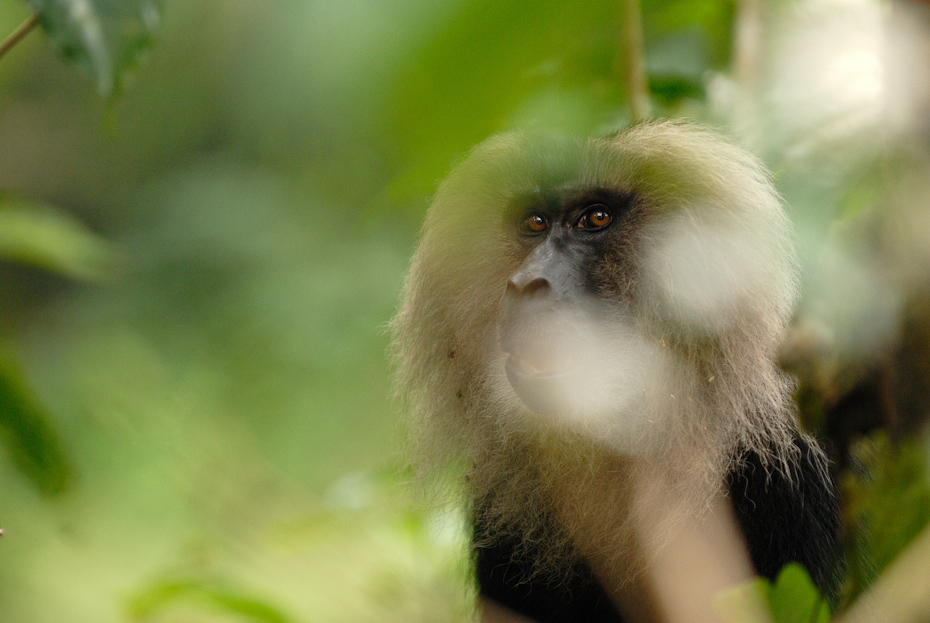
The rainforests of Western Ghats are home to some of the most wonderful creatures which are found only in these forests and nowhere else on the earth. The Lion-tailed Macaque Macaca silenus is the symbol of this endemic diversity of this biodiversity hotspot. Less than 4000 of these survive today making it one of the most endangered primates in the world.

Since these primates have evolved in the rainforests, they have very simple stomachs which can easily digest fruits, seeds and insects. This adaptation has helped them be a habitat specialist of the tropical rainforest, where these are available throughout the year. The other endemic primate is the Nilgiri Langur which is a purely leaf-eating primate. They do not compete with each other directly.

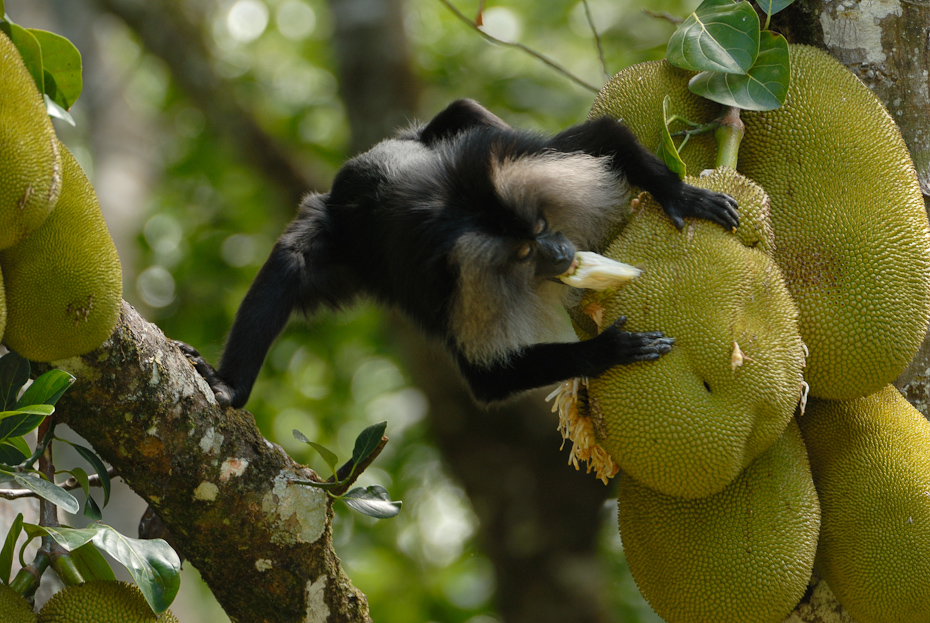
Being native, the Lion-tailed Macaques feast on these Jackfruits. Only the males have the strong canines to rip open the thick outer shell of the jackfruits.
The Nilgiri Langur (Trachypithecus johnii), is one of the two endemic primates of the Western Ghats

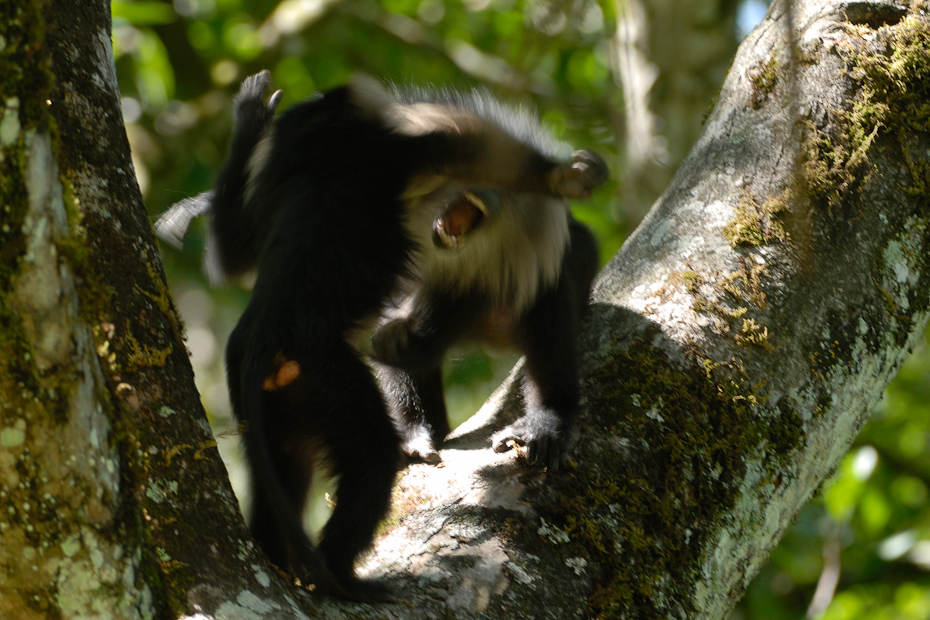
Good fruiting trees are of great demand and sometimes rival groups fight with one another to have rights over these trees. It’s usually the alpha male of the group that engages in these fights, though other monkeys do join at times. Males have canines, mostly just to show them off to rival males. These large canines come into use when the macaques feast on fruits like Cullenia, which is one of the keystone species of the Western Ghats. Their flowers and fruits serve as food for many of the rainforest species including the Lion-tailed Macaque.

Males have canines, though mostly just to show them off to rival males. These large canines come in use when the macaques feast on fruits like jackfruits and Cullenia. Good fruiting trees are of great demand and sometimes rival groups fight with one another to have rights over these trees. It’s usually the alpha male of the group that engages in these fights, though other monkeys do join at times.

Only the males have canines, though mostly just to show them off to rival males. These large canines come in use when the macaques feast on fruits like jackfruits and Cullenia
Good fruiting trees are of great demand and sometimes rival groups fight with one another to have rights over these trees. Its usually the alpha male of the group that engages in these fights, though other monkeys do join at times.

Being more meat-eating than other macaques of the world, the Lion-tailed Macaque sometimes hunts and feeds on young ones of giant and flying squirrels.

A lot of roads go through these forests breaking them into isolated fragments. These primates which very rarely step on the ground in undisturbed forests are now forced to come down to cross these broken canopies. About 25% of the Lion-tailed Macaques are found in small isolated forest fragments. This often leads to tragic consequences further affecting populations of this endangered species.

Being macaques, they tend to explore a lot and sometimes discover easy ways of finding food.
A lot of roads go through these forests breaking them into isolated fragments. These primates which very rarely step on the ground, are now forced to come down to cross these broken canopies

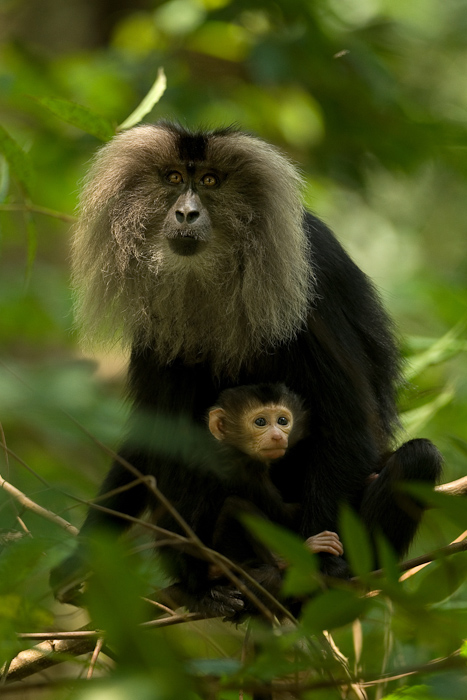
The reproduction cycles of these macaques are very slow. A female gives birth only once in three years and only the dominant female gives birth. Because of the low birth rate and high age at first birth, it gives very little chance for these populations to bounce back.”

The dead fetus of a Lion-tailed Macaque

Kalyan Varma is an Emmy nominated filmmaker and nature photojournalist who has worked with National Geographic, BBC, The Guardian, Lonely Planet, Netflix and other publications. He was the BBC wildlife photographer of the year in 2013 and is the co-founder of Asia’s largest nature photography festival, Nature InFocus.

Photograph credits: Kalyan Varma

This article is republished under a Creative Commons Attribution-NonCommercial-ShareAlike license. The original owner is Kalyan Varma.

Categories
Issue 20

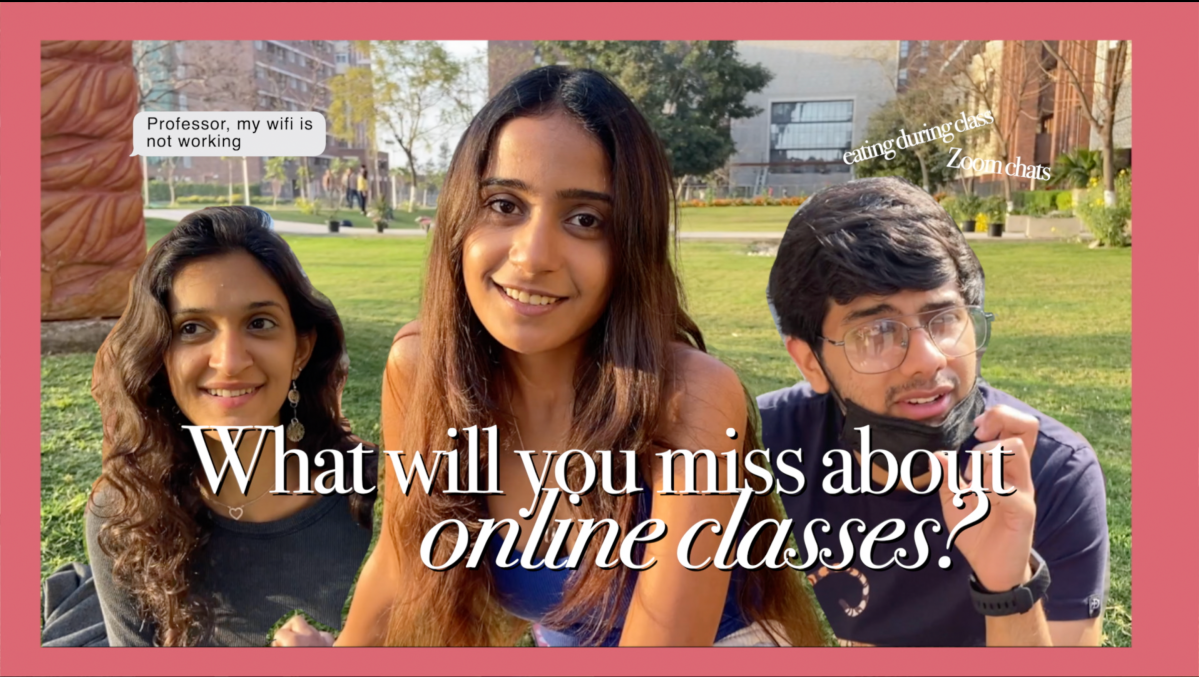
What Will You Miss About Online Classes?

With Ashoka University starting offline classes on campus again after two years, OpenAxis asks the Ashoka student body what they will miss about online classes.

Interviewer & Videographer: Jaidev Pant

Video Editor: Shree Bhattacharyya

Categories
Issue 20

Inventing Anna: Everything Is True Except the Parts That Are Fake

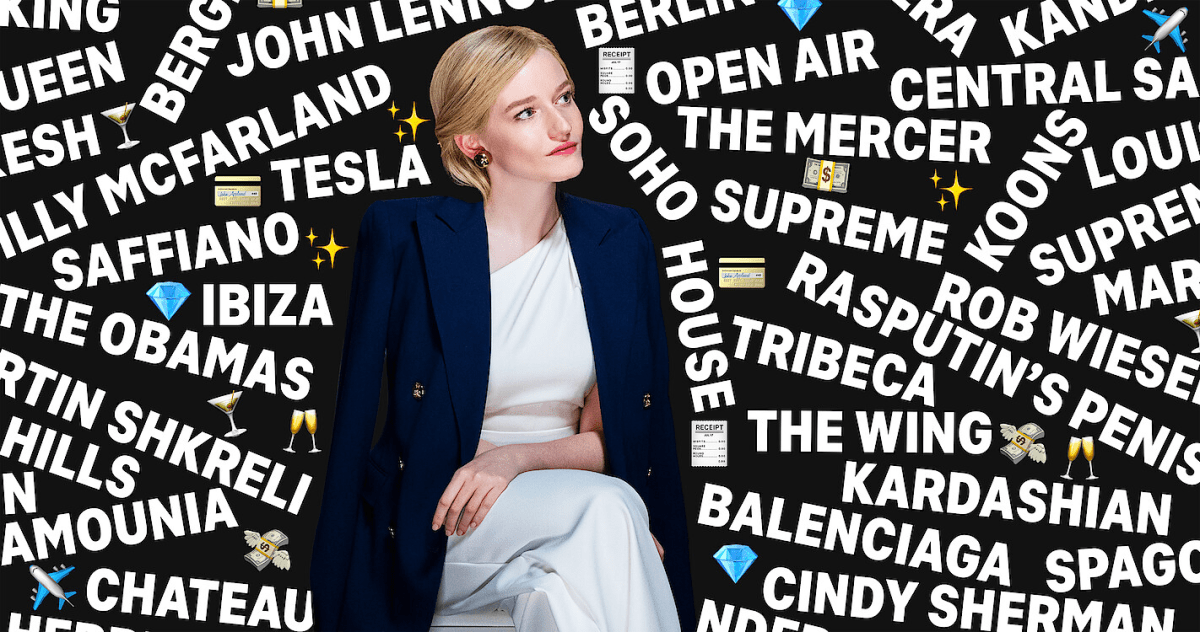
New York high society. Art galleries, fashion designers, and gorgeous locations. An influencer heiress eager to make her name in social circles. Netflix’s latest trending release Inventing Anna has all the right elements to keep you hooked until the very last episode. While the setting of the show in upper-class Manhattan is familiar (from shows like Gossip Girl), the show offers a breath of freshness to the city via the lens of faux-heiress Anna Delvey and the people in her life. Based on a 2018 New York Magazine article, the show is successful in portraying the twenty-something from Russia as a brilliant scam artist, rather than as a woman scorned and out to get the men around her. Neither is she represented as a Robin Hood-esque figure, out to help those less wealthy. Anna is inventing herself, and only herself- and boy, does she do a good job. The show instead offers an insightful perspective into the psychology of relationship building and connections, branding oneself as a commodity in a capitalist society, and most importantly, the frivolity of money. 

Jaidev Pant is a student of Psychology and Media Studies at Ashoka University. He is interested in popular culture and its intersections with politics, gender, and behavior. 

Image Source: Netflix

We publish all articles under a Creative Commons Attribution-NoDerivatives license. This means any news organisation, blog, website, newspaper or newsletter can republish our pieces for free, provided they attribute the original source (OpenAxis).