Categories
Issue 21

Tax-Free Films: A “Larger” Message or the Government’s Message?

A palpable sense of desperation and anguish fills the hall. Then, the Indian flag slowly unfurls. The audience waits with bated breath. They wait for that moment — when the emotion on the screen mirrors the turmoil in their hearts. The music swells as 170,000 Indians are rescued from Kuwait and brought back home. Immersed in that moment with our eyes glossy and wide, leaned forward in our seats, and our hearts filled with joy, it is hard not to acknowledge the power of cinema.

Airlift (2016) is a film that follows Ranjit Katyal’s and Air India’s efforts to lead the evacuation of thousands of Indians from Kuwait (when Iraq invaded the country). It is patriotic, sentimental, and has a powerful message. With this message, the film ceases to be merely entertainment, and instead, it becomes part of a larger cause. The state then responds to this media in a way that clearly signifies its support: through subsidies. However, is it always a “larger” message that prompts this response? Is it on the whim of the government that a film reaps the benefits of being tax-free, or are there political, social, or sentimental undercurrents that influence this decision?

In India, the goal of making a movie tax-free is to lower the cost of the ticket so that more people can watch it. When a state declares a film tax-free, they are willing to let go of their share of the tax, whereas the Centre still receives their share. A tax-free stamp often increases the film’s publicity and reach. On March 19th, Savita Raj Hiremath, one of the producers of the film  Jhund (2022), questioned why her film was not made tax free. Jhund is based on the life of Vijay Barse, the founder of NGO Slum Soccer. The film is about caste and economic disparity, underprivileged children, opportunity, and it clearly points to a social message. Hiremath argued the same when she said that the film had a subject that is “crucial to our country’s growth”. The remarks were in response to the film The Kashmir Files (2022), which was released a week after Jhund and was made tax-free in multiple states. The crux of the matter here is not whether the former is a better film than the latter but whether there is a criterion that determines when one film gets benefits over the other. 

In 2020 (right before the pandemic hit the country), 22 feature films made it to the Uttar Pradesh government’s subsidy list, so that they could benefit from the government’s film policy. The list included six Bhojpuri films and movies such as Anaarkali of Aarah (2017), Shaadi Mein Zaroor Aana (2017), Sonu Ke Titu Ki Sweety (2018), and Behen Hogi Teri (2017). Critics state that Anaarkali of Aarah  is a feminist narrative that has a strong message and focuses on the big picture of sexual assault and consent. The other films on the list, such as Behen Hogi Teri and Shaadi Mein Zaroor Aana, do not have any clear or powerful social message, but they have been shot in locations in Uttar Pradesh. Moreover, Anurag Kashyap’s Saand Ki Aankh (2019), which was declared tax-free the previous year by the UP government, did not make it into the list. Saand Ki Aankh promotes women’s sportsmanship as it is about two women in their sixties – from Uttar Pradesh – who learn the art of shooting and win various accolades. However, despite its social message, it was speculated that the BJP government did not include the film because Kashyap had then spoken against the new citizenship law.

In the past, various other films have received tax-free status in India. Dangal (2016) is a film about two sisters who are trained in wrestling by their father, after which they represent India and win at the Commonwealth Games. It was declared tax free in Delhi, Uttar Pradesh, Uttarakhand, and Haryana. The Chief Minister of Haryana also announced that because the film promotes “Beti Bachao, Beti Padhao”, the government decided to make it tax-free. Other subsidised films, such as Bajirao Mastani (2015), Sarbjit (2016), Uri: The Surgical Strike (2019), and Tanhaji (2020), are nationalistic and patriotic. Mary Kom (2014) and Sachin: A Billion Dreams (2017) are biopics about inspirational sports icons. Mom (2017) and Nil Batey Sannata (2016) are feministic and support women. Padman (2018) and Toilet Ek Prem Katha (2017) support the “Swachh Bharat Abhiyan”, a clean India mission launched by the government in 2014.  Some films have a message, while some are shot in a particular state, and some do not receive benefits due to ongoing political movements. Some are feministic, sports-themed, patriotic, or support government schemes. Yes, most of the subsidised films have a message. However, it also seems completely arbitrary, because there is no fixed criterion. 

With no set ground rules, the government supporting a film to be tax-free seems to be dependent on their choice, and the message they want the majority of the population to pay attention to. Cinema can often be polarising and evocative, and when a film gets the state’s support, their reach becomes much more powerful. In such a diverse country, where forms of art such as film shed light on innumerable points of views, it is important to note which voices are getting highlighted by the government and which are not. There is a fine line between supporting a film and pushing an agenda through the film, and it seems that subsidy is that fine line. The state has the power through subsidies, but so does cinema – through its narrative. Perhaps to balance this power, it is necessary that certain rules be drawn regarding which films get tax-free status. One can argue that it is the nature of the cinema to be enigmatic in its meaning, thus making it harder for one to put it in a box that categorises it as “tax-free”. However, that does not mean that it cannot be done.

Shree Bhattacharyya is a student of English literature and Media Studies at Ashoka University.

Picture Credits: Shree Bhattacharyya

We publish all articles under a Creative Commons Attribution-NoDerivatives license. This means any news organisation, blog, website, newspaper or newsletter can republish our pieces for free, provided they attribute the original source (OpenAxis).
Categories
Issue 20

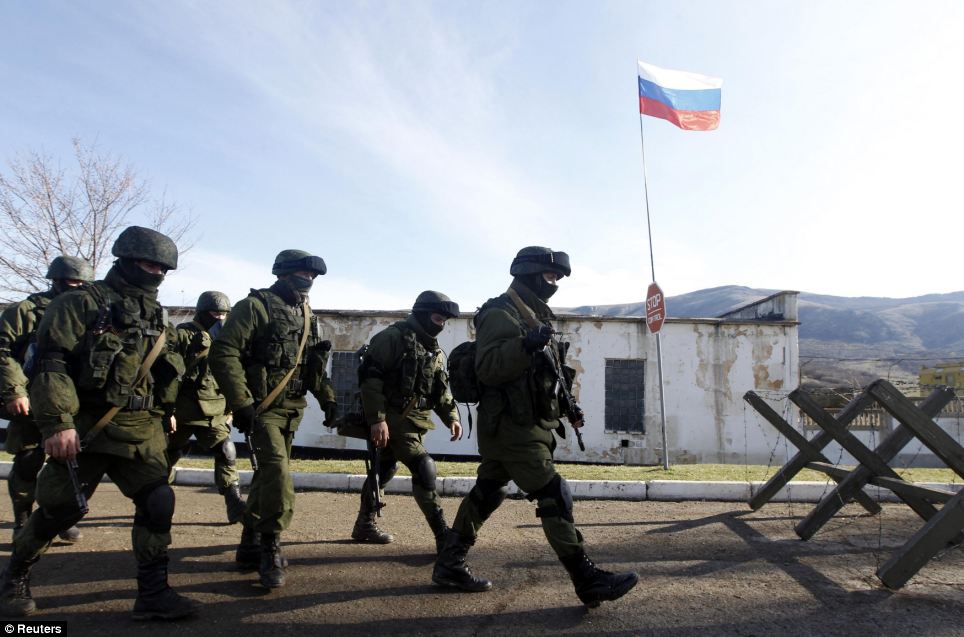
The Economic Cost of Putin’s March Towards Kyiv

Tense security reports had been trickling in for months that Russia’s autocrat President, Vladimir Putin, was growing alarmingly restless about Ukraine’s affinity to the West. As early as November 2021, NATO Secretary-General Jens Stoltenberg warned Russia of “costs” if long-standing peace on the European continent was disturbed.

The talk surrounding this conflict, which took its full form on February 24, has often hinged around economic terms like ‘costs’. That’s no surprise since the coming of war in any part of the world induces sudden and potentially deep bruises on economies. After a draining pandemic, world leaders and economic institutions have been flurrying to balance tough economic war efforts and save national economies from being hurt. 

Joseph Borrell, the foreign affairs chief of the European Union, heralded on the eve of Russia’s march towards Kyiv that the bloc would impose the strictest economic sanctions it ever has against Russia. It was clear, that economic sanctions–actions by countries to hurt the economic interests of belligerent countries–would be the prime bargaining token against Putin. Though, critics have always pointed out that sanctions also hurt the economies of countries imposing them–sometimes considerably more. In our hyperconnected and intricately interdependent world, the ‘hurt’ brought on by sanctions is felt across regions and borders. How has this Catch-22 impacted lives? 

First, let’s put Russia’s place in the world economy into perspective. The largest country on Earth also harbours the largest natural gas reserves in the world, second largest coal reserves and eighth-largest oil reserves. According to OECD data, trade counts for more than 25% of Russia’s nominal GDP and energy accounts for half of that trade. In short, the world is heavily dependent on Russian energy to fuel its economy.

This is why European leaders like German Economy Minister Robert Habeck have resisted sanctions on Russian energy. Other sanctions have already caused a “big impact” on all sectors of the German economy, he said. Despite the German caution, U.S. Secretary of State Antony Blinken’s February 6 announcement that embargoes on Russian oil were being considered drove up oil prices to historic highs. 

Crude oil is crucial. We not only use its products in our private cars and homes, but almost all other goods need it as production fuel. Each good also needs transportation. This means that as oil prices skyrocket, prices for almost everything also rise. Indian Finance Minister, Nirmala Sitharaman has expressed her concerns that such flaring oil prices could impact the provisions in the Union Budget presented last month. 

In the short term, consumers have largely been sheltered from rising prices. Domestic prices for oil have remained unchanged. Though, worries about the long-term effect of the conflict on India’s growth are abounding with some economists projecting a growth rate of less than 8% in FY23. Jayanth R Varma, Economist and member of India’s Monetary Policy Committee, has also called attention to inflation rates in light of the unpredictable conflict. 

Key industries in India also depend upon trading goods with Russia and Ukraine. In the last financial year, Bilateral imports and exports between India and Russia amounted to $9.4 Billion and with Ukraine, to $2.3 Billion. A slowdown in trade with the affected States due to sanctions has increased the domestic prices of automobile components, pharmaceuticals, engineering goods, agricultural products, and telecom equipment since the outbreak of the war. The exclusion of Russia from SWIFT, a system used by most major international banks to coordinate cross-border transactions, has also led to insecurity for Indian exporters about the $400 million currently stuck in the system. The uncertainty of Putin’s next moves and the subsequent retaliation by Western powers has also spooked the financial markets with value of the Rupee plunging to historic lows

The bridle that economists and leaders have been trying to put on a frenzying economy after a devastating pandemic has been greatly disrupted by the unpredictability of the war. While Ukrainians face the military might and imperialist dreams of Vladimir Putin, officials at home now have the task to control inflation, secure alternative routes to trading while walking a diplomatic tightrope and hope for a soothed financial market. 

Rutuparna Deshpande is a second-year student of Politics, Philosophy and Economics at Ashoka University.

Picture Credits: Reuters

We publish all articles under a Creative Commons Attribution-Noderivatives license. This means any news organisation, blog, website, newspaper or newsletter can republish our pieces for free, provided they attribute the original source (OpenAxis).

Categories
Issue 20

Hindutva Beyond Politics: The Rise of an Alternate Pop-Culture in India

The rise of Hindutva, especially in the past seven years, has proved that it is not only a political or electoral phenomenon. The ideology of Hindutva, a blend of creating a purely Hindu nation-state while othering non-Hindus, has today penetrated all levels of our social systems and democratic setup. It has infused exclusionary values of religious nationalism in our bureaucratic institutions, bent large parts of the judicial system in its favour, has completely encapsulated the media ecosystem to propagate its ideology, and is working towards saffronising Indian academia. However, nothing represents Hindutva’s deep dive into shaking the foundations of an imagined liberal and secular India more than the evolution of popular culture in the past seven years. 

The vandalisation of the sets of Padmaavat, protests against the release of the film Sexy Durga and its eventual ban, protests against the film PK, are only a few examples of the intolerant and reactionary attitude of Hindutva organisations towards art and artists. However, the attempt to influence popular culture has gone beyond mere mob reactions. There is a concerted effort to demand a nationalistic and often Hindutva narrative from the cultural industries. 

For instance, the number of nationalistic movies that were released in the years 2018 and 2019 is insightful, especially given that was the election year and the BJP government was at the peak of its popularity. Aiyaary, Parmanu: The Story of Pokhran, Satyameva Jayate, Kesari, Uri – The Surgical Strike, Bharat, Manikarnika: The Queen of Jhansi are the most notable ones. Each of these movies either portrays the Indian army’s valour or represent a version of India’s past that espoused religious nationalistic pride. 

Whether or not these films had any impact on the results of the 2019 General Elections, where BJP expanded its majority in the parliament, is debatable. But the fact that there was an overflow of superhit nationalistic movies in 2018 and 2019, reflects that Bollywood producers are seeing opportunity in the film market where there is commercial benefit in making nationalistic films. Furthermore, the rise of actors like Kangana Ranaut, who minces no words in expressing her love for Hindutva, has to be seen in the context of the expanding influence of Hindutva in the cultural industry. Both these phenomenons; a rise in the number of nationalistic movies, and the emergence of Hindutva superstars, indicate the extent to which the ideology has been infused in our cultural trends and media discourse. To top this all, Uttar Pradesh Chief Minister Yogi Adityanath has declared that a film city will be created in Noida, possibly a sign that Hindutva is willing to challenge Bollywood’s hegemony over Indian culture.

Hindutva’s ascendance in popular culture is also visible in the most prominent cultural wars that have emerged in the past few years. Take for example the entire debate on nepotism and the alleged drug mafia in Bollywood. A debate that emerged in the backdrop of the death of actor Sushant Singh Rajput, this debate soon transformed into a slugfest of targeting specific superstars who may have been perceived to be against Hindutva. Similarly, the arrest of Aryan Khan, son of Shah Rukh Khan, can also be understood in the same context. It is not only its attempt to shape the narrative of popular culture, but Hindutva has also succeeded in creating a civil society in its favour that is willing to aid them in manufacturing cultural wars on the pretext of cultural issues, such as the nepotism debate. While it is indeed true that Bollywood as an industry remains extremely inaccessible to most of the country, and the art it produces continues to lack diversity, it is also important to note that Bollywood’s failure itself offers an opportunity for Hindutva to expand its cultural agenda.

Hindutva civil society is also moving towards the production of an alternate popular culture that is committed to its ideology. Consider the rising popularity of Hindutva pop music for instance. Laxmi Dubey is a singer from Madhya Pradesh whose songs have lyrics that espouse Hindu nationalist ideas. Some of her most popular songs are titled Fir Modi Ko Lana Hai, Har Ghar Bhagwa Chhayega, Yogi Aditya Nath Gatha. Each of these songs amassed at least 2 million views on YouTube. Another singer, Sanjay Faizabadi, is equally popular, with some of his most popular songs on YouTube being; Pakistan Hila Denge (16 million views), Har Hindustani Chahe Pure Pakistan Ko (10 million views), Lehrayenge Tiranga Lahore Mein (4.5 million views). The videos of their songs are filled with visual effects of saffron pride, the Indian army bombing its enemies, and often feature BJP leaders like Modi, Shah, and Adityanath. Apart from artists like Dubey and Faizabadi, there are numerous lesser-known artists and content creators who produce music, videos, and memes, in relatively low quality but follow a firm pattern of propagating Hindutva ideas. The scale of production of such xenophobic, bigoted, and chauvinistic music or art, and the popularity it has gained is unprecedented. 

That there is a concerted attempt by Hindu nationalist organisations to take over popular culture is amply clear. However, the disconcerting fact is the pace at which the production of an alternate popular culture is emerging. While an industry like Bollywood is relatively inaccessible for artists and production companies prioritise profit over any ideology, platforms such as YouTube and Spotify give artists like Dubey and Faizabadi an opportunity to share their music and gain a following, not to mention the inordinate amount of Hindutva content that is produced in Instagram and Facebook daily by other Hindu nationalists accounts. 

In India, however, cultural clout has a catch named diversity. The sheer diversity in our country, and internal diversity in each state, render an attempt to homogenise and dominate culture almost impossible. Cultural identities are so ingrained in every Indian community or social group, that it is hard to imagine Hindutva pop-culture dominating national culture on its own. Unlike Nazi Germany and Stalinist Soviet Russia’s success in dominating culture through propaganda, similar projects in India may yet again be saved by the sheer strength of our cultural diversity. 

While Bollywood has largely surrendered itself to the pressures of a Hindu nationalist government, film and music industries of other languages across different states may provide suitable resistance to Hindutva. The solution to such an onslaught on popular culture is in diversifying the output in our popular culture. After all, culture persists only when it connects to people.

Biplob Kumar Das is a Graduate Student at Ashoka University currently pursuing an Advanced Major in Political Science and a Minor in Media Studies. He completed his undergraduate degree in Political Science and takes a keen interest in anything related to Indian politics, media, art and culture. 

Picture Credits: YouTube

We publish all articles under a Creative Commons Attribution-NoDerivatives license. This means any news organisation, blog, website, newspaper or newsletter can republish our pieces for free, provided they attribute the original source (OpenAxis).
Categories
Issue 20

Documenting the Knights of the Western Ghats

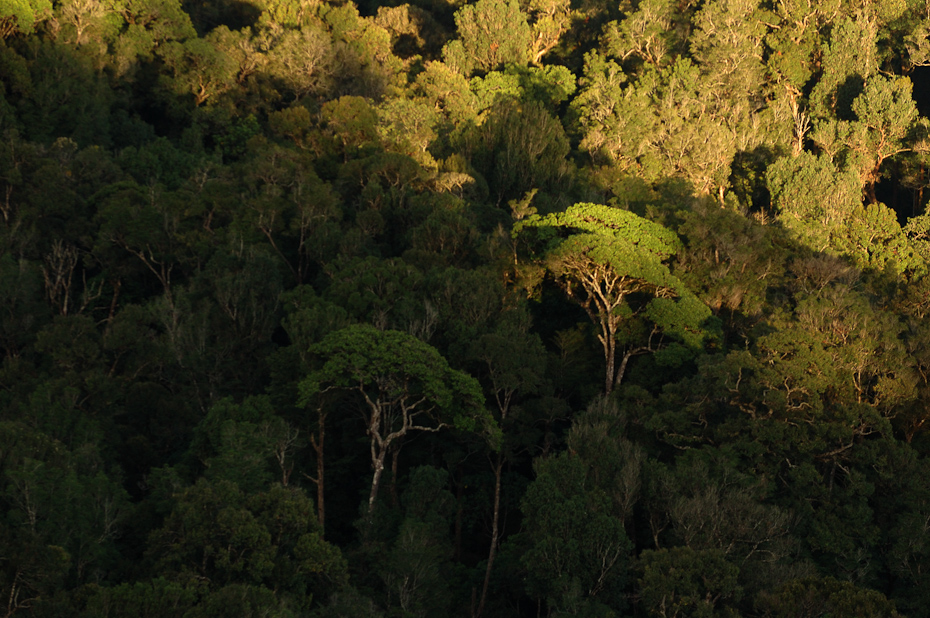
“Along the west coast of India lies a range of mountains known as the Western Ghats. Far more ancient than the larger and better-known Himalayas in the north, the Ghats harbours a diverse and extensive range of habitats from the thorn-scrub in the drier plains to shola-grasslands in the upper reaches. These ranges are also home to many species of endangered and endemic plants and animals. As exploration continues, new species are being discovered even today, giving us an opportunity to better understand the evolutionary and ecological history of this ancient mountain range.

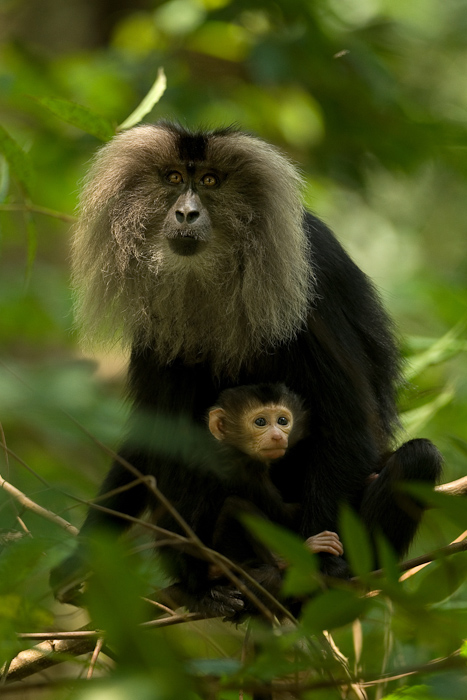
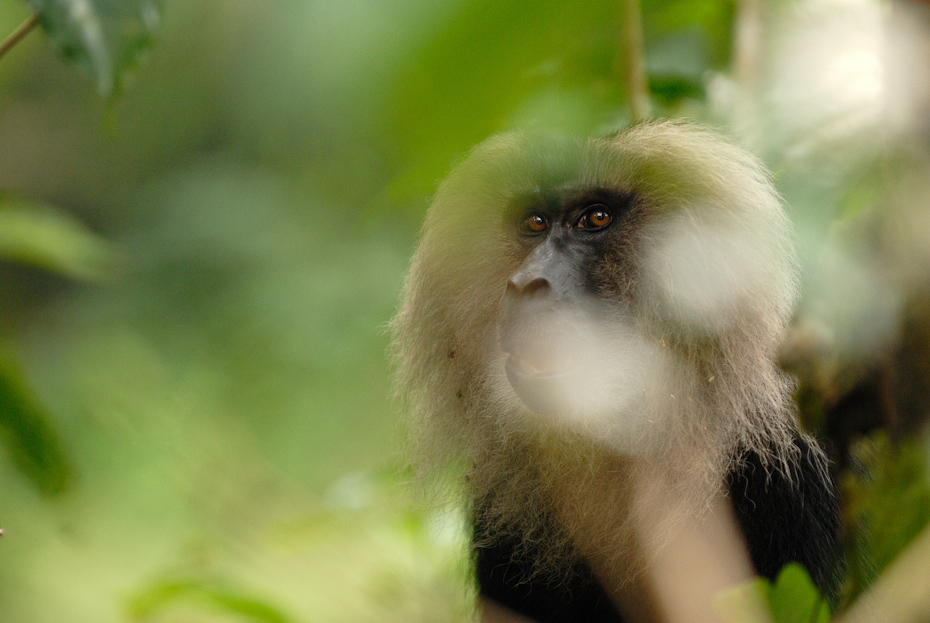
The rainforests of Western Ghats are home to some of the most wonderful creatures which are found only in these forests and nowhere else on the earth. The Lion-tailed Macaque Macaca silenus is the symbol of this endemic diversity of this biodiversity hotspot. Less than 4000 of these survive today making it one of the most endangered primates in the world.

Since these primates have evolved in the rainforests, they have very simple stomachs which can easily digest fruits, seeds and insects. This adaptation has helped them be a habitat specialist of the tropical rainforest, where these are available throughout the year. The other endemic primate is the Nilgiri Langur which is a purely leaf-eating primate. They do not compete with each other directly.

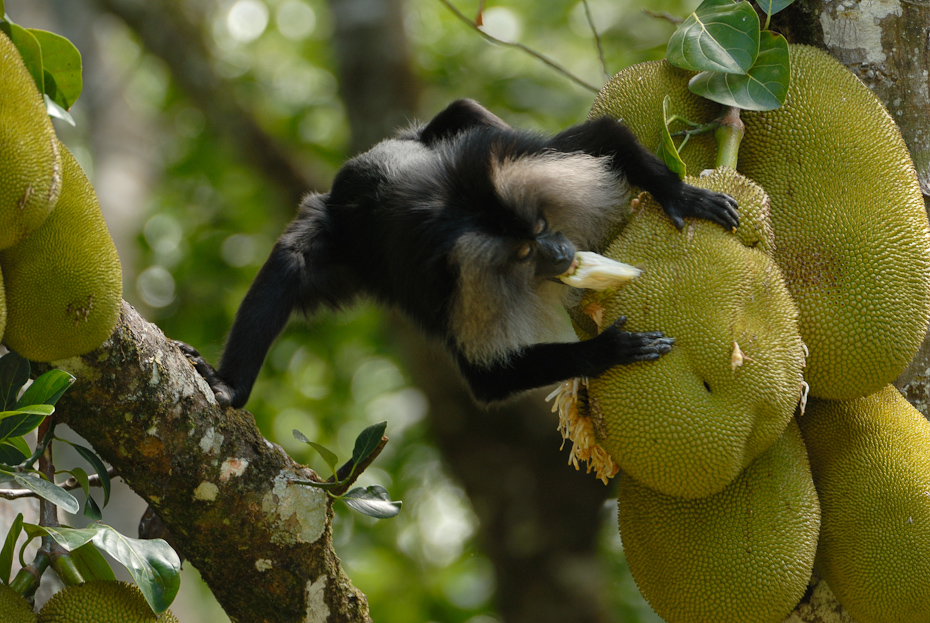
Being native, the Lion-tailed Macaques feast on these Jackfruits. Only the males have the strong canines to rip open the thick outer shell of the jackfruits.
The Nilgiri Langur (Trachypithecus johnii), is one of the two endemic primates of the Western Ghats

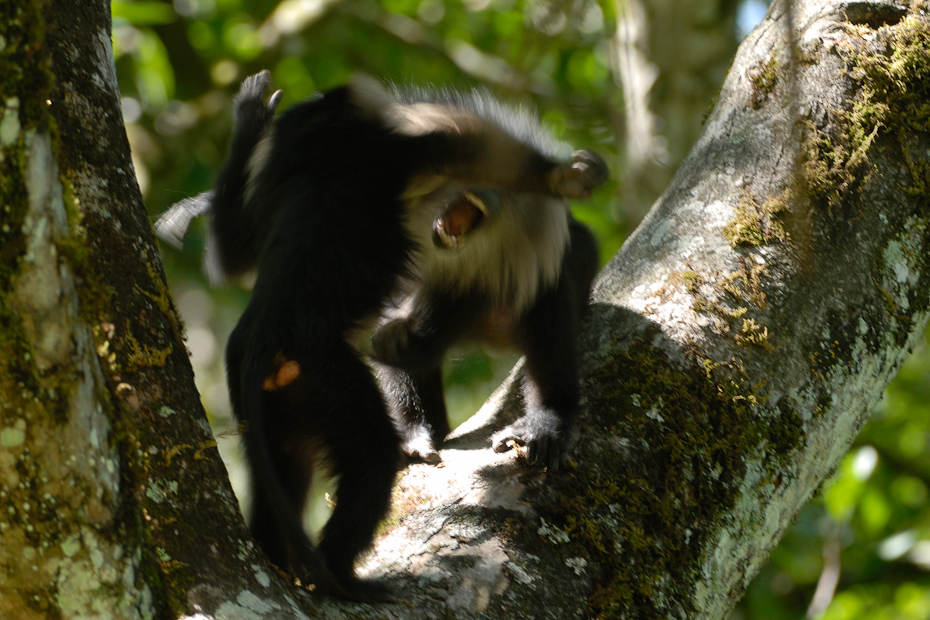
Good fruiting trees are of great demand and sometimes rival groups fight with one another to have rights over these trees. It’s usually the alpha male of the group that engages in these fights, though other monkeys do join at times. Males have canines, mostly just to show them off to rival males. These large canines come into use when the macaques feast on fruits like Cullenia, which is one of the keystone species of the Western Ghats. Their flowers and fruits serve as food for many of the rainforest species including the Lion-tailed Macaque.

Males have canines, though mostly just to show them off to rival males. These large canines come in use when the macaques feast on fruits like jackfruits and Cullenia. Good fruiting trees are of great demand and sometimes rival groups fight with one another to have rights over these trees. It’s usually the alpha male of the group that engages in these fights, though other monkeys do join at times.

Only the males have canines, though mostly just to show them off to rival males. These large canines come in use when the macaques feast on fruits like jackfruits and Cullenia
Good fruiting trees are of great demand and sometimes rival groups fight with one another to have rights over these trees. Its usually the alpha male of the group that engages in these fights, though other monkeys do join at times.

Being more meat-eating than other macaques of the world, the Lion-tailed Macaque sometimes hunts and feeds on young ones of giant and flying squirrels.

A lot of roads go through these forests breaking them into isolated fragments. These primates which very rarely step on the ground in undisturbed forests are now forced to come down to cross these broken canopies. About 25% of the Lion-tailed Macaques are found in small isolated forest fragments. This often leads to tragic consequences further affecting populations of this endangered species.

Being macaques, they tend to explore a lot and sometimes discover easy ways of finding food.
A lot of roads go through these forests breaking them into isolated fragments. These primates which very rarely step on the ground, are now forced to come down to cross these broken canopies

The reproduction cycles of these macaques are very slow. A female gives birth only once in three years and only the dominant female gives birth. Because of the low birth rate and high age at first birth, it gives very little chance for these populations to bounce back.”

The dead fetus of a Lion-tailed Macaque

Kalyan Varma is an Emmy nominated filmmaker and nature photojournalist who has worked with National Geographic, BBC, The Guardian, Lonely Planet, Netflix and other publications. He was the BBC wildlife photographer of the year in 2013 and is the co-founder of Asia’s largest nature photography festival, Nature InFocus.

Photograph credits: Kalyan Varma

This article is republished under a Creative Commons Attribution-NonCommercial-ShareAlike license. The original owner is Kalyan Varma.

Categories
Issue 20

The Veil of Spirituality


Faith, a word so important to human history and society, it is virtually sacrosanct. People claim their lives are incomplete without faith, and those who seek power over others weaponise and leverage the faith of devout believers for their own personal, political or financial gain. 

The constant tension between believers and rationalists came to the fore once again in recent weeks. Sparked this time, by the controversy at The National Stock Exchange. 

Chitra Ramakrishna, the CEO of NSE, put her trust in a Himalayan ‘sage’  who was supposedly “mentoring and guiding” her through the tedious process of running the country’s largest stock exchange. She exchanged inside information with this ‘sage’ until the news leaked, and another ‘baba’ scam came to the limelight. According to SEBI as reported by India Today, The Queen of Bourses, shared the exchange’s board agenda, financial projections, and business plans. This entire situation can possibly land her in jail as the Delhi High Court refused her anticipatory bail application

This is not the first time faith in spiritual leaders has cost people much more than they anticipated. Asaram Bapu, Ram Rahim, Rampal, Narayan Sai, and many more… have manipulated, harassed, and assaulted people in the name of Faith. But why does Faith have such a stronghold on us? Why does it shroud our reason, logic, and rationality? The American Psychological Association believes that Faith, or religion, in particular, is a byproduct of our tendency to find order among chaos, to look for discipline in our lives. Chitra Ramakrishna, like most people in the world, sought to Faith and was allegedly tricked by Anand Subramaniam. A woman who ran the largest stock exchange could not have been naive or senile, yet her Faith got the better of her. Faith, therefore, has this power of blinding rationality, which has been proved, time and time again. Her faith in this so-called sage, led her to make executive level appointment decisions as per his commands

The ever-growing cases of people being defrauded in the name of Faith, superstitions being upheld (sometimes at the cost of somebody’s well being), and the rising hostility in the name of Faith, calls for a discussion on rationality. How can we strike a balance between logic and belief, wit and virtue? We need to understand the complexities of Faith, to what extent it is healthy and where it becomes a sin. People need somebody to believe in, somebody to hold accountable, somebody to complain, and somebody to hope from. Faith, in general, and spiritual leaders, in particular, play on these emotional needs. To top it all, the dynamic of pain/pleasure is always at play. Society conditions us to think that following religious duties leads to positive reinforcement while giving up religion makes us sinners. To escape this loop and avoid falling into a pit hole, we need self-awareness.

Self-awareness, in this context, means being alert when common sense stops making sense. The Art of Living says alertness and faith are complementary. We need to bring this complement to the table. Faith may be helpful, but blind faith can be dangerous. There is nothing wrong with seeking help by having faith in people and religious institutions. However, one needs to be cognisant of what they are sharing, and how authentic is the advice they are receiving. Leaning on somebody is not wrong, it makes us human and as humans, we are bound to make mistakes. We need a self-check measure, before following the advice of such leaders. We also need to keep a check on the authenticity of such leaders and sages in the era of cyber-crime. Chitra Ramakrishna was scammed over email, an electronic tool. Most religious and spiritual sites have a web address, email address, and web payment portals. This substantially increases the chances of getting involved and robbed in a quest for spirituality.

But is it spirituality that we all are after? Or is it the perks that the popular notion of spirituality offers? In this hustle world, everybody is after success in all its forms. After all, who does not like a high paycheck, a beautiful home, a healthy relationship, and mental peace. My logic gives me a red flag at this stage itself, I cannot have everything, one or the other thing has to be sacrificed. The spiritual leaders, often, promise all these with the additional bonus of spiritual peace. The realization of these promises, however, is less certain and more unrealistic. Human nature, however, falls for these pretenses and a veil of spirituality is cast over our minds which bars rationality from seeping into consciousness. 

This does not imply that we must give up our entire faith on spiritual leaders and spirituality, but we must be smart enough to not get veiled. We need to use the same logic of rationality i.e., rational decision making that we follow before enrolling in schools, colleges, or universities. The same double-checks we do before going to a hospital or for a regular check-up. Moreover, when somebody advises a particular institute we do not blindly enrol ourselves or our near ones in it. We analyse our own situation and background, the same way we analyse an institute. If we begin applying the same logic in following spirituality, we will follow a safer path. Moreover, if we understand that we have to work for whatever we need, then we will fulfil the dual goals of spiritual peace and safety.

Lakshya Sharma is a first year undergraduate student at Ashoka University. He is an economics and media studies student. Apart from his academic interests, he has keen interest in writing and fashion.

Picture Credits: Daily Pioneer

We publish all articles under a Creative Commons Attribution-NoDerivatives license. This means any news organisation, blog, website, newspaper or newsletter can republish our pieces for free, provided they attribute the original source (OpenAxis).
Categories
Issue 19

The Pegasus Controversy: Locking the Stable Door

Born of the gorgon Medusa, Pegasus was a winged horse so powerful and valiant that the god Zeus turned him into a constellation, sharing the sky with Leo, Draco, Gemini, Orion, and the like. The flying white horse is a compelling emblem: the Israeli cybersecurity firm NSO Group clearly found it so, naming one of their deadliest systems after it. Their Pegasus was a chimeric attack software, capable of infiltrating the latest and most expensive smartphones. Critically, unlike many others, it did not require a target to make a mistake: you didn’t have to click a dodgy link or download a file to get infected. These were “zero click” attacks, which leveraged vulnerabilities in common software, like Apple’s iMessage.

Pegasus clients could get access to phone data in many ways: if a targeted “spearphishing” email with a link worked, fine. If it didn’t, then they’d use zero-click attacks or other means, including physically getting access to a device and infecting it. The latter was necessary in some cases where the target had reduced their vulnerability to attack by having separate devices which they did not otherwise use. Once installed, it could intercept phone calls, chats, and emails, access photos and videos, grab location data, and even activate the microphone or camera remotely. Finally, it could erase itself, practically without a trace, once access was no longer required.

While the tool has been around for over a decade, it came to public attention in mid-2021, due to a data leak (the irony!). This leak comprised around 50,000 phone numbers that were allegedly targeted by Pegasus. What alarmed the group of journalists analysing the leak was the fact that the numbers included many journalists and activists. In other words, a military-grade cyberattack tool, intended to target terrorists and the like, was being used against innocent citizens.

There are three questions we must tackle: (1) How bad is this? (2) Clearly, some bad things have happened, so who is to blame? (3) What can we do this fix things in the long term, so that such incidents do not occur in the future?

The answer to the first question isn’t as obvious as it first appears, especially in the backdrop of planetary-scale mass surveillance by the US government and many others. The level of utter betrayal involved in things like the Belgacom scandal (where the British government infiltrated a government-controlled Belgian telecom giant) or the Gemalto hack (where the US and the UK together broke into a Dutch company’s systems to obviate the new security systems it was installing on SIM cards) might make this particular case seem banal. It is critically different, however: this is a private company producing military-grade products and should be treated like a missile producer. Worse, unlike a missile, code can be replicated with ease. If Lockheed-Martin sells one Hellfire missile to the wrong client, it is still practically impossible for that client to make more. Not so with this (though, of course, this kind of attack software needs to be constantly updated in a cat-and-mouse game with companies patching their defences). Clearly, there needs to be strong, international regulation of the sale of such systems, with sufficient sanctions built in to prevent misuse.

When it comes to blame, there is a lot to go around. It is important to note that the sale of NSO’s cyberattack software is regulated by the Israeli defence minister, who grants individual export licences, presumably making sure that only vetted, “good” nations get access to it. The leaked data and subsequent forensic analysis, however, indicate that the majority of these vetted nations swiftly reneged on their promises (to use this power to target criminals) and started targeting journalists and activists. This is not to say that the blame lies only with these nations: it beggars belief that NSO and the Israeli defence ministry, both supremely competent institutions, were unaware that their vetted clients were doing bad things. It would appear that they decided to look the other way. In India’s case, we have neither a strong data protection bill nor real public pressure around data security and privacy (along with outdated laws and oversight in this area). Misuse is practically inevitable, especially given that it would be almost impossible to prove in court.

What can be done? Here, I strongly agree with many other experts: laws, technical defences, and good cyber hygiene are all necessary but not sufficient. At the end of the day, the main thing that will stop this from happening in the future is strong and steady public awareness, and anger at such incidents: a government must know that this is an issue that can lose it an election. We do not have anything of the sort in India today: outrage at a privacy breach is a coffee table conversation, and, frankly, not even a heated one. If Shark Tank produces more emotion than Pegasus, don’t expect privacy breaches to be taken seriously. Until that time, the Indian government, among others, will pay only lip service to protecting privacy and security. After all, the government represents its citizens – and we, clearly, don’t seem to care.

Debayan Gupta is currently an Assistant Professor of Computer Science at Ashoka University. He is also a visiting professor and research affiliate at MIT and MIT-Sloan. Debayan’s primary areas of interest include secure computation, cryptography, and privacy.

Picture Credits: Kaspersky Daily

We publish all articles under a Creative Commons Attribution-NoDerivatives license. This means any news organisation, blog, website, newspaper or newsletter can republish our pieces for free, provided they attribute the original source (OpenAxis).
Categories
Issue 18

Money, Money, Money- Always Funny in the Twitter World!

Editors : Jaidev Pant, Lakshya Sharma and Maahira Jain.

Categories
Issue 18

Harvesting a Vote Bank

As the states of Punjab and Uttar Pradesh gear up for their respective state elections, political parties are making several promises to the farmers of the two states. The looming shadow of the year-long farmer’s agitation that ended in November 2021 with the repeal of the three farm laws has made its mark, as political parties have taken resurgent interest in farmer’s issues. In Punjab, farmers’ unions who were part of the agitation have created their own political party, Samyukt Samaj Morcha (SSM) to contest the state elections. Meanwhile, in Uttar Pradesh, Bharatiya Kisan Union leader Rakesh Tikait has sustained his campaign against the ruling Bharatiya Janata Party in the face of the elections.

Amidst the debate and the rhetoric around farmer’s issues, we take a look into the promises made for the farmers by the main contenders in the upcoming elections of UP and Punjab. 

In Uttar Pradesh, the ruling Bhartiya Janata Party (BJP) is primarily banking on agricultural schemes and decisions it had already implemented, both at the state and center to campaign among the farmers. Sugarcane prices have been a contentious issue in Uttar Pradesh, especially the Western UP region where 40 lakh farmers grow sugarcane. In 2021, the UP government had increased the purchasing price of sugarcane by Rs 25 per quintal, hoping to pursue the UP farmer population. However, the opposition has not shied away from pointing out that sugar mills are yet to clear around Rs 2000 crore pending dues to farmers. 

The BJP is also campaigning on the basis of national level schemes such as the PM Kisan Nidhi instalments, which it claims has benefitted numerous farmers. On the issue of guaranteed Minimum Support Price (MSP), which emerged as one of the main demands of farmers during their year-long protest, the BJP has largely stayed silent. Overall, the party has primarily chosen to campaign on the issue of better law and order, occasionally raising issues around “Jinnah”, or “80 vs 20 elections”, in what can be seen as a way to polarise Hindu-Muslim voters. 

The alliance of the Samajwadi Party (SP) and Rashtriya Lok Dal (RLD) have emerged as the main challengers to the incumbent BJP. The alliance has opted to heavily emphasise on farmers issues throughout their campaign. In a press conference dedicated to farmers’ issues, former Chief Minister Akhilesh Yadav of SP stated that upon coming to power their government will make a law to assure MSP for every crop. 

Additionally, he also stated that his government will provide free electricity up to 300 units which will benefit the farmers immensely. The party also promised to provide free irrigation facilities for the farmers. Yadav also mentioned that a Farmers Corpus Fund and a Farmers Revolving Fund would be created to pay arrears to sugarcane farmers within 15 days of their government formation. He further stated that farmers will be granted interest free loans, while insurance and pension schemes will be implemented for their benefit. 

Another big promise that the SP-RLD alliance has made is that it will withdraw all cases filed against farmers during the year long agitation. They have promised to pay a compensation of Rs 25 lakhs to the family of each farmer who died during the protest. Additionally, they have assured to grant the status of ‘martyrs’ to the farmers who died during the protests. RLD leader Jayant Choudhury’s claim that “this is an election between ‘ganna’ (sugarcane) vs ‘Jinnah’” seems to epitomise the campaign approaches of the two main contenders in Uttar Pradesh. 

In Punjab, the state which participated most vehemently in the farmer’s agitation, the upcoming election is witnessing a tri-cornered contest. While incumbent Congress is looking to retain power, the Aam Aadmi Party (AAP), and the alliance of Shiromani Akali Dal (SAD) and Bahujan Samaj Party (BSP) are seen as the main challengers. Responsible for the supply of wheat and paddy to most of the country, the farmers of Punjab have been promised several benefits by each party. 

The Congress recently released a ‘farm model, ’ which promises to help farmers steer out of the wheat-paddy cycle by replacing paddy with diversified crops, thereby allowing beneficial returns. The party has promised the procurement of dal, oilseeds, and maize at guaranteed MSPs through state cooperatives and corporations. The party has also promised to create a parallel market intervention scheme under which the government would pay the differential between market selling price and MSP directly to the farmers. 

Similarly, the SAD-BSP alliance has also promised to introduce MSP for fruits and vegetables and pay the differential to farmers. The alliance further promised crop insurance for any damage of crops during the protests. The alliance also acknowledged the need to end the culture of over-reliance on wheat and paddy crops in the state. 

Meanwhile, the Aam Aadmi Party has promised to make farming profitable through a ‘special plan.’ While the special plan itself has not been revealed, nor a manifesto published, the AAP has made several pledges through its campaigns. The party has promised that upon forming the government farmers will be paid crop loss compensation by April 30th. The party also stated that they would facilitate the use of stubble for power, cardboard and agro-based industries, and DAP fertilisers. 

Uttar Pradesh will vote from February 10th to March 7th in seven phases, meanwhile Punjab is set to vote on 20th February in a single phase. The results will be announced on 10th March. While the election rhetoric has often tended to shift towards religious and caste based issues in both the states, the impact of the farmers protests have assured that agrarian issues are not overlooked by the parties. One can imagine the stakes for the farmers to be higher in these state elections given the backdrop of a successful farmers’ agitation and given that agriculture remains a state subject. 

Biplob Kumar Das is a Graduate Student in Ashoka University currently pursuing an Advanced Major in Political Science and a Minor in Media Studies. He completed his undergraduate degree in Political Science and takes keen interest in anything related to Indian politics. 

Picture Credits: Al Jazeera

We publish all articles under a Creative Commons Attribution-Noderivatives license. This means any news organisation, blog, website, newspaper or newsletter can republish our pieces for free, provided they attribute the original source (OpenAxis).

Categories
Issue 18

On the Fence: The Sino-Indian Standoff Continues

On 12th  January 2022 , commanders of the Indian Army and People’s Liberation Army of China met for the 14th round of Corps Commander Level talks with the aim being “resolution of the relevant issues along the LAC in the Western Sector.” The first round of talks between the respective division level commanders of both armies was held on 18th June 2020, following violent clashes between Indian and Chinese troops in the Galwan valley. This clash represented the most deadly outbreak of violence between the two nations in nearly 50 years,  resulting in 20 casualties on the Indian side, and an indeterminate number of casualties on the Chinese side. Since this flare up of violence, both sides have ramped up military presence across the entire length of the Sino-Indian border, and the question of how to de-escalate and chart a response going forward has been on the minds of multiple stakeholders. 

After 14 rounds of official talks at the military, diplomatic and political levels, the question of the future of Sino-Indian relations still remains standing. The heart of the issue goes back to the boundary shared between the nation. The boundary question is however, very complex.  “The alignment of the LAC has never been agreed upon, nor has it been delineated or demarcated. Remote and uninhabitable, the contested territory has no significant natural resources or population centers. The terrain varies from dry and desolate in the Western sector to hilly and dense in the Eastern sector.” Notions of history, culture, and civilization differences present their own set of problems that have to be considered. This is not to say that concentrated efforts to resolve the crisis haven’t been made, or de-escalation hasn’t happened before. The 2005 agreement signed between the two governments, marked a step forward by recognising that “the boundary settlement must be final, covering all sectors of the India-China boundary.”

At the same time, this ongoing crisis represents a new turn. Simply put, the repeated talks have failed because while either side does not want further violence, each side also differs in how exactly they see de-escalation and the terms of resolving the larger border issues. A key demand for the Indian side as a precursor to the normalization of the relationship between the two nations has been the “complete withdrawal from all the friction points and status-quo until restored as it existed before May 2020.”

This stated aim has not been achieved so far and seems unlikely to be reached for the simple reason that it is not in China’s interest to withdraw and let the issue quietly die down.  China’s new strategy at the border is a mix of strategies that have been successfully used in other flashpoints. It is a mixture of not only salami-slicing tactics, but also gray zone warfare, both working to China’s benefit.

Gray zone warfare often relies on deniability, remaining below an adversary’s response threshold, and achieving a cumulative effect through seemingly minor actions.” One can see instances of this approach all across the current crisis. One major area is the effort to solve each hotspot, or area of tension on its own, as a piecemeal approach with the aim of de-linking certain hotspots from a larger political settlement of the issues. The history of the various talks is littered with such examples. Of the various flashpoints, it was during the 9th round of talks that troops were disengaged from the Pangong Tso lake area, from the Gogra region during the 12th round of talks, and the focus of the failed 14th round of talks was the Hot Springs area in Eastern Ladakh.  Experts and news media have pointed out that certain areas are no longer on the table for even the base process of ‘disengagement’. For example, the ongoing standoff in the Depsang and Demchok in Eastern Ladakh. While the Indian side has pushed for resolution here, the issues at play, i.e., denial of patrolling routes of the Indian army by the Chinese have been delinked and cast as ‘legacy issues’. Such an approach, however, masks the fact that the Chinese side has successfully used the 2020 crisis to block access of the Indian side to areas it historically used to patrol in. Further, for the Indian side to recast ongoing flashpoints as ‘legacy issues’ that cannot be talked about even for ‘disengagement,’ shows that the onus of escalation firmly lies on the Indian side, and secondly, gray zone warfare is indeed in effect.

China has also sought to recast the border issue in terms of sovereignty. Statements such as those made in regard to Arunachal Pradesh, seem to confirm that the aim of the Chinese side is indeed to split up the boundary question into sector-wise chunks, and not deal with it as a political whole, going back from what was previously agreed upon, such as the 2005 agreement. As Shivshankar Menon, former National Security Advisor points out “unlike past confrontations and face-offs, the framing of the crisis by China as a sovereignty dispute — rather than as a border dispute which would be solved by give and take — makes it harder to settle.”

The other Chinese strategy that dovetails perfectly with the advent of gray zone warfare is that of putting the onus of escalation on the Indian side. Chinese efforts such as occupying territory, building infrastructure, aggressive patrolling, disputing agreed-upon boundaries, or denying patrolling routes portray tightly controlled moves designed to put the serious onus of escalation on the other side while quietly accruing the benefits of this carefully scripted brinkmanship. The question for the Indian side is whether it can bear the costs of a steady level of escalation by the Chinese without resorting to any new levels of violence. 

The costs of managing and operating the armed forces in brutal and inhospitable conditions, against a hostile neighbor, are happening during a time when the Indian Military is considering reforming its force structure to a Joint Theater Command System. This move, while argued by many as necessary, especially in light of China’s own military reforms, has its own set of myriad challenges and delays for policy-makers. Another area of concern is the issue of budgetary allocation for the Armed Forces. While the 2022-23 allocation of Rs 5.25 Lakh Crore represents “a 9.8% higher [increase] over the Budget estimates of last year” it “masks the challenge of the availability of resources … this increase is barely keeping up with the inflation and the demands of the three services”. More importantly, as pointed out by General Naravane, the ultimate solution to the problem lies at the political level. However, considering the increasingly strained personal relationship between Modi and Xi, one is unsure of the political vision of Indian policy makers. It is important to point out that while the Indian side as a response to Chinese aggression has “initiated a build-up of troops and weaponry along the border”, the more important question is till what point  such an aggressive posture is sustainable. 

In conclusion, one definitely hopes for the introduction of new confidence building measures, based on an approach that recognizes changed political and ground realities, while working together to solve long standing border issues between these two Asian giants in the spirit of mutual cooperation. What is more likely, and is disturbingly seen on the ground, is the fact that the relationship going forward between the two countries will depend on whichever of the two sides blinks first.

Shauryavardhan Sharma is a Graduate Student at Ashoka University. He graduated with a degree in History and International Relations, and is currently pursuing a Research Thesis on India’s Nuclear Programme. His interests lie in the field of Security Studies, and the analysis of India’s foreign policy.

We publish all articles under a Creative Commons Attribution-Noderivatives license. This means any news organisation, blog, website, newspaper or newsletter can republish our pieces for free, provided they attribute the original source (OpenAxis).

Categories
Issue 17

The trees are dead! Long live the forest!

What does one do about dead trees? The question has been pondered time and again. But before we get into that, it’s important to understand tree death in general. How do trees die? Let us count the ways. Often, a tree dies in situ, standing where it is. Sometimes, its roots weakened by soil erosion, it is felled in a storm. And sometimes, disease takes away a tree, hollowing out its core. A wounded tree falls prey to parasites. Fungus and bacteria, along with insects and worms, eat away the soft living tissue. Fires may singe and scar the bark. Rising water levels often flood tree roots, choking them. Nesting birds like cormorants paint them with copious quantities of caustic guano from their droppings, killing the trees in due course. In the forest, an opportunistic usurper may strangle it. Animals like elephants turn to tree bark when food is scarce, and excessive raids may tear the tree to shreds. Humans may murder it and saw away the wood, leaving nothing but a hole in the ground. 

As we can see, when trees die, they don’t go to heaven. Death itself is a long-drawn-out process, often lasting years. After a lifetime of service, a dead tree is pressed into retirement, but the work doesn’t stop even after death. When left alone in the wilderness and not cleared up by foresters, dead trees serve a vital function. 

Pause to consider the irony of that sentence. 

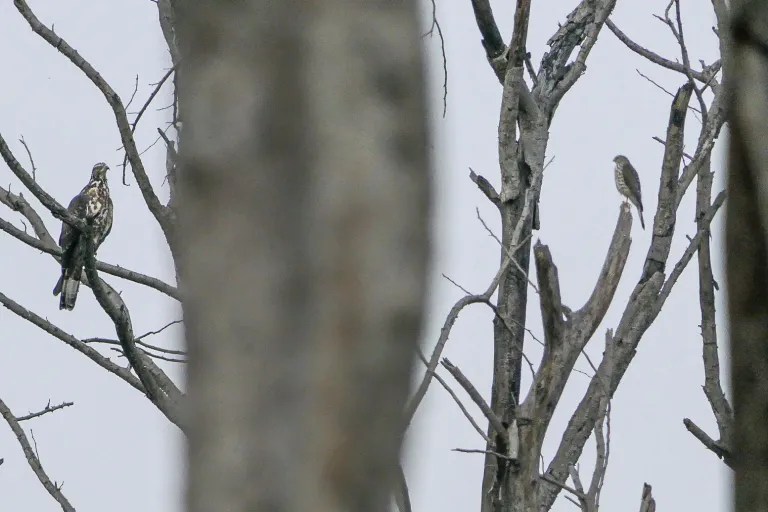
An Oriental Honey-Buzzard (L) and a Shikra scan their surroundings for prey in a tangle of dead trees.
Image credits : Bijoy Venugopal

Life feeds on life. But life thrives on death, too. 

So, what good is a dead tree? Is it a threat to living trees? Is it an eyesore? Should it be removed?

I am part of an enthusiastic community of nature-lovers in eastern Bangalore. Most of us are fascinated by birds and wildlife. Some of us fancy trees. Others spiders and bees. When we are not sharing nuggets on our Signal group, we are hanging out singly, in pairs, or in small and large flocks at our neighbourhood wetlands. One lockdown brought us all together; now we’re enduring another cooped up at home and aching to return to our urban wilderness. 

A few months ago, we began an intense discussion on the utility of dead trees at Saul Kere, one of the lakes that we frequent. Besides offering a variety of wetland habitats that harbour over 150 species of birds, Saul Kere also has a woodland on its eastern flank, so dense that it can without much ado be called a secondary forest.

Working its robust bill like a drill, a White-cheeked Barbet excavates a nest hole in a dead tree trunk. 
Image credits: Saravana S

Bordering this woodland, where the grounds of the lake share a wall with the campus of a well-known information technology company, is a copse of dead trees. How they died one really does not remember, but the sight of them standing there like oversized deer antlers, bare of leaf, their trunks picked clean of bark and cambium, evoked mixed reactions. 

Some people wanted them to be removed. Others – particularly the photographers – thought they made aesthetic backdrops for their pictures. A few pondered if they would fetch any money if they were sold. Most wondered why we were making such a big fuss over a few dead trees. Live and let live; live and let die. 

For many of us, dead trees are just wood. We use the term deadwood metaphorically to describe things or people that no longer have any utility. I learned that foresters have a word for dead trees, too. They call them snags. Not a pretty word, it suggests that dead trees are obstructions to some sort of imagined progress. The truth is that forests and woodlands without dead trees would not be as full of life. In fact, without dead trees, a forest would slowly and surely lose its pluralistic character and die.

How much life can a dead tree support? Often as much, or more, than a living one.

German forester Peter Wohlleben, known for propounding fascinating but controversial ideas about trees talking to each other through a ‘wood-wide web’ in his book The Hidden Life Of Trees, draws attention to the vast underground fungal networks that intertwine among the root systems of trees in a forest. Scientists know these subterranean systems as mycorrhizal networks. The root-tips of living trees have fine, hair-like strands, which are linked by tiny fungal filaments. Trees in a forest, Wohlleben says, share information, water and nutrients through these networks. Fungi thrive on sugar and the trees produce a lot of it through photosynthesis. For the services rendered by the fungi, the living trees pay a tax: up to 30% of the sugar they produce goes to the fungi. A dead tree is prime loot.

Wood-ear mushrooms colonise the bark of a dead tree. 
Image credits: Bijoy Venugopal

Fungi are first to know when a tree dies. There’s no mourning, no wake. Instead, it’s a party. A feast.

As fungi and bacteria get to work digesting and decomposing the tissue, insects colonise the fallen wood, attracting insectivorous mammals, birds and reptiles. Beetles, which relish tree tissues even while they are alive, lay eggs that hatch and live within the innards as grubs, which are a great source of food for questing woodpeckers. The hollow innards of a dead tree are highly prized real estate. Hole-nesting birds stake their claim, but they are careful to let the heavy lifters make the first move.

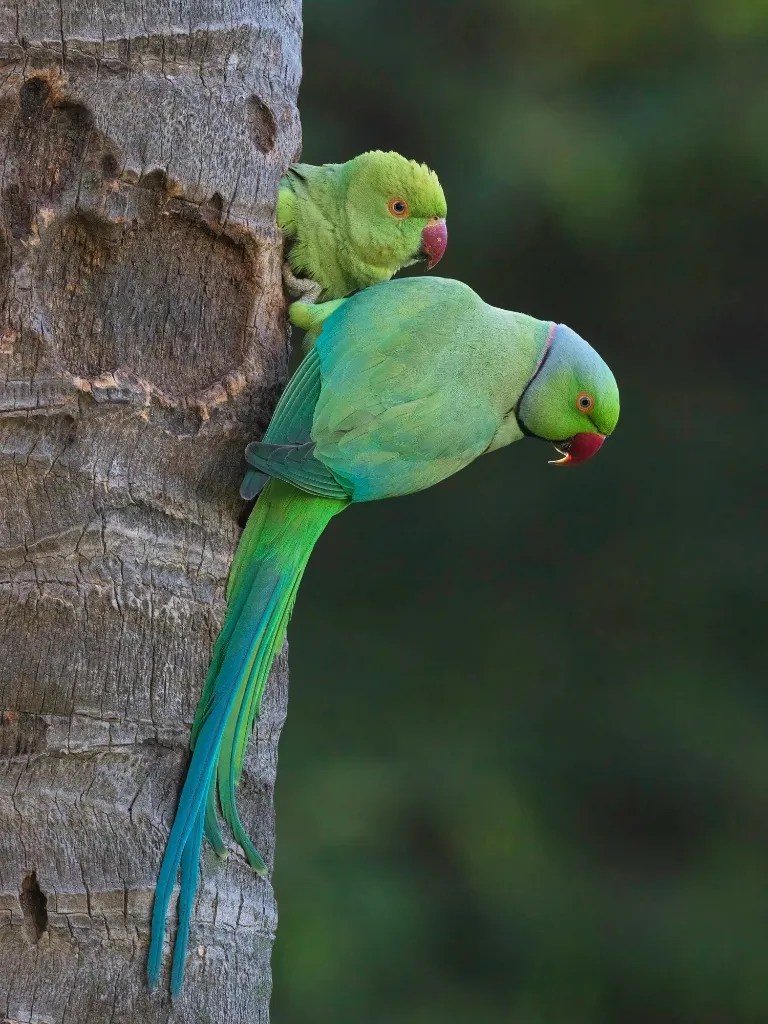
This pair of Rose-ringed Parakeets have occupied a nest hole vacated by a barbet
Image Credits: Saravana S

Woodpeckers and barbets are the builders of the woodland. They have a knack for seeking out the ideal nesting sites. Woodpeckers are often seen clambering up and down the length of a branch, probing intently for chinks in the tree’s armour. Tapping and drumming against the bark, they listen for the sound the wood makes. A hollow echo may be the cavity made by a burrowing beetle larva. The bird’s probing bill morphs into a power tool. In goes the drill, boring through the bark to get at the morsel. In due course, some of these excavations result in permanent hollows, offering an access point for moisture and fungal growth. The tree may fight back, but repeated attacks leave it vulnerable. On live trees, wounds may heal and scar over time, but in dead trees, they present opportunities to be exploited.

A male Oriental Magpie-Robin explores a nest-hole in a dead tree
Image Credits: Bijoy Venugopal

At Saul Kere, Black-rumped Flamebacks and White-naped Woodpeckers have been observed on occasion, but it is the White-cheeked Barbets and their smaller cousins, the Coppersmith Barbets, that are the most prolific builders. Over time, the holes they make in the deadwood are taken over by Rose-ringed Parakeets, Oriental Magpie-Robins, Common Mynas and Jungle Mynas. Dead coconut palms, beheaded by lightning strikes or disease, offer attractive short-term co-living accommodations. The hollowed-out core of the palm allows for multiple apartments with separate entrances and often, shared common areas. Privacy may be a concern, but good behaviour and tolerance are essential for coexistence. We have observed parakeets and barbets coexisting quite harmoniously with large families of Spotted Owlets.

Rose-ringed Parakeet on a dead tree, tidying up a claimed nest hole.
Image credits: Saravana S

Hoopoes, White-throated kingfishers, Spotted Doves and Green Bee-eaters favour the bare branches as perches. Sometimes, the odd Shikra or Oriental Honey-Buzzard can be seen in the woodland, scanning the surroundings while perched atop a dead tree stump. 

Eventually, completely eviscerated and eaten out hollow by termites and other insects, the trees collapse. The space they vacate in the woodland is occupied over time by shrubs and grasses, even other saplings. The remnants nourish the soil, creating fertile beds for wind-blown seeds to plunge roots. From death, the forest springs to life.

In late March, before the second wave of the pandemic drove us indoors, I stood in the woodland at Saul Kere, watching a pair of parakeets engaged in studious home inspection. They had picked out the used nest of a White-cheeked Barbet, which had raised a brood recently. Patiently, and with great diligence, they scoured out the hole and took out the previous occupants’ garbage. This went on for hours, even days, and eventually the pair moved in to raise their own brood.

Green Bee-eaters favour open perches on dead trees as they offer little obstruction while making sallying flights to capture insect prey
Image Credits: Bijoy Venugopal

As I watched them, ignoring the squabbling Jungle Mynas behind me, a party of green bee-eaters sailed through the air like oversize butterflies and alighted on the deadest, barest bough, trilling the very words that were music to my ears: Tree-tree-tree-tree

Feature image credits: Saravana S

This article first appeared in the Green Ogre India and has been republished with their permission. You can see more of their work here.