Categories
Issue 19

India Art Fair 2022: Director Jaya Asokan On What to Expect This Year

The India Art Fair is the leading platform to discover modern and contemporary art in South Asia. In anticipation of its upcoming 13th edition – taking place in New Delhi from 28 April till 1 May 2022 – Jaidev Pant has an insightful conversation with Jaya Asokan, the Fair Director.

_

The India Art Fair has become a trademark exhibition for modern art, with people from all over the country looking forward to the event. What can one expect this year? What should audiences watch out for?

The upcoming edition of the India Art Fair will be first and foremost a celebration of the strength and resilience of artists from India and South Asia. From the monumental fair facade being designed by the young Indian artist Anshuka Mahapatra, our pick from an open call we led in partnership with The Gujral Foundation, to a long and diverse list of names being shown within our exhibition halls for the first time, the aim is to give a platform to new talent and to present the bright future of South Asian art. 

Along with the stellar list of 60+ galleries from India and abroad presenting at the fair, an exciting new dimension of this year’s fair will be the unprecedented number of non-profit art institutions, museums and artist collectives. From a large-scale mural celebrating gender and creative expression by Bangalore based transartist collective Aravani Art Project supported by Saffronart Foundation, spotlighting grant-winning projects of Serendipity Art Foundation and Space 118 to incredible presentations by legacy arts organizations such as the Kiran Nadar Museum of Art, Kochi Muziris Biennale, Chennai Photo Biennale and many others, we hope we bring the crucial work being done at the grassroots level in India into focus.

At the same time, we will have an eye to the region’s rich art history, with a newly revamped ‘Platform’ section being led by curator Amit Kumar Jain, and including a selection of masterpieces of Indian living traditions, including Madhubani paintings, primitive bhuta masks and bronze sculptures. We believe in the dynamic cultural scene of India today, the binary classification of folk and contemporary art simply does not hold, and we are pushing to place both at a level playing field.

You can also expect to see important and iconic works by India’s most loved modernist artists from Amrita Sher-Gil to M.F. Husain –– a perfect gateway into understanding and appreciating our art history. At the same time, our public programme of talks, performances, outdoor art projects and artist-led workshops will show off the contemporary voices and presentations, giving audiences an opportunity to participate and take a closer look at the variety of works on display. 

Do you think the rise of NFTs and technology in art has changed what kind of art and artists sell in the market? Will the fair be incorporating the NFT currency or conversations around it in any form? 

The fair is a place to reflect on and give shape to contemporary art world trends. For the 2022 edition, we have invited Terrain.art, a pioneer in this field in India, to present digital and NFT works by young Indian artists like Amrit Pal Singh, Khyati Trehan and Laya Mathikshara in a dedicated space at the fair. We will also have a talk around NFTs through which we hope to shed some light on the blockchain model and how artists are using it. 

I feel modes of circulating and selling art are always changing, and whether it is art that goes through traditional routes or NFTs, ultimately the story and work put into the piece will always be most important, along with the community of people it inspires. We are looking to NFTs as an exciting possibility, the full potential of which has not yet been fully explored, and are keen to lead the discussion in this space. 

Do you think with the pandemic and the consequent shift to mostly virtual art exhibitions and viewings, more diverse audiences are becoming interested in the art world? Or has the digital divide in India further limited who can access art-related events? 

For sure! Digital has allowed art to flourish beyond the big cities, where most galleries are located, as well as become an important means for both collectors and creatives to discover and follow the works and careers of their favourite artists. Although it can never fairly replace seeing and experiencing art in flesh and in person, the power and potential of the online cannot be understated.

Social media especially has become a major medium for sharing and consuming art, and from a market perspective too, it’s having an incredible impact on the art world. Art can be shared, admired and bought all on a smartphone. In very concrete terms, the result is that we are seeing millennials and young buyers buying art online and on social media, without ever having to visit a physical gallery, art fair or auction house.

Galleries have been quick to jump on board too and are using social media and other digital platforms to expand their presence, publish prices and increase exposure for their artists. And both galleries and artists are seeing a growth in art transactions originating online, even among their more traditional “offline buyers”.

I also see digital spaces and communication as an opportunity for knowledge sharing and cross-boundary collaboration. In fact, we recently held a fully virtual international symposium on the future of South Asian art titled ‘Staging the Contemporary’ with Ishara Art Foundation in Dubai, with tremendous results. Artists and practitioners from all across the region from Mizoram and Assam, Delhi, Colombo, Karachi and Kabul were able to come together with a global audience — a feat that is only possible online.

As per you, what kind of art is more popular in the country currently? Are people gravitating towards more traditional artworks and artists or has the modern art space with emerging artists taken over the scene?

Even though there is an active and growing interest in digital art, photography, performance art and so on, the buying we are seeing currently largely remains in the domain of more traditional art forms like painting, prints and sculpture. The fair is the perfect place to discover art, across a range of mediums, styles and price points. Wherever possible, we attempt to push these boundaries and bring in new visions of what art can be to our audiences.

What vision do you have for the Art Fair 5 years from now? Where do you think the art world will be in terms of artists, gallery owners, and consumers?

India’s art market is dynamic with strong domestic demand. The market has been resilient and the pandemic year sales recorded an increase of 57% from the previous fiscal year sales of ₹560 crore / US$ 75 million. 

We’ve seen greater collaboration and curiosity amongst art world players to learn, experiment and adapt to changing audience needs, whether it’s galleries coming together under collaborative digital efforts such as South-South, InTouch and TAP India to sell works, or engaging local audiences under Mumbai Gallery Weekend and Delhi Contemporary Art Week. Auction houses have upped their digital games and artists too, with online sales initiatives such as Art Chain India, and supporting each other through the challenging times. 

As a fair, we are striving to take this upward trajectory further, in terms of continuously bringing not just fresh new artists but also nurturing new and young collectors. The art world can be daunting and opaque, and a big aim of the fair is to open access, whether through the strength of our editorial and social media voice or year-round programming to give local and international audiences an insight into India’s dynamic arts scene. 

Moreover, the boundaries of art are certainly blurring, and we welcome it. A big aim for the future is to build more and more bridges with other creative fields such as design, fashion and architecture — continuously welcoming people into the world of visual art from neighbouring territories and renewing our idea of what art can be. 

Finally, I believe the future of art will be incredibly diverse. I really hope we’re able to broaden our horizons and champion artists across different backgrounds, genders, age groups and abilities. 

Jaya Asokan is Fair Director at India Art Fair, where she is responsible for the strategic and curatorial enhancement of the fair, and increasing its footprint in India and internationally. Bringing over 20 years of experience in numerous creative industries including arts, culture, design, fashion and luxury, Jaya has played an important role in repositioning the fair whilst spearheading international gallery and institutional participation along with overseeing the partnerships and production.

We publish all articles under a Creative Commons Attribution-NoDerivatives license. This means any news organisation, blog, website, newspaper or newsletter can republish our pieces for free, provided they attribute the original source (OpenAxis).
Categories
Issue 19

Another Decade, Another Drama: The Crown’s Controversies

6th February 1952, a woman was vacationing peacefully in Kenya with her husband, free from worldly stress. However, peace and her job never went hand-in-hand, and from that day her long-distance relationship with peace was going to get even more distant. Her father, incumbent to the top office, had died. This young woman had no idea that her dearest father never woke from his sleep until her husband, The Duke of Edinburgh, broke the news to her. She became leader of multiple nations and peoples overnight and in that capacity Her Majesty swore to her job– ‘till death do us part’. 

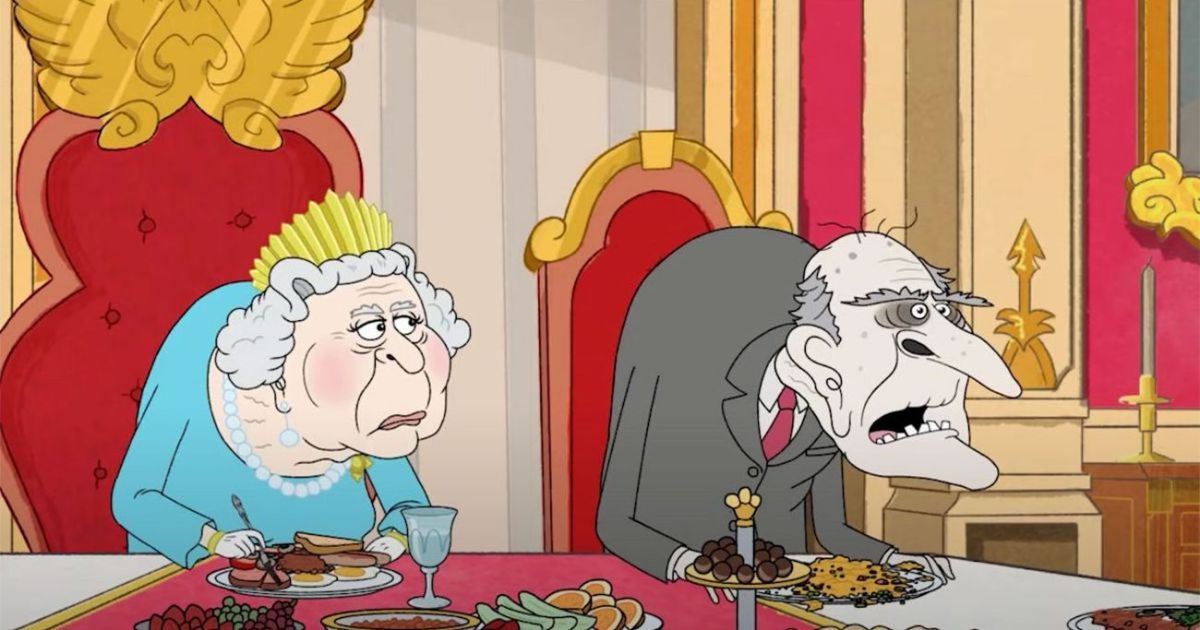
It has been 70 years since British people have been singing “God Save The Queen”. At 96, Her Majesty has become the longest-reigning British monarch and longest-reigning female monarch in history. Her reign of exceptional growth and development was, however, not free from drama. Who knew even the title of The Queen cannot save you from all this drama, here’s to you a compilation of seven controversies that Our Good Gracious Queen had to endure.

  1. Sister Issues

A lovely, young, and charismatic woman with an excellent sense of humour, HRH The Princess Margaret was absolutely devastated by the death of her dearest father. Life, however, had planned more losses than the young royal would have expected. Her Royal Highness fell in love with Group Captain Peter Townsend shortly after her father’s death, and their affair became public when the princess was seen picking fluff off his coat at her sister’s coronation. Falling in love was not her sin – being a royal was. Peter Townsend was already married to Cecil Rosemary and had filed for a divorce due to her infidelity. The Church of England (The Queen heads the church) strictly prohibited marrying a divorcee. (Sounds like Romeo Juliet, doesn’t it?) Prime Minister Churchill refused to allow the marriage, but the public was in favour and The Queen squished in between. In the end, she was unable to give her blessing and Townsend was positioned in Brussels. Their affair and his banishment made headlines and later caused an amendment in a constitutional article. (A tad more dramatic than Shakespeare, I guess)

  1. When she broke her silence

A finger on your lips is not a punishment but The Queen’s governing principle. Constitutionally, she cannot issue any public political statement. EVER. As a compliant human, she never broke her law. That is until she found a woman who nudged her to break her unbreakable vow — Margaret Thatcher. An exceptionally strong, opinionated, and powerful Prime Minister, she always did what she wanted to do. During the Apartheid Regime in South Africa, the entire Commonwealth agreed to impose sanctions in order to put an end to this inhumanity. Forty-eight countries signed, however, one did not. Guess who? The UK. Baroness Thatcher downright refused to sign any kind of sanction that was against Britain’s economic interests, and the rift caused The Queen to say something she may still regret. Sunday Times published that her majesty believes Thatcher to be “unkind, uncaring”, and that “she was dismayed by her behaviour.” Margaret was furious with the statement and its publication and the palace apologised.

  1. Son gone rogue

Adultery– The church condemns it. The opinion of the Head of the Church is not too difficult to conclude, she condemns it as well. Children, however, usually end up doing what their parents despise the most. Royal children are no different. Charles, The Prince of Wales, never moved on from Camilla Parker-Bowles (née Shand). He admitted to the public about his affair and brought the much needed public disapproval his family needed. This is common knowledge, but what many do not know is that The Boss already knew what her son is up to. According to sources, one of her employees told her about her son’s affair with the wife of a brother officer. The Queen later admitted to Princess Diana that “He is hopeless” (Ouch) so we do know her opinion on infidelity after all. The public acceptance of the affair and the queen’s not so altruistic behaviour brought a lot of negativity for the family.

  1. Diana

Need I say more? The name is itself legendary. Her Royal Highness The Princess of Wales, colloquially, Princess Diana, is a woman who cannot be justified in words. Diana, the people’s princess, was a gift to the public. She was a soft corner among the harsh-cold royalty, the showstopper– but also a trouble-maker. “I follow from the heart” were Diana’s words on her work and actions. Her heart, however, was usually at odds with the royal protocols and the rules of the institution. From writing her own vows to putting family before duty, the beloved princess was a royal rebel. Her fashion and clothing always had some hidden message from the black sheep sweater to the iconic revenge dress. The biggest turmoil on her ledger comes from the famous 1995 interview she gave to Martin Bashir, where she said, “We are three in this marriage, so it’s a little crowded.” The Royal Family’s mistreatment and her death painted the institution in black, forever.

  1. Keeping Up with The Kueen

Long before Keeping Up with The Kardashians aired, Prince Philip hired BBC to create a documentary on how “hard” the family works to keep their dying reputation from crossing to the other side. Cameras were installed, the palace was cleaned and the royals were called. The film emerged as a commercial success in terms of the number of views but was criticised heavily. David Attenborough said the documentary was “killing the monarchy”. The Queen ultimately banned the documentary and it never saw the light of day again. Recently it was leaked on YouTube, however was quickly pulled off. HRH The Princess Royal once said, “I never liked the idea of the royal family film. I always thought it was a rotten idea.” 

  1. The American Influence

May 2018, a fairytale event took place at St. George’s Chapel, Windsor Castle. His Royal Highness Prince Harry married Rachel Meghan Markle, and everything seemed picture-perfect. Though, as they say, too much of anything is hazardous, and too much perfection brought its own fair share of imperfections. The British Media was after Meghan’s life, her colour, moves, words – everything was criticised. History was repeating itself. Prince Harry always blamed the paparazzi and media for his mother’s death, and now his wife was being targeted. The lack of support from his family, images of Diana’s death, and continued molestation by tabloids, ultimately pushed the prince away. They broke precedent, and Prince Harry and Meghan left the family. The decision shook the institution to its core, with The Queen and The Prince of Wales caught off-guard. Additionally, The Oprah Interview became a major cause of trouble for the family, where the Royals faced allegations of racism and of not showing enough support– the latter of which was also a matter in the case of Princess Diana. The Royal Family was put on a public trial after the interview, receiving mixed remarks and judgements.

  1. His Royal Highness Prince Andrew

Virginia Gruffe is a name that Queen Elizabeth will not forget in her lifetime. An American national who was once allegedly assaulted and lent out to powerful men by hedge fund manager Jeffery Epstein, has put forward her charges against His Royal Highness Prince Andrew. Andrew, a friend of Epstein, has been charged with sexually assaulting the woman (as a minor) when she was “lent out” to him by Epstein. Though Andrew denies such allegations, The Queen has withdrawn all of his military and royal titles till the battle prevails. Earlier, he voluntarily stepped down from all his royal duties but the evolving nature of the criminal charges forced the monarchy to withdraw all kinds of support. Andrew might be guilty or not but his actions have caused enough damage to the reputation of the institution and earned him the title of a private citizen. The case got settled on February 15 2022, with Prince Andrew praising Virginia for her bravery.

Lakshya Sharma is a first year undergraduate student at Ashoka University. He is an economics and media studies student. Apart from his academic interests, he has keen interest in writing and fashion.

Picture Credits: Daily Star

We publish all articles under a Creative Commons Attribution-Noderivatives license. This means any news organisation, blog, website, newspaper or newsletter can republish our pieces for free, provided they attribute the original source (OpenAxis).
Categories
Issue 19

Employ and Empower: Upskilling Homemakers in India

Females in India aged six and above spend nearly seven hours a day on household chores while men contribute a measly three. The findings of a 2019 survey highlight the crucial role that 160 million homemakers play in the well-being of their households. Post-pandemic, only 7% of men lost their jobs as compared to 47% women, a significantly larger chunk. Predictions that fewer women will return to work, while employment levels for men will recover to pre-pandemic levels make such statistics jarring. 

Interestingly, homemakers from various backgrounds have begun transforming their vast skillsets into potential businesses to help their families financially. From providing tiffin services in Patiala, selling candles in Chandigarh, and designing macrame wall hangings in Mumbai, homemakers are setting up an assortment of businesses. Their success is aided by Instagram and other platforms that are actively promoting small businesses. 

Government policy has begun to recognize homemakers as a part of the workforce and as significant contributors to the national economy. Homemakers are being promised financial tools to venture into the sphere of small businesses with notional incomes in compensation-related cases, and sums of money from political leaders as an attempt to recognize their daily work and encourage entrepreneurship. 

However, in an age where online education on platforms such as Coursera and Indian portal Swayam aim to equip individuals with diverse skills, is providing homemakers with kitchen-based business opportunities and interest-free loans enough? Or is there a need for digital upskilling to exercise these opportunities? 

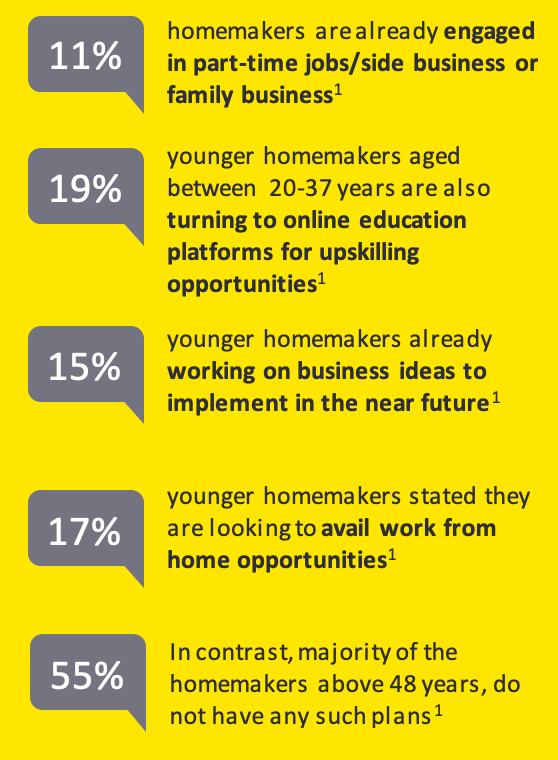
As per a recent study assessing the lives of homemakers from Tier-1 cities, 19% of homemakers aged between 20-37 years frequently take up online courses to upskill themselves, while around 15% are in the process of ideating and developing their business strategies. However, 55% of the homemakers aged 48 and above showed no noteworthy interest in starting businesses. 

Source: Ernst and Young

Therefore, policymakers might benefit from exploring schemes that upskill younger homemakers in urban India with the requisite digital skills. Such skills, which complement the financial assistance offered by government interventions will allow homemakers to launch and expand their small businesses. 

While the results of the aforementioned study were largely limited to homemakers in Tier-1 cities, various non-profit organizations are working towards imbibing digital skills among homemakers in rural India. For example, the Mann Deshi Foundation seeks to empower female entrepreneurs in the rural areas of Maharashtra and Karnataka. The organization aims to provide female micro-entrepreneurs with an enhanced skill set via courses in financial and digital literacy, agri-business training, basic computer programming, and other vocational skills, to successfully set up their businesses. 

The foundation also uses a community radio in these areas to spread awareness of schemes launched by the government to promote entrepreneurship among women. This is particularly important given that only 1% of women participate in government schemes due to reduced awareness. 

While several schemes have been launched by the government to promote entrepreneurship in the country, hardly any focus particularly on upskilling homemakers. Some exceptions like the Credit Linked Capital Subsidy Scheme (CLCSS), which aims to improve technology and mechanization in small-scale industries like coir and khadi production give preference to women entrepreneurs. Even though an upgradation in technology is a welcome step towards the introduction of modern skillsets, it cannot be equated with digital upskilling. 

The 2022-23 Union Budget saw no mention of the CLCSS, and technology upgradation saw a massive slash of 75%. Contrarily, there was an overall increase in the allotment for MSMEs. This suggests a unidimensional approach to the expansion of local small businesses, which promotes the growth of the local economy without introducing any schemes specifically for women and homemakers, who face additional domestic and societal challenges.

A large number of sectors in the economy remain heavily weighted against the employment of women. This was most recently exemplified by the State Bank of India’s (SBI) circular preventing women pregnant for more than 3-months from taking up jobs in the public bank until after delivery. In such scenarios, small businesses run from home provide some respite. However, in a primarily digital world with facilities like online banking and transactions essential to running businesses, homemakers must be provided skill development in digital services that can uplift them to professionals. Though such initiatives cannot completely eradicate the gender gap in the economy, it is a promising step towards achieving some semblance of economic equality. 

Despite some progress in this sphere, social and domestic constraints surrounding homemakers remain a harsh reality in India. As of 2018, only nine countries in the world, including Syria and Iraq, have a lower working population of women than India, with most homemakers primarily running households. India’s Female Labour Force Participation Rate (FLFPR) fell to 16.1% in 2020 from an earlier 20.5% in 2019. The pandemic was a significant contributor to the decline in the FLFPR, particularly with an increase in household duties for women. In 2020, 43% of female small-business owners in urban areas reported a drop in productivity because of household distractions, as per a report by Bain and Company. 

The central government has launched various initiatives to aid the economic recovery and growth of MSMEs in India, such as the Emergency Credit Line Guarantee Scheme (ECLGS). This scheme enables small and medium business owners to extend emergency credit facilities with banks to stabilize their businesses post covid-induced lockdowns. 

What remains missing from a majority of such schemes is a recognition of the additional burden of the family and household duties that homemakers face. Not just homemakers, even general schemes to specifically assist women-led business remain absent. This highlights a prominent gap in policymaking since almost 73% of female-owned enterprises were negatively affected by the pandemic, and 20% are on the verge of shutting down, as per the same report. Thus, recognition of this uniquely female experience might prove to be useful in future policies aimed towards upskilling. 

Jaidev Pant is a third-year student of Psychology and Media at Ashoka University. He is interested in popular culture and its intersections with politics, gender, and behavior.

Picture Credits: Mexy Xavier

We publish all articles under a Creative Commons Attribution-Noderivatives license. This means any news organisation, blog, website, newspaper or newsletter can republish our pieces for free, provided they attribute the original source (OpenAxis).

Categories
Issue 19

Issue XIX: Editor’s Note

As the world recovers from a bruised way of living that a two-year-long pandemic and multiple lockdowns had inflicted upon us, humanity looks for respite. We turn towards our loved ones, we turn towards our communities, and we turn towards art. With art as a symbol of our perspective – one that has been forever altered due to the pandemic – we aspire for art to re-assume the position of being our reference points. Art structures our emotions, passions, and breathes life into our imaginations. Perhaps, it is this characteristic of art that gives it so many forms. Some find art in a canvas, an Instagram feed, or even in a five-letter word. For others, art is found in institutional boundaries, while some find it on the street walls outside those very institutions. However, even with the fervour by which it is created and shared, art still remains vulnerable. It can be destroyed, taken away, or even influenced by politics and power. It is this complexity, the tranquillity and the chaos, that the 19th issue of Open Axis aims to explore.

Artist, academic, and researcher Vishnupriya Rajgarhia lyrically writes “Art is personal, the personal is political, they are social and to most ephemeral” about the birth of the contemporary art world, travelling from the ruins of the Soviet Union to modern art galleries in Central Asia.

In remembrance of the late Lata Mangeshkar, Ashwini Deshpande, an avid listener of Hindi film music, traces the queen of melody’s life through her music, her excellence, and persona that united India across divides.

A legal challenge to marital rape laws has opened up conversations around consent around the country. Shreyashi Sharma explores what our laws on rape actually say and whether they are enough to protect women and their rights.

Debayan Gupta, whose primary interests lie in secure computation and privacy, writes on the controversy surrounding Pegasus and why the public has to be as watchful as governments.

Shree Bhattacharyya dissects the addiction behind Wordle, the word-play game that has become a viral phenomenon in a matter of months.

The India Art Fair has become a trademark exhibition for modern art, with people from all over the country looking forward to the event. In conversation with Open Axis, Jaya Asoka, the director of the India Art Fair 2022, tells us about what one can expect from this year’s rendition.

In a day and age where every entity has an online presence, Jaidev Pant questions whether India is missing an opportunity to upskill its homemakers to run their own businesses.

Meanwhile, Lakshya Sharma goes back to the past and counts down the most riveting controversies for the seven decades that Queen Elizabeth II has been a monarch.

Arunava Sinha, a translator and a professor of Creative Writing, explains the forces behind Amazon’s decision to shut down Westland publishing while examining the larger implications this has on the English language trade publishing business in India.

Influencers impact every aspect of our life, especially on social media. In conversation with two Indian influencers, Lakshya Sharma explores what it means to be an influencer, how it ties into one’s identity, and the impact it has on the world.

Coming to art in the digital world where the definition of what constitutes art is driven by ‘likes’ and ‘shares’ versus technique and skill, Maahira Jain talks about the boons and banes of social media in the art world and the ongoing sanitisation of art.

– Reya Daya, Shree Bhattacharyya, Rutuparna Deshpande & Biblop Kumar Das

Illustrator of cover image: Rutuparna Deshpande

Categories
Issue 19

From Strolling to Scrolling through Galleries: How Has the Art World Changed?

According to a 2021 survey, social media users form 57% of the world’s population. Over the last decade, art and culture on social media have journeyed through several aesthetics and ideals. A canvas has been replaced by a screen, a paintbrush by a smartpen and the intricacies of brushstrokes and handmade forms are waning. User-generated content has become the primary focus. Artists’ styles are fueled by the need to please the audience, as what appeals to them is what will get noticed. Appreciation is now marked by ‘likes’ and ‘shares’ versus technique and skill. 

These broadened digital platforms gave birth to new genres, like experiential art where the piece relies on its ability to be captured by a phone and deemed Instagram worthy. Success is measured by reposts, comments and the audience’s ability to repurpose a piece for their personal social media, falling prey to a consumer-oriented approach. Yayoi Kusama, pioneering Instagram art sensation, has developed several such immersive experiences, attracting global audiences. While such installations have been a huge success worldwide, with millions of trending hashtags, are they only working to fit consumer ideals and seek engagement ? Can Yayoi Kusama’s ‘Infinity Mirror’ rooms be compared to Da Vinci’s ‘The Last Supper’? Are his immersive pieces mere attempts to appease the masses?

A recent study traces through these shifts in art spaces, audiences and aesthetics, where researchers Lachlan Macdowall and Kylie Budge say: 

Instagram shifts the spaces, scale, speed, and terms of visual culture. It generates new terms (#instaframe) and forms (the selfie) and creates and organizes new audiences. Overall, Instagram affects the institutions of the art world.” 

The boons and banes of social media in the art world are a tipping scale, the unspoken impact of which remains in the nature of creating and experiencing art. The limitations of Instagram’s square grid, curated exposure through algorithms, and repetitive styles restrict accessibility and dilute creativity. Artists design pieces to fit the 1:1 dimensions of an Instagram post, using it as a basis to create, consequently limiting the scope of their ideas. In fact, consumers are only shown what an algorithm chooses to expose them to, based on their previous engagement. This limited exposure tempts artists to design within a niche aesthetic, which receives the most views, giving way to monotony.

While the media has given people an equal and accessible medium to engage with art, the digital divides remain. Boosting posts on Instagram requires significant payments, while promotion and management are now the job and expense of the artist. They are required to spend anything between a few hundred to forty thousand rupees daily to promote each post for a menial financial return, making it a luxury only some can afford. In fact, with the increasing need to create and market art digitally by using technological tools like Apple Procreate and other software, is the art industry still retaining its “elitist” roots? 

Increased accessibility also enabled the commercialisation of art, and an entrepreneurial mindset among artists who now sell and commission artwork for brands in advertising and marketing gigs, making them more of a commodity than before. Social media feeds act as portfolios, thus putting a tremendous emphasis on not merely the physical piece but its social media appearance.

Social media has been taking the art world by storm for over a decade now. NFTs  (non-fungible tokens) however, made their mark in 2021 with sales valued at approximately 25 billion.  In several instances, artists have been hesitant to upload artwork online due to a lack of protection against piracy, theft and copyrights. NFTs by providing bonds of authenticity acts as a solution but is now being wrongly equated with art. 

Everything ranging from a tweet to a selfie to a hand-painted canvas is sold for millions of dollars. Everyone is a creator, right from your next-door neighbour who posts pictures of her cat every day to a famous artist uploading their painting. The exclusivity of art has been overshadowed by the agency of online media.

Social media and NFTs together have created a clutter of content online, with no filters or screening system but much rather an abundance. This commodification has undermined the uniqueness and scarcity of creations, stealing away the very roots of purchase; demand.  

This begs the question- why will a consumer pay millions of dollars to purchase a piece of art, which can be downloaded, shared or printed for free? 

The rising hype around NFTs only increases the impending threat on physical artwork. Pushing the boundaries of artistic trade, they continue to endanger museums and galleries. While sceptics have held their ground, globally NFTs have snuck their way into auctions, art fairs and online marketplaces including social media. 

NFTs continue to sanitize and hamper the creativity and aesthetics of art. Auctions like the Gobardhan Ash collection in Prinseps Mumbai sold both physical and blockchain versions of pieces. Celebrities like Amitabh Bachchan have launched collections, businessmen have created NFT exclusive marketplaces like Wazirx all furthering the extinction of natural art forms. NFTs cater to consumers’ laziness, and the growing demand for online retail by providing an easy way to purchase assets like art, without the need for storage.
Social media and NFTs align on their agenda of agency and access of art to all. Platforms like Twitter have allowed NFTs as profile pictures, Youtube distributed them to key influencers and Reddit is in the process of doing the same. Artists have eagerly joined the NFT craze adopting a commercial lens towards art. Higher rates of return and surety of financial gains have caught artists attention. The slowly fading presence of innovation-driven artwork will accelerate once social media platforms also start selling NFTs, reducing them to mere means of monetary gain and not displays of unique talent.

Maahira Jain is a third-year student at Ashoka University studying Psychology and Media studies. She is a movie buff and is extremely passionate about writing and travelling.

Picture Credit: Unsplash

We publish all articles under a Creative Commons Attribution-NoDerivatives license. This means any news organisation, blog, website, newspaper or newsletter can republish our pieces for free, provided they attribute the original source (OpenAxis).