Categories
Issue 18

Harvesting a Vote Bank

As the states of Punjab and Uttar Pradesh gear up for their respective state elections, political parties are making several promises to the farmers of the two states. The looming shadow of the year-long farmer’s agitation that ended in November 2021 with the repeal of the three farm laws has made its mark, as political parties have taken resurgent interest in farmer’s issues. In Punjab, farmers’ unions who were part of the agitation have created their own political party, Samyukt Samaj Morcha (SSM) to contest the state elections. Meanwhile, in Uttar Pradesh, Bharatiya Kisan Union leader Rakesh Tikait has sustained his campaign against the ruling Bharatiya Janata Party in the face of the elections.

Amidst the debate and the rhetoric around farmer’s issues, we take a look into the promises made for the farmers by the main contenders in the upcoming elections of UP and Punjab. 

In Uttar Pradesh, the ruling Bhartiya Janata Party (BJP) is primarily banking on agricultural schemes and decisions it had already implemented, both at the state and center to campaign among the farmers. Sugarcane prices have been a contentious issue in Uttar Pradesh, especially the Western UP region where 40 lakh farmers grow sugarcane. In 2021, the UP government had increased the purchasing price of sugarcane by Rs 25 per quintal, hoping to pursue the UP farmer population. However, the opposition has not shied away from pointing out that sugar mills are yet to clear around Rs 2000 crore pending dues to farmers. 

The BJP is also campaigning on the basis of national level schemes such as the PM Kisan Nidhi instalments, which it claims has benefitted numerous farmers. On the issue of guaranteed Minimum Support Price (MSP), which emerged as one of the main demands of farmers during their year-long protest, the BJP has largely stayed silent. Overall, the party has primarily chosen to campaign on the issue of better law and order, occasionally raising issues around “Jinnah”, or “80 vs 20 elections”, in what can be seen as a way to polarise Hindu-Muslim voters. 

The alliance of the Samajwadi Party (SP) and Rashtriya Lok Dal (RLD) have emerged as the main challengers to the incumbent BJP. The alliance has opted to heavily emphasise on farmers issues throughout their campaign. In a press conference dedicated to farmers’ issues, former Chief Minister Akhilesh Yadav of SP stated that upon coming to power their government will make a law to assure MSP for every crop. 

Additionally, he also stated that his government will provide free electricity up to 300 units which will benefit the farmers immensely. The party also promised to provide free irrigation facilities for the farmers. Yadav also mentioned that a Farmers Corpus Fund and a Farmers Revolving Fund would be created to pay arrears to sugarcane farmers within 15 days of their government formation. He further stated that farmers will be granted interest free loans, while insurance and pension schemes will be implemented for their benefit. 

Another big promise that the SP-RLD alliance has made is that it will withdraw all cases filed against farmers during the year long agitation. They have promised to pay a compensation of Rs 25 lakhs to the family of each farmer who died during the protest. Additionally, they have assured to grant the status of ‘martyrs’ to the farmers who died during the protests. RLD leader Jayant Choudhury’s claim that “this is an election between ‘ganna’ (sugarcane) vs ‘Jinnah’” seems to epitomise the campaign approaches of the two main contenders in Uttar Pradesh. 

In Punjab, the state which participated most vehemently in the farmer’s agitation, the upcoming election is witnessing a tri-cornered contest. While incumbent Congress is looking to retain power, the Aam Aadmi Party (AAP), and the alliance of Shiromani Akali Dal (SAD) and Bahujan Samaj Party (BSP) are seen as the main challengers. Responsible for the supply of wheat and paddy to most of the country, the farmers of Punjab have been promised several benefits by each party. 

The Congress recently released a ‘farm model, ’ which promises to help farmers steer out of the wheat-paddy cycle by replacing paddy with diversified crops, thereby allowing beneficial returns. The party has promised the procurement of dal, oilseeds, and maize at guaranteed MSPs through state cooperatives and corporations. The party has also promised to create a parallel market intervention scheme under which the government would pay the differential between market selling price and MSP directly to the farmers. 

Similarly, the SAD-BSP alliance has also promised to introduce MSP for fruits and vegetables and pay the differential to farmers. The alliance further promised crop insurance for any damage of crops during the protests. The alliance also acknowledged the need to end the culture of over-reliance on wheat and paddy crops in the state. 

Meanwhile, the Aam Aadmi Party has promised to make farming profitable through a ‘special plan.’ While the special plan itself has not been revealed, nor a manifesto published, the AAP has made several pledges through its campaigns. The party has promised that upon forming the government farmers will be paid crop loss compensation by April 30th. The party also stated that they would facilitate the use of stubble for power, cardboard and agro-based industries, and DAP fertilisers. 

Uttar Pradesh will vote from February 10th to March 7th in seven phases, meanwhile Punjab is set to vote on 20th February in a single phase. The results will be announced on 10th March. While the election rhetoric has often tended to shift towards religious and caste based issues in both the states, the impact of the farmers protests have assured that agrarian issues are not overlooked by the parties. One can imagine the stakes for the farmers to be higher in these state elections given the backdrop of a successful farmers’ agitation and given that agriculture remains a state subject. 

Biplob Kumar Das is a Graduate Student in Ashoka University currently pursuing an Advanced Major in Political Science and a Minor in Media Studies. He completed his undergraduate degree in Political Science and takes keen interest in anything related to Indian politics. 

Picture Credits: Al Jazeera

We publish all articles under a Creative Commons Attribution-Noderivatives license. This means any news organisation, blog, website, newspaper or newsletter can republish our pieces for free, provided they attribute the original source (OpenAxis).

Categories
Issue 18

Could Home-schooling Have Saved India’s Students During COVID?

India shares a grim pedestal with Nepal and Bolivia as the country with the second-longest school closures due to the COVID-19 pandemic at a staggering 82 weeks. The justification for this measure has recently fallen out of favour with public health experts, parents and educators

Among many is the reason that online learning has exacerbated the existing education crisis of low literacy and a high drop-out rate. This is attributed to unequal access to resources like electricity and digital devices. Though alternative education models like distance learning and open schooling have existed alongside traditional schools for decades, they have not been able to offset the gaps left by online learning during the last two years. 

Under the current legal framework, the National Institute of Open Schooling (NIOS) functions as the only National Board of Education for open schooling at the pre-university level. Under NIOS, NGOs and Institutes run affiliated centres which acquire and distribute self-learning material to enrolled students. Exams are conducted at government schools twice a year or on-demand for classes III, V, VIII, X & XII, with a liberal 9 attempts allowed in 5 years. 

NIOS was set up by the Ministry of Human Resources and Development in 1989 and currently stands as the largest open schooling system in the world. Though there are multiple other ‘boards’ like the All India Council for Open Schooling which are established as educational institutions that mimic the working of a school board, they have the legal validity of a coaching centre since they are not affiliated with NIOS. 

More than 5 lakh non-traditional learners depend upon NIOS for getting their recognised passing certificates that are required to get admission into higher education. This group includes the ones disproportionately affected by the pandemic: children of migrants, those living in rural areas, and women. 

Thus, ‘home-schooling’ is an elusive concept in the formalised education culture of India. Parents cannot, by law, register themselves as their children’s educators. To gain any real economic value out of home-based education, children need to be enrolled under NIOS affiliated centres. As philosophies of homeschooling gain popularity amongst India’s urban middle-class, cases like that of Malvika Raj Joshi are bound to crop up. In 2016, the 17-year-old was given admission into the Massachusetts Institute of Technology (MIT) after being rejected by IITs since she did not have a formal Class X or XII qualification. Malvika’s mother had pulled her out of school when she was 13 and had set up a learning environment at home.  MIT based her admission and a scholarship on 3 medals at the prestigious International Informatics Olympiad.

For the urban poor and the rural children in India, access to other types of merit certifications like an International Olympiad are far from the realm of possibility. According to the Annual Status of Education Report (ASER) 2021, the proportion of children not enrolled in schools in rural India grew from 2.5% in 2018 to 4.6% in 2021. A survey by the Brookings Institution among children in Chennai revealed that a fifth of the children surveyed were enrolled in schools that did not offer remote learning facilities. Without access to basic schooling, external examinations remain a far-fetched luxury. 

A caveat to this data is that enrollment does not imply education. A study conducted by the Azim Premji Foundation last year found that about 60% of India’s children do not have access to digital learning tools. 

A natural answer to this digital divide in education could have been open learning platforms under the NIOS. Although reality treads in the other direction. According to a report by the Times of India, NIOS saw its lowest enrollment in 2021.  

A possible reason for this slump maps on to the same digital divide that has plagued traditional schools. NIOS is heavily dependent on technology to deliver its learning materials in using the radio, television or online libraries. Legislation by the government like the National Education Policy, 2020, through which a virtual open learning school was constituted last year, moves towards a digitally dependent growth of NIOS. 

At the beginning of the pandemic, the Central government had partnered with UNICEF to deliver remote learning material to students in lockdown via radio, TV, and internet-based learning. After two years of an ever evident lack of digital infrastructure, this line of policies has continued with Finance Minister Nirmala Sitharaman mentioning PM’s e-Vidya programme in her Union Budget speech to Parliament. The full potential of distance and open learning seems to be limited by the same issues that have restricted traditional schools. 

Rutuparna Deshpande is a second-year student of Politics, Philosophy and Economics at Ashoka University.

We publish all articles under a Creative Commons Attribution-Noderivatives license. This means any news organisation, blog, website, newspaper or newsletter can republish our pieces for free, provided they attribute the original source (OpenAxis).

Categories
Issue 18

‘There is as much cacophony in policy-making corridors as there is out on the streets’: Immunologist Satyajit Rath on Scientific Policymaking

In many ways, the complex interplay between fear, trust, and evidence have been the hallmarks of our collective pandemic experience. We have learnt to fear large numbers in the form of mounting cases, all the while trusting the vaccines by the way of their efficacy data. How policy-makers communicate evidence has been crucial to which impulse our attention rests at—fear or trust. 

In this insightful interview, visiting Professor of Immunology at the Indian Institute of Science Education and Research Satyajit Rath in conversation with Rutuparna Deshpande answers the perennial dilimmeas of evidence-based policymaking.

The pandemic has revealed that ‘fear’ is a powerful emotional contagion among the non-expert population. How do you think policy-makers can balance stating the facts ‘as is’ and avoiding unrealistic speculations in public opinion?

It might be useful to make three preliminary points. One is that the distinction between ‘expert’ and ‘non-expert’, commonly thought of as clear, is anything but. ‘Expertise’ is a complex landscape, and most of us have a bit of it in some area and very little in most others. Therefore, ‘experts’ speaking to the rest of us poor souls ex cathedra is more pretence than substance. And a lot if not most of the times, policy-makers are not actually ‘experts’, they are simply getting advice from semi-randomly chosen groups of people with some expertise. A second point is that fear for oneself, one way or another, is not restricted to the ‘non-experts’; so-called ‘experts’ have it quite as much, and sometimes perhaps even more. And finally, neither the category of ‘policy-makers’ nor the ‘rest of us’ are a homogeneous body; both groups vary widely in perspectives, prejudices and predilections. There is as much cacophony in policy-making corridors as there is out on the streets.

That said, the only meaningful way we have of dealing with fear is through empowerment, which comes from evidence-based, self-correcting and cautious narratives of cause and effect. For this, governing authorities need to stop pretending that they have more ‘facts’ than they do, that their ‘facts’ are more clear than they actually are, and that these ‘facts’ indicate certain policies more unequivocally than they do. This elaborate pretence has long been a norm of governance in India, and we are all aware of and accustomed to it. That is in part why we, as the governed, trust government pronouncements less that the crazed claims of random weirdos on social media. It is crucial for ‘the authorities’ to explain the strengths as well as the weaknesses of currently available evidence, to explain the ongoing efforts to fill the gaps, and to discuss both the robust and the tentative components of the resultant policies. Mature collective sharing of the current state of evidence, explanations and strategies, warts and all, is the only way to avoid falling into diverse kinds of private terror-filled frenzies.

Numbers have played a large role in how we perceive the soundness of restrictions. Do you think absolute numbers rather than relative numbers are useful in having a well-informed population?

 I think that both absolute and relative numbers matter; I think it is useful to have as many ways of looking at and thinking about evidence as possible. But there is an additional point involved here. I think we have needed much more by way of numbers than we have had. People tend to look at their local experience, and they notice the discrepancies between those local experiences and the ‘national’ or ‘state’ numbers that come up prominently in public discourse. I think that it has been important to provide local numbers, not simply of ‘cases’, but of tests done, ‘positivity rates’, numbers of people who are seriously ill, numbers of local critical care beds available and occupied, so that the gap between what people experience anecdotally and what numbers are discussed as the bases for local restrictive policies is reduced as much as possible, helping policies make sense.

Some social media users have expressed confusion over the rapidly changing guidelines and advisories by the ICMR. How can policy-makers efficiently respond to an evolving pandemic while communicating rules in a timely manner?

 In an emerging and new situation, when the evidence is still fragmentary, when interpretations are changing, and when policies do need to be changed periodically in response to better, though still provisional, understanding, these kinds of confusions are almost unavoidable. Paradoxically, acknowledging that would help more than making each iteration sound like it was written in stone.

As Omicron has surged, breakthrough infections have become increasingly common. In light of this, how do you think policy-makers can distill convincing evidence for the vaccine’s effectiveness in the Indian context?

To begin with, it must be noted that all covid vaccines have been tested for protection against serious illness, and not so much against ‘infection’ of the asymptomatic or mild-illness kind. This protection appears to be still quite robust even against the omicron strains. However, sadly, India’s vaccine effectiveness monitoring has never been particularly reliable. Despite a year-long vaccination campaign, and apparent access to large-scale evidence about who is vaccinated, who is testing positive, and who is landing up in hospital, we still do not know how well our current two vaccines have protected and are protecting against severe covid illness, whether there is a difference between them, whether they have been differently effective in mid-2021 versus early 2022, and so on. While claims, including official ones, have been made about some of these questions, the actual evidence has been scarce. It is therefore unclear if these questions can ever be clarified with reliable, substantial and large-scale numbers, though one lives in hope.

Dr. Satyajit Rath is a visiting professor of immunology at the Indian Institute of Science, Education, and Research.

We publish all articles under a Creative Commons Attribution-Noderivatives license. This means any news organisation, blog, website, newspaper or newsletter can republish our pieces for free, provided they attribute the original source (OpenAxis).

Categories
Issue 18

1 Like = 1 Vote? Election Campaigning in the Time of Social Media

The project of liberal democracy finds an unlikely candidate in independent India. The adoption of democracy in a post-colonial and economically backward state has baffled scholars for decades. There has been considerable debate over how such a form of government came about in a country that was still healing from the bruises of its colonial past. A key feature of this democratic setup was free and fair elections. Independent India held its first general elections in 1951. Over the next few decades, the nation was witness to various social movements, secessionist attempts by different states, attacks from enemies within and external to its territorial boundary.  The only constant fixture was elections. 

Much of what forms a part of the run-up to the great Indian election is roadshows, speeches among large crowds, and rallies. Be it Indira Gandhi’s famous Garibi Hatao campaigns, Rajiv Gandhi’s fatal meeting with the public in Chennai, or Atal Bihari Vajpayee’s memorable speeches, interactions with the public have been at the core of campaigning in India. However, with the arrival of the Bharatiya Janata Party as the contender for the general elections in 2014, social media became the buzzword. The horrors of UPA 2 had turned the public opinion against them. In a term marred by scams, corruption, and the horrific handling of the Nirbhaya case, it was evident that the Congress government had been brought down to its knees. The BJP capitalized on this anti-government sentiment and launched widespread multimedia and social media campaigns. These advertisements used references from popular movies and television shows to grab the attention of younger voters. The BJP eventually went on to win the election and was elected for the second time in 2019.

Post-2019 their social media presence increased exponentially. The infamous IT cell of the BJP was involved in numerous online campaigns against dissenters. The BJP has arguably benefited from the social media boom in India. Prime Minister Modi himself garnered around 46.6 million followers on Twitter. The party has created many pages about their candidates and campaigns across multiple social media platforms, designed to target individuals between the ages of 18-30.

The manner in which social media has helped political parties in micro-targeting voters is particularly interesting. After the pandemic hit India, rallies, and roadshows had to be significantly restricted. As a result, parties turned to various forms of media for the dissemination of information. During my work with the Trivedi Center for Political Data, I worked on a project that dealt with social media usage by political parties. It focussed on annotations of political ads from the Facebook ad library. My work involved meticulously combing through around 2500 advertisements by various political parties and categorizing them according to their content, target audience, tone, and authenticity of these advertisements. I was tasked with looking into the West Bengal Assembly elections of 2021. The main parties were the BJP, the TMC, the CP(I)M, and the INC. While every election campaign is different depending upon the context and the state that is going to the polls, some trends are broadly similar in most states.

The BJP continues to rely on Narendra Modi as their “X” factor. Their state campaigns rarely mention the candidate who is actually contesting. The narrative is focused on the Modi factor. Slogans like “aapka har vote directly Modi ko jayega” have helped popularize this rhetoric,  creating the illusion that irrespective of who is contesting, the people should show their approval for Prime Minister Modi by voting for the BJP. Campaigns of regional parties like the TMC are centered around the cult of the chief minister. This has led to the creation of apps like “Didir Doot” which was launched by the TMC to help CM Mamata Bannerjee connect with the public. Along with these technological changes, parties have increasingly used pop culture references to appeal to the youth. The BJP recently launched an ad campaign against Mamata Bannerjee called “Pishi Jaao” which sounds eerily similar to the popular song Bella Ciao of Netflix’s Money Heist (2017) fame. The catchy tune is chosen to connect and target the youth as the electorate. Be it the AAP or the Shiv Sena, all parties are committed to increasing their social media presence through tweets by ministers or creating memes. A good example is the #DidYouKnow campaign  by the Shiv Sena to raise awareness before the 2017 municipal elections. Social media has also been vital in propagating the party’s ideas beyond their immediate electoral goals. It has become an easy device to discredit their opponents since it allows them methods of representation beyond just speeches. A useful manifestation of this is the misogynistic tone that characterized the BJP’s campaign in West Bengal in 2021. The fact that the opponent in question was a woman, prompted the party to attack her character and make derogatory remarks about her personal life. Male candidates are more often than not accused of corruption and inefficiency whereas women are character assassinated. This isn’t state-specific either. UP’s former Chief Minister Mayawati has also been at the receiving end of such disrespect. 

However, this is not the only way in which parties use social media. A recent investigation by The Wire revealed that the BJP was reportedly using an app called TekFog to infiltrate various social media platforms to plant stories about themselves and spread misinformation about the opposition parties. The application was used to target opposing voices. The aforementioned IT Cell has used this application to spread hateful comments about women who have spoken out against the party.  By saving private citizens’ information, it was instrumental in making hashtags that target members of marginalized communities. The Big Brother-like phenomenon should come as warning bells for a country that has already been considered as the latest case of democratic backsliding. While we mourn the gradual erosion of democracy in India, it is important to remember what George Orwell wrote in 1984, “they could spy upon you night and day, but if you kept your head, you could still outwit them. With all their cleverness, they had never mastered the secret of finding out what another human being was thinking.”


Ranjini Ghosh is an undergraduate student majoring in Political Science at Ashoka University. She is currently working with the Trivedi Center for Political Data. Her work involves categorizing and analyzing candidate data for the upcoming Goa and Manipur Assembly elections.

Picture Credits: BGSU News

We publish all articles under a Creative Commons Attribution-Noderivatives license. This means any news organisation, blog, website, newspaper or newsletter can republish our pieces for free, provided they attribute the original source (OpenAxis).
Categories
Issue 18

Keeping Up With Covid

After a brief period of coronavirus restrictions due to a surge in cases caused by the Omicron variant, England recently returned to Plan A, lifting mask-mandates and other coronavirus restrictions as its Covid-19 planning shifts towards living with the virus. “As Covid becomes endemic, we will need to replace legal requirements with advice and guidance,” Prime Minister Boris Johnson told lawmakers. His decision to allow citizens to resume daily activities stems from a successful booster dose rollout and the Omicron variant’s current nature, which drove cases up to record levels in December without increasing the number of hospitalizations and casualties in the same manner.

Several other European countries such as Portugal, Denmark, the Netherlands, and Spain have followed suit to consider public health and the effects of lockdown-like measures on the daily lives of citizens, businesses, and the economy. Whether the European blueprint can be applied to other nations, vaccination rates seem to be a decisive factor in deciding how safe it is to begin living with the virus.

After a devastating second wave in India, thousands of hospital beds were converted to ICU beds, anticipating a rise in Covid-19 cases fuelled by the omicron variant. Almost a month after the onset of the third wave, most Covid ICU beds across the country remain empty. Trends across Europe follow suit, with Omicron cases resulting in fewer hospitalizations. This begs the question – can India begin to live with the virus, and what will our new normal look like? While India’s Covid handling is commendable, the country has been able to fully vaccinate over 71 crore people, which given its large population, yields a vaccination coverage of only 51.7%. It seems unlikely that India will adopt a no-mask and no-restrictions policy anytime soon. However, with decreasing active cases and hospitalizations, the need for a shift in strategy and policy measures is evident. India’s priority at this stage should be to revive its economy and continue to strengthen its health care systems. India has shuffled between two extremes throughout the pandemic: undue panic and extreme carelessness.

There is a growing need to find a middle path – living safely with Covid, and taking into consideration the reality of how the pandemic has changed our socioeconomic fabric. Since the first Covid case was detected in India on January 27, 2020, the country faced a two-month-long national lockdown, heavy restrictions, and curbs on citizens’ mobility. With the overnight closure of the country, Indians were forced to think quickly and collectively decided to accept the new way of living, which put the power of human adaptability to test. Today, the new normal is mutating with the virus. As we repeatedly went back into lockdowns, descended from having a semblance of normalcy right back into isolation, we were forced to find a way to keep on living and adapting.

A Bengaluru-specific study found that while night and weekend curfews delayed the spread of the virus, eventually, Omicron would spread and affect the same number of people it would have without restrictions. It might be time to stop implementing lockdowns whose primary function is to avoid overwhelming health care systems. Following the decline in cases, states such as Maharashtra, Delhi, and Karnataka have begun easing restrictions with many reopening schools and colleges and adjusting curfews. India also began second dose inoculations for 15-18-year-olds on January 31, 2022 as a step to ensure a safer return to physical classrooms.

The high transmissibility of the Delta and Omicron variants has made it clear that the goal of zero-Covid is not possible without stringent public-health measures and restrictions. Civil society must collectively set new goals to facilitate a shift from pandemic to endemic. While targets to reduce the burden on healthcare systems continue to be necessary, there is a need for new metrics to be used to ascertain the goals that account for the impact of Covid-19 on the daily lives of people, such as missed workdays, closed businesses, or school absenteeism. Hospitalizations and ICU occupancies should be monitored closely, but mass testing may no longer be required.

Until India reaches 90% double vaccination coverage and protects vulnerable sections with a booster dose, preventive measures such as masking-up, maintaining social-distancing, and making use of self-testing kits will remain a part of people’s daily routines as citizens start stepping out. These will aid the government in implementing policies that enable society to start living with the virus. 

The fear of falling sick enabled the world to develop a cashless society. Being social creatures, necessity drove us online, accelerating the infrastructure for virtual interactions. College students worldwide have spent entireties of their college experiences learning on Zoom, with many even graduating virtually. This has opened up the possibilities of developing the proper infrastructure for remote learning to those unable to access education. Similarly, offices moved entirely to work from home, showing that countries can be more productive and have more meaningful work experiences working remotely rather than in-person. A study showed that 82% of employees preferred working from home rather than returning to the workplace, and hybrid work environments are here to stay. Mental health was brought to the forefront of conversations as recognized by the 2022 budget, which will boost the mental healthcare sector in India.

The need for interaction led to a virtual entertainment sector with virtual concerts, stand-up shows, and live streaming. This proves that the pandemic has caused a shift in the way businesses will function moving forward. Video calls became a way to bring people together for everything, from birthdays and weddings to funerals, allowing people never to miss a crucial moment. Covid has normalized the online behaviours of millennials and Gen-Z for all generations, assisting the transition to the metaverse that is coming our way. As our normal keeps adapting, as tricky as it has been, it is also exciting to see the many ways in which our experiences with Covid will lead to progress in innovation, infrastructure, and quality of life.

Reya Daya is a third-year student, studying psychology and media studies at Ashoka University. Her other interests include writing, photography and music.

We publish all articles under a Creative Commons Attribution-Noderivatives license. This means any news organisation, blog, website, newspaper or newsletter can republish our pieces for free, provided they attribute the original source (OpenAxis).

Categories
Issue 18

Issue XVIII: Editor’s Note

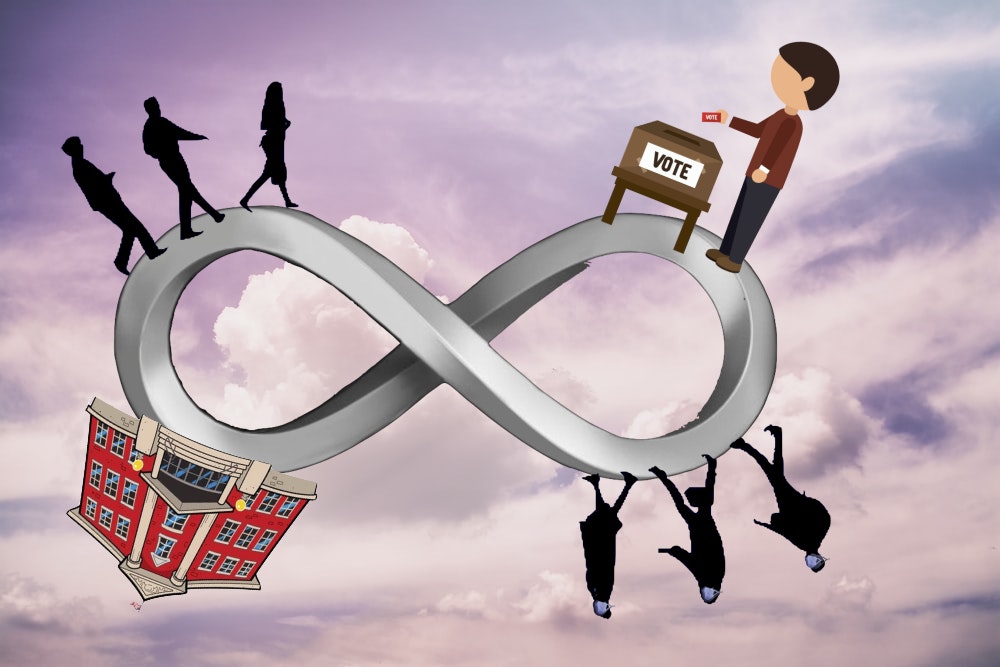
The last year has been a rollercoaster for people around the globe. One might even come close to calling it a fever dream of sorts, with some months bringing us respite and optimism about a possible covid-free future, while others had us wrapped up in blankets, back to hosting virtual Christmas parties. Three mega covid-waves later, we once again dip our toes into the outside world warily attempting to be the creatures we were in the pre-pandemic era. One can’t help but wonder if the third time will be the charm. Questions about what the new(est) normal has in store for humanity looms on the horizon, as time in today’s world seems to be marked by an endless loop of living between pandemics and finding periods of normalcy, however abnormal that may be. Reflected in our cover art, the 18th issue of Open axis reflects on the year that has been, and where the loop might take us in the coming months. 

To begin with, Reya Daya tracks global covid developments and vaccination trends, dwelling on the power of human adaptability and the need to learn to live alongside a virus that shows no signs of burgeoning. Sharing his thoughts on the pandemic and government messaging surrounding covid, immunologist Dr. Satyajit Rath gets into conversation with Open Axis on correct policy-making and mixed messaging in times of a disease outbreak. 

On the upcoming Indian assembly elections, Biplob Kumar Das writes on the promises made to the farmers by parties contesting in Uttar Pradesh and Punjab, particularly in the backdrop of a successful farmers movement. Further, Ranjini Ghosh from the Trivedi Center for Political Data analyzes the growth of social media usage in election campaigns and the implications of social media on microtargeting voters. 

Rutuparna Deshpande critically examines the homeschooling infrastructure in India and explores the consequences that homeschooling mechanisms (or lack thereof) might bring for India’s students with pandemic-induced nationwide school shutdowns. 

Reflecting on the happenings surrounding the 76th Republic Day and a resplendent parade in the capital, Ujjwala Shankar breaks down the consequences of extinguishing the eternal Amar Jawan Jyoti. Meanwhile, Adit Shankar examines India’s relationship with its constitution, a document perceived by many to be increasingly under threat. When a script for a movie surrounding a gay ex-army officer was rejected by the Defence Ministry, a nationwide uproar emerged on social media platforms. Shree Bhattacharyya reflects on this controversial rejection while exploring the complexities of gender and sexuality in the Indian Army. 

Bharatnatyam dancer, performer, and instructor Justin Mcarthy writes on the legacy left behind by the late Kathak legend Birju Maharaj. In global news, Shauryavardhan Sharma dives deep into the future of India-China relations and factors that may shape the direction of future ties. 

Finally, Founding Editor of The Wire and popular economic and political writer, M.K. Venu shares his thoughts on the latest Union Budget and the government’s big push to public investment in infrastructure. To wrap up the issue, we present a collection of some of our favorite memes on the budget. 

Through the diverse topics presented in this issue, which make up a small but significant part of today’s new normal, we hope our readers find some incentive to step out into the world again and embrace all the changes the new world brings to us. 

-Jaidev Pant, Lakshya Sharma, Maahira Jain

Picture Credits: Vartika Sharma