Categories
Issue 10

Silence of the Players: The FIFA World Cup and Human Rights in Qatar

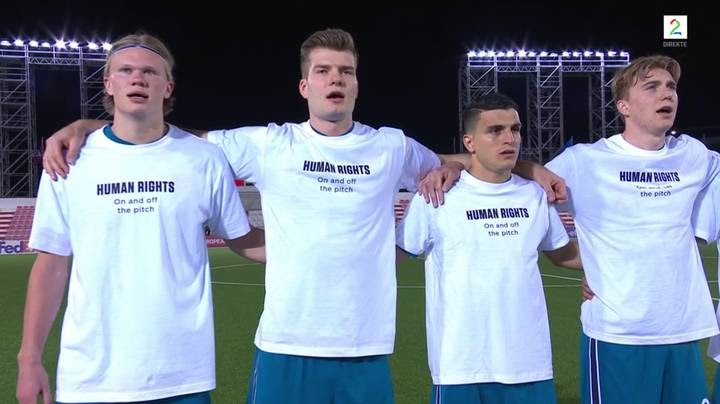
At the time of writing, there are 608 days left for the 2022 FIFA World Cup in Qatar. There was controversy even during FIFA’s initial decision to award host status to the Middle Eastern country in December 2010, and criticism has, with good reason, only grown in magnitude since then. Reports of human rights violations and migrant labourers being forced to work in atrocious conditions have received wide publicity in the lead up to the world’s biggest sporting event. Earlier this year, the Guardian estimated that more than 6500 migrant workers from India, Pakistan, Nepal, Bangladesh and Sri Lanka have died in Qatar since December 2010. Another report by Amnesty International cites several issues that many migrant labourers in Qatar are forced to confront. These include terrible living conditions, wage problems and forcible detention in the country by employers. While calls to boycott the tournament have been made by fans and clubs alike, there has been a notable lack in public statements or stands made by players participating in the tournament. Many footballers who are aware of the situation unfolding in Qatar are likely to face some degree of moral conflict or external pressure whether or not to use their reach to advocate change, or even a complete boycott. The risk of losing one’s place in the team, being restricted from speaking out by sponsor companies, the influence of PR teams, football organizations and countries present several possible explanations for the relatively low amount of condemnation that the tournament has received from players. 

Players are the most visible part of a World Cup. Apart from being the carefully selected group to represent a country, they are also the most marketable part of the World Cup, and hence, subject to utmost scrutiny. However, should players be carrying any sort of moral burden? 

Although they are a fundamental part of the tournament, they are independent of the operations and decision making processes of FIFA and its political and commercial partners. The highest governing authority on football should be held more accountable for not only granting Qatar the rights for the World Cup, but also failing to ensure more stringent rules and directives. FIFA’s complicitness in Qatar exploiting its labourers points at the need for drastic structural change. There have been several accusations against the organisation that it took bribes to allow Qatar to host the tournament. Former FIFA President Sepp Blatter, who is serving a ban from FIFA-related activities following a separate scandal of his own in 2015, wrote in his book Ma Verite, that FIFA executive committee (Exco) members chose to disregard advice that Qatar would not be able to host a World Cup, and that “he alleges Qatar’s shock victory was a combination of a rule-breaking collusion deal and political pressure exerted on Michel Platini, the French Exco member”. With the multiple political and diplomatic layers shrouding the World Cup behind endless trails of scattered bureaucracy, it is unlikely that significant structural changes will take place before 21 November, 2022. The route that FIFA seems to have taken is one of deflecting attention until then, in the hopes that the glamour of the first World Cup to take place in the Middle East (and only the second in Asia) will outshine the tournament’s corrupt foundations. 

Some nations and players have chosen to publicly take objection with the events in Qatar on their own accord. Norway coach Staale Solbakken said that his team was planning to use a special gesture to raise awareness about migrant labour conditions in their first fixture against Gibraltar. In 2016, two Dutch players, Tom Hogli and William Kvist , who signed with FC Copenhagen in Denmark, spoke out regarding the same issue. Riku Risi, a Finnish striker, boycotted a collective tour with Sweden and Iceland in January 2019 due to “ethical concerns”, despite putting his place in the team at risk in choosing to do so. Yet, not all players and others associated with the game on the ground level share the same sentiments. Footballing legend Zlatan Ibrahimovic stated in a recent interview that “A football player will play in the World Cup no matter what. Whatever happens off the pitch is not up to me”. Former Barcelona superstar Xavi Hernandez, who is currently the manager of Al-Sadd in Qatar, has emerged in favour of hosting the World Cup there, mainly due to the country’s small size and subsequent lack of travel time between venues. His personal stakes in Qatari football, alongside the fact that he will be an official ambassador for the World Cup could mean that he is virtually unable to raise any grievances against Qatar or FIFA due to the implications for his career. Or, like Ibrahimovic, he could be detached from the various causes for concern associated with the tournament and simply wish to focus on football instead. 

It is evident that players who wish to publicize their opinions must take into consideration the effect it will have on their market values, commercial deals and position within the team, and not to mention, their chances of representing their country. Showing signs of solidarity at the tournament or even boycotting it entirely can only be part of a short-term solution— it would take a great deal of movement in a short time-frame before it starts, for any kind of drastic change in either Qatar or FIFA. For now, it seems like FIFA is counting on the worldwide spectatorship and footballing glory that the World Cup brings with it every four years to supersede the magnitude of their mistakes. 

Shourjo Chatterjee is a 4th year undergraduate student at Ashoka University studying English Literature and International Relations. In his free time you’ll find him drumming and reading novels.

We publish all articles under a Creative Commons Attribution-Noderivatives license. This means any news organisation, blog, website, newspaper or newsletter can republish our pieces for free, provided they attribute the original source (OpenAxis).

Categories
Issue 10

Remo D’Souza: The Man Who Changed the Face of Indian Dance

Bollywood thrives on dance. Hindi cinema feels incomplete without fabulous dance sequences at regular intervals, nudging us to jump out of our seats and grin at the sheer grandiosity of it all. Songs are integral to the emotional fabric of these films; and choreographed dance steps only serve to enhance their mood and rhythms. Despite its importance, dance had always been a background element. It had always been present, but was seldom the main focus of the film. However, in the past few years, this subsidiary status has changed. Dance films and dance reality TV shows have become more common, and dancers have steadily gained celebrity status. This shift in perception can be credited to various reasons,  one of the principal ones being Remo D’Souza. 

Remo D’Souza is an Indian dancer, choreographer and director. He started his journey as a dancer in 1995. On account of his dark-coloured skin, he was subject to racism and rejected from many films. He found his first break as a background dancer in choreographer Ahmed Khan’s group in the film Rangeela. Later, he decided to venture into choreographing music videos. His choreography in Sonu Nigam’s “Deewana” in 1999 was very well received. Remo eventually changed paths and tried his hand at choreographing film videos. Here, director Anubhav Sinha’s Tum Bin was a major milestone for him. In 2009, he made his television debut as a judge on the show Dance India Dance (DID).

D’Souza’s extraordinary influence on the Indian dance scene stems from his stint on DID. As a judge on the show, he mentored various novice dancers like Dharmesh Yelande, Salman Yusuff Khan, Raghav Juyal, Prince Gupta and Punit Pathak who flourished under his guidance, and till date credit him for their success. Khan was the winner of DID, and appeared in the title song of Wanted. In 2013, he won Jhalak Dikhhla Jaa with dancer Drashti Dhami. In 2014, he was a participant of Fear Factor: Khatron Ke Khiladi 5. He was also a judge on the dance reality show Dance Dance Junior. A spin-off of DID called DID Li’l Masters aired in 2010. Dharmesh was a skipper on the show; and his mentee won. Both Juyal and Gupta were skippers on DID L’il Masters 2. Juyal stayed on as skipper for the show’s third season too. In 2015, D’Souza started appearing as the Super Judge on TV show Dance Plus. Dharmesh and Pathak are regular judges on the show; while Juyal has been the host since the show’s premiere. This is unprecedented — to achieve success through dance in such a short period of time; and managing to hold on to that glory. These shows and their contestants’ success have significantly altered the way people see ‘dance’, and established it as a non-queer career choice. 

Through his films ABCD: AnyBody Can Dance, ABCD 2 and Street Dancer 3D, D’Souza has brought the genre of dance films into mainstream Bollywood. His cast is composed almost entirely of dancers, and besides his regular crew of Yelande, Khan, Juyal and Pathak, D’Souza also spotlights upcoming dancers through these films. Popular American dancer Lauren Gottlieb made her Bollywood debut in ABCD. Today, all these dancers are prominent names in India’s dance circuit. D’Souza has also contributed to the recent wave of novel dance forms in Hindi cinema. His film ABCD famously played around with almost 50 different dance forms like western contemporary, ballroom, pumping, hip-hop, kathak, Indian folk, semi-classical, local street dancing, etc. 

The films in the ABCD franchise employ inspirational plots. I write “employ” because the major plot is always dance, and its interaction with different characters. The sub-plots within the dance films serve to enhance the exhilaration of witnessing that interaction. In ABCD: AnyBody Can Dance, Prabhudeva says, “Dance apne aap mein ek nasha hai. Jab yeh nasha ho, aur koi nasha nahin ho sakta!” (Dance is an addiction in and of itself. When this addiction is present, no other addiction can be entertained!) Here, sheer passion for dance is posited as the condition of an excellent dancer; and an excellent dancer is shown as a rich dancer. ABCD 2 structures itself upon the binary of ‘dance to express/dance to impress’. It tells the story of a dance crew who make their way to a hip-hop competition in Las Vegas. They do not win; but they successfully exhibit the impact of dance on one’s life. Street Dancer 3D utilises the binary of ‘dance for yourself/dance for others’. Here, the dancers earn money by winning a dance competition and use it to send struggling, South Asian immigrants back home. All these stories argue for dance’s positive influence on people; and also assert its place as a viable career and lifestyle in today’s India. 

D’Souza’s persistence and creativity have shifted the way dance is perceived in India. For an art form which is utilised by the poor to facilitate class ascension; dancing used to be popularly dominated by the rich and the famous. D’Souza’s endeavours have collapsed this distinction. By foregrounding background dancers and allowing their skills to dominate the frame, his projects give artists a platform and highlight their versatility alongside the films’ heroes. In his films, while Varun Dhawan and Shraddha Kapoor are the clear protagonists; dancers Prabhu Deva and Lauren Gottlieb are never sidelined. Consequently, dancers and actors receive the same treatment and both are viewed as celebrities in their own right. Through various projects across his career, D’Souza has encouraged this shift; and thereby his lasting contributions to the Indian dance scene cannot be overstated. 

Anushka Bidani is a 20 year old poet & essayist from India. She’s studying English literature at Ashoka University. You can find her at https://anushkabidani.com

We publish all articles under a Creative Commons Attribution-Noderivatives license. This means any news organisation, blog, website, newspaper or newsletter can republish our pieces for free, provided they attribute the original source (OpenAxis).

Categories
Issue 10

Delhi’s Water Crisis: Not Just a Water Shortage Issue

Recently, the shortage of water in Delhi prompted the Delhi Jal Board (DJB) to approach the Supreme Court against the Haryana government. Raghav Chadha, Vice-Chairman of the DJB, cited the rising ammonia levels in Yamuna and its falling water levels when there is a necessity for higher water supply in the upcoming summer months, as reasons for the shortage in Delhi’s water supply. Chadha claimed that despite notifying officers concerned of the Haryana government on a daily basis, no concrete action had been taken and there had been no improvement towards restoring any normalcy, pushing him to take up the inter-state matter with the apex court. While the Supreme Court has decided to hear the DJB’s plea against Haryana over the looming water crisis on March 25, the Delhi-Haryana water dispute is an age-old tale that needs immediate resolution.

Haryana supplies water to Delhi through the Carrier-Lined Channel (CLC), Delhi Sub-Branch (DSB) and the Yamuna. There is a regular fall in the level of Yamuna, especially during summers, affecting the quantity of water received at Wazirabad Pond. The normal level of the Yamuna near Wazirabad Pond should be 674.50 feet but it has dropped to 670.90 feet, failing to observe the Supreme Court order of February 1996, which stated that the pond level in Wazirabad has to be kept full. 

The drastic fall in the water level at Wazirabad pond has affected water production at Wazirabad, Okhla and Chandrawal water treatment plants which supply drinking water to central, north, west and south Delhi. To add to these problems, Haryana through CLC canal is supplying only 549.16 cusecs against 683 cusecs and Delhi Sub-Branch canal is supplying 306.63 cusecs against 330 cusecs. While the quantity of water supplied to Delhi by Haryana is diminishing, the quality of the water has not met the necessary standards either. This is a recurring issue that is still seeking addressal as the rising level of ammonia and other industrial waste in Yamuna has made it unsuitable for water treatment.

At the surface level, the Delhi-Haryana water dispute might seem like a problem with a straightforward solution, but in reality it is riddled with legal and political baggage that pose a serious threat to the availability of water for Delhi in the future. 

LEGAL HISTORY: Punjab, Haryana and Delhi

The reorganisation of the state of Punjab in 1966 set the ball rolling for a series of legal interventions that would dictate the water-sharing agreements between Punjab and Haryana. Considering the fact that Haryana is not a riparian state that is largely dependent on water due to 70 percent of the population being involved in agriculture, it was important for Haryana to claim a water supply channel from Punjab. However, by 1976, the failure to reach any mutual agreement on water-sharing led to the central government passing an order for the construction of the Sutlej Yamuna Link (SYL) Canal, which would divide the Ravi-Beas surplus water in favour of Haryana, at 3.78 : 3.26 Million Acre Feet (MAF). 

Even though the matter should have been resolved here, Punjab’s non-cooperation led to the slowing down of the construction of the canal. Through repeated interventions, such as the 1981 agreement which stated that the construction be finished in two years, the 1990 SC order which stated that the construction be finished in a year, and the 2004 SC order which stated the same, the state of Punjab failed to live up to its obligations. In turn, the Punjab government passed The Punjab Termination of Agreements Act, 2004, which rid them of all these aforementioned obligations. 

It is no surprise, therefore, that Punjab’s non-cooperation with Haryana on water-sharing agreements have resulted in repercussions for Delhi. In a report for the Firstpost in June 2018, Pranav Jain reports, “Even though the Delhi government paid for concrete lining of the Munak Canal in order to avail benefit of water saved from wasteful leakages, the Haryana government often plays truant, and routinely diverts water from the Munak to multiple off-shoot regular canals downstream, a little before the Delhi-Haryana border”, indicating how the Haryana government is forced to play foul with regard to its water supply to Delhi.

While legal tensions are responsible for elevating the water sharing disputes between the three states, the growing political differences between the Centre and State governments in Delhi are making matters worse.

POLITICAL TURMOIL: BJP vs AAP

Raghav Chadha’s move to take the dispute to the top court is not the first time in the recent past when an AAP party member has made an attempt to resolve the inter-state issue through legal means. In May 2018 as well, the DJB chaired by Arvind Kejriwal had moved the Supreme Court, Delhi high court and the NGT regarding the reduced quantity and quality of water supplied from Haryana. What followed was a war of words between lieutenant governor (L-G) Anil Baijal and Kejriwal regarding how the issue was handled, with the LG citing that attempts should have been made to resolve the water dispute through negotiations and dialogue rather than through confrontation in court. As reported by Pranav Jain, it is no secret how the BJP has constantly made use of the Lieutenant Governor (L-G) office in crippling the efforts of the AAP government in Delhi.

However, in response on May 31, the BJP-led Haryana government assured supply of water until the monsoon season, but under the condition that the DJB and Delhi government withdraw all the cases filed. The AAP government responded to these demands swiftly, succumbing to the political pressure that was evidently overruling these decisions. Dinesh Mohaniya, then vice-chairman of the DJB, claimed on June 01, that the Supreme Court case had been withdrawn as the court directed them to approach Upper Yamuna River Board (UYRB). Similarly, the NGT case on pollution and excess ammonia flowing in raw water, was withdrawn as it “was no longer the case”. Given the additional bureaucratic procedures that the Delhi government is forced to take in shifting the case from the SC to the UYRB, and the regulations that need to be put in place by the Haryana government to resolve the release of industrial waste into the Yamuna, it is surprising how these issues were deemed as resolved within a day’s time. 

Clearly, there is a growing misrepresentation between what is happening at the ground level in comparison to what is being agreed upon in these water-sharing disputes. The AAP government’s decision to withdraw all cases momentarily in 2018 indicates the lack of foresight that was present when dealing with the grave circumstances of water shortage. This has hampered the progress that could have been made in resolving this issue, but the crisis continues to loom over Delhi’s future even today. If the Centre and State government do not work in tandem to resolve these legal and political disputes, Delhi, Haryana and Punjab could be facing a water crisis in the near future with no immediate answer. Environmental concerns can only be addressed once these internal disputes are overcome, and it is the need of the hour for elected representatives to avert any emergencies in the foreseeable future when it comes to the provision of a basic necessity such as water.

Picture Credits: Tribune India

Rohan Pai is a Politics, Philosophy and Economics major at Ashoka University. In his free time, you’ll find him singing for a band, producing music and video content.

We publish all articles under a Creative Commons Attribution-Noderivatives license. This means any news organisation, blog, website, newspaper or newsletter can republish our pieces for free, provided they attribute the original source (OpenAxis).